
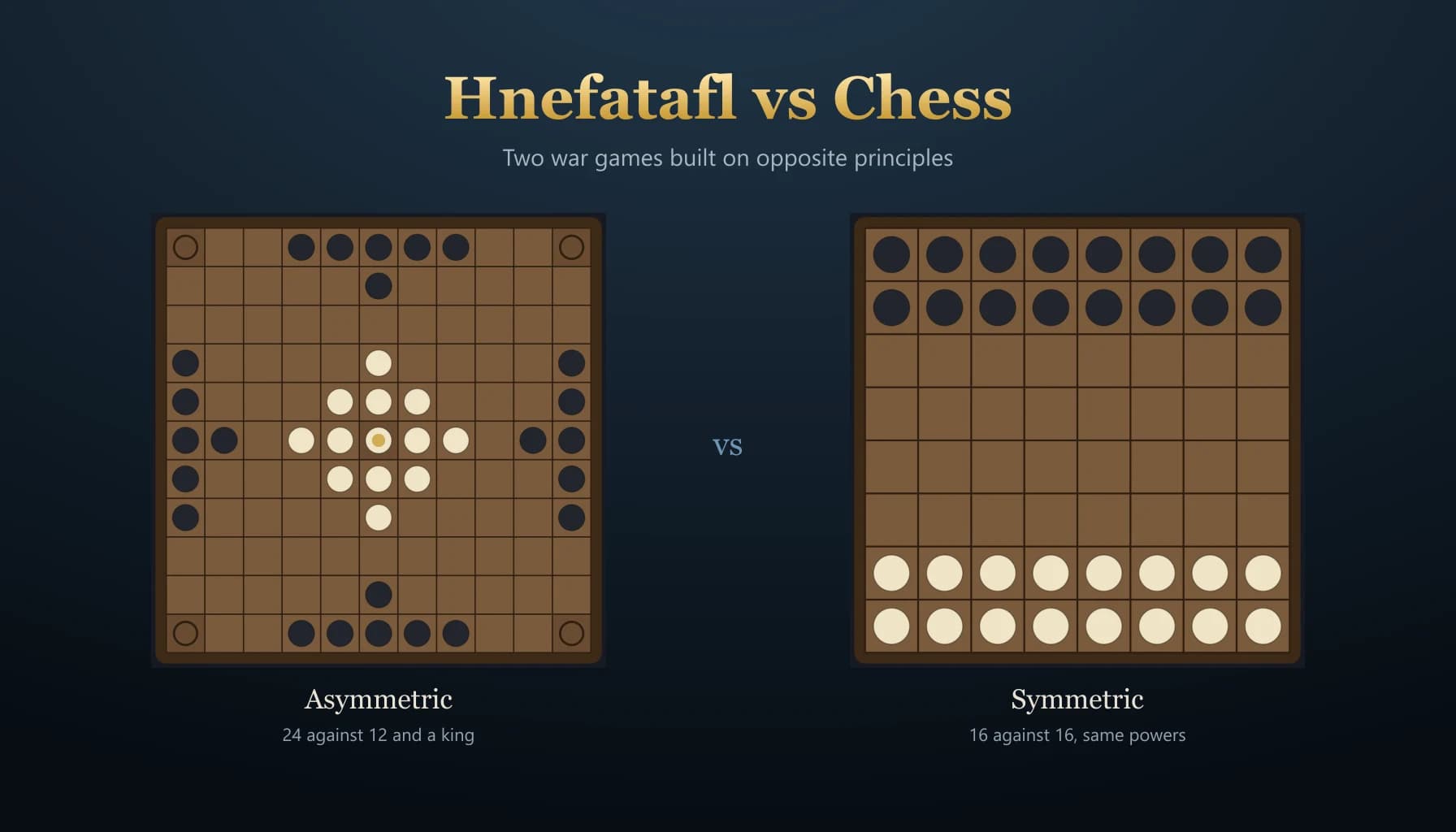
Around 1110, crusaders coming home to Norway brought a board game back with them. Within a century the game northern Europe had been playing for four hundred years was gone.
The newcomer was chess. The casualty was hnefatafl. What is striking about the swap is not that one game beat another — it is that the two are built on opposite principles, and northern Europe traded one for its mirror image.
The one difference everything else follows from
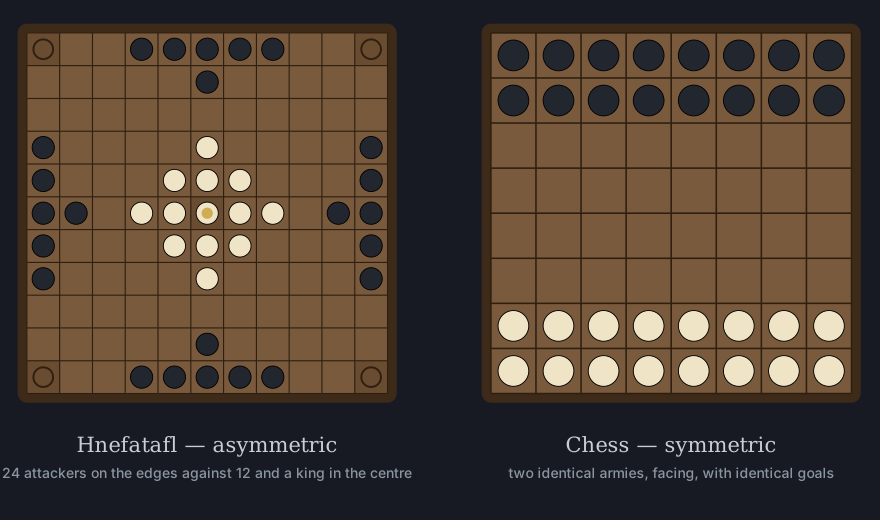
Chess is symmetric. Both players get the same pieces, the same board, the same goal. Whatever you can do to me, I can do to you. The whole game is a contest of execution, because the starting conditions are identical.
Hnefatafl is not. One player has a king and a small guard in the centre. The other has twice as many attackers around the edge. They do not want the same thing and they cannot do the same things:
| Attackers | Defenders | |
|---|---|---|
| Pieces | 24 | 12 + the king |
| Goal | Capture the king | Get the king to a corner |
| Position | The edges, everywhere | The centre, boxed in |
| Wins by | Closing a ring | Opening one line |
| Loses by | Leaving one line open | Running out of shields |
Everything else about the two games comes out of this. Chess players trade pieces because material is the currency. Tafl attackers trade pieces because it thins the defence — but tafl defenders can be five men down and completely winning, because the only thing that ends the game on their side is an open line to a corner.
What a chess player has to unlearn
Three habits, and the first is the hard one.
Moving next to an enemy is safe. In chess, a piece that steps beside an enemy can be taken. In hnefatafl, only the piece that moves captures, and it captures by sandwiching an enemy between itself and a friend. Step into the gap between two enemies and nothing happens at all. This one rule reverses the entire feel of the board, and it is what keeps tafl from collapsing into mutual annihilation.
Nothing has a value. No queens, no rooks, no pawns — every piece except the king is identical, and every piece moves the same way, like a rook. There is no "winning the exchange". There is only whether the shape on the board is closing or opening.
Material is not the score. In chess, being a piece up is being ahead. In tafl, the attackers start two-to-one up and it is still a fair fight. Counting pieces is the single most common way a chess player misreads a tafl position.
What a tafl player would find strange about chess
Fewer things, but they are real. Chess has piece types, which means learning six movement rules before you can play at all — tafl has one. Chess has promotion, a rule that lets material change value mid-game, which has no equivalent in tafl. And chess has stalemate as a draw: a player who cannot move gets a half point. In tafl, a side with no legal move simply loses — being shut in is exactly what the attackers are trying to achieve, so rewarding it would be absurd.
How chess actually won
The displacement is documented well enough to date. Chess reaches Scandinavia in the eleventh and twelfth centuries, with one specific route recorded: crusaders returning to Norway around 1107–1110. The Norse called the new game skáktafl — "chess-tafl" — which is the linguistic fingerprint of a replacement rather than an addition: the old word attached itself to the new game. The Lewis chessmen, Norse work from the mid-twelfth century, mark the changeover in objects. By around 1200 hnefatafl had been almost completely pushed out.
Why is where the evidence thins and the reasoning starts, so here is the case rather than a verdict:
They competed for the same slot. Both are war games for two players, both take an evening, both are the thing you play by the fire. A culture rarely keeps two games doing exactly the same job.
Chess arrived with the right passport. It came from Christian Europe at the moment Scandinavia was joining it. Hnefatafl was the game of the world that was being left behind — which is a poor position for a pastime.
Chess could be written down. This is the argument we find most convincing. Chess arrived with a literature: rules, problems, recorded games, a way of being taught by a book instead of by a person. Tafl had none of that. When fashion turned against chess in later centuries it survived on paper. When fashion turned against tafl, it simply stopped — and took its rules with it.
That last point is not speculation, because we can see the hole it left. Every modern tafl rule set descends from one source: Carl Linnaeus watching a Sámi game in 1732 and writing down what he could work out, in Latin, without speaking the language. The full story of that gap is worth knowing before you buy anything sold as "authentic Viking rules".
Which is the better game?
Wrong question, and the answer is nearly always chess if you ask it that way — chess has had eight hundred years of continuous development and tafl has had about forty. What tafl has is something chess structurally cannot offer:
You play both sides. Switch seats and it is a different game with the same pieces. The lines you spent an hour guarding become the lines you are running down. There is no equivalent experience in chess, because in chess both seats are the same seat.
It is short. The 7×7 Irish board takes ten minutes. You can lose three games and understand why before a single chess game would have reached the middlegame.
Nobody has solved the opening. Chess opening theory is an industry. Tafl has essentially none, which means the position in front of you is genuinely yours to work out.
If you want the game with depth, play chess. If you want a game where the two players are doing different jobs and neither of you has memorised anything, play tafl.
Play them
- Hnefatafl, 11×11 — the full Viking board, about an hour.
- Tablut, 9×9 — the historical original.
- Brandubh, 7×7 — ten minutes, and the fastest way in.
- Chess — the one that won.
And if you want to know how the six known tafl variants compare, and which of them have any evidence behind them at all: the tafl variants compared.