
Senet is the oldest board game we have physical evidence for — though that claim has three different answers depending on what you mean by oldest. Boards turn up in Egyptian graves from around 3100 BC, and people were still playing it when the Romans arrived — a run of roughly three thousand years, longer than the gap between the last Egyptian player and today.
Egypt left us more of this game than of almost any other object of daily life. Complete boards with their pieces. Paintings of couples playing. A queen at the board in her own tomb. Four separate sets buried with one teenage king.
Nobody wrote down how it worked.
Where it starts
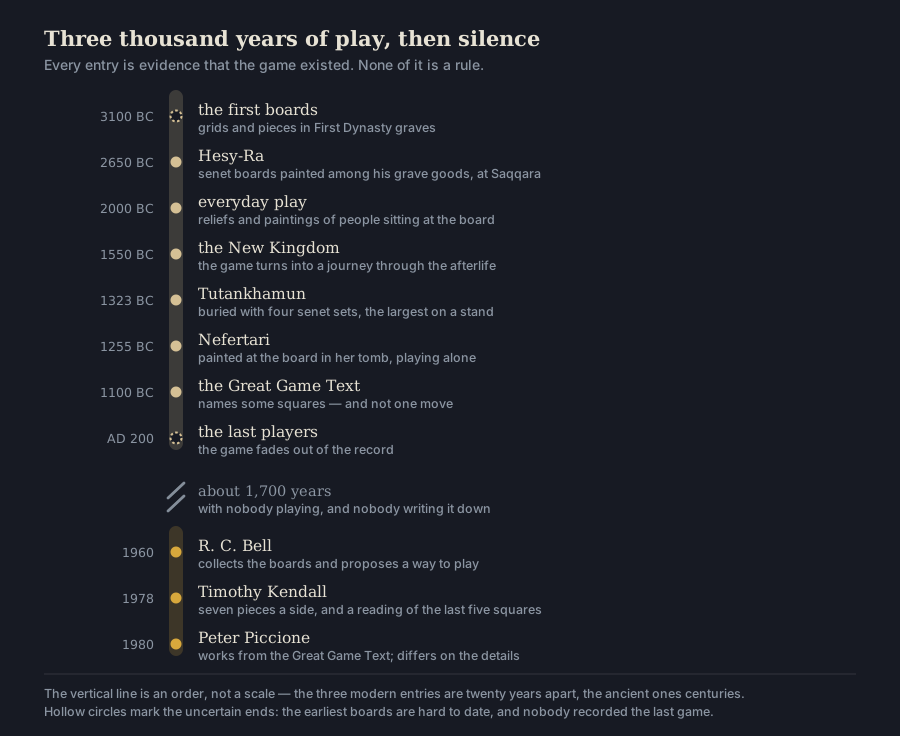
The earliest candidates are also the shakiest. Grids of thirty squares turn up in First Dynasty burials around 3100 BC, and a funerary slab from the same period appears to show two people at a board. Whether every one of those grids is a senet board, and whether they were all played the same way, is exactly the kind of question a rulebook would settle.
By the Third Dynasty, around 2650 BC, the evidence is unambiguous. The tomb of Hesy-Ra at Saqqara has senet boards painted among his grave goods, recognisable at a glance: three rows of ten.
From there the game simply does not go away. Old Kingdom reliefs show people sitting at it. Middle Kingdom tombs contain boards. By the New Kingdom it is everywhere — and by then it has picked up a second job.
From pastime to passage
The Egyptian word snt means something like "passing". For the first fifteen hundred years that reads as a description of the game: pieces pass along a track and pass each other on the way.
Then, in the New Kingdom, it starts to mean passing in the other sense.
Senet turns up in the Book of the Dead — in the vignette to Spell 17, the deceased sits at a board, playing against an unseen opponent for the right to continue. The board becomes a map of the journey through the underworld, and the last squares of the track acquire names to match: the House of Happiness, the House of Water, the House of Re-Atoum, the House of Horus. Each of them is a station in the underworld and a rule in the game at the same time — what the senet board means takes them one by one.
This is not a later reinterpretation by scholars. The Egyptians did it themselves, and they did it while still playing the game for fun. Both things are true at once, which is why the last five squares are simultaneously a theological statement and a perfectly practical endgame rule. The marks on squares 28, 29 and 30 are three, two and one stroke — and that is exactly the throw you need to bear a piece off from each of them.
Tutankhamun's four boards
The tomb of Tutankhamun, sealed around 1323 BC, contained four senet sets. Not one — four, in different sizes, from a small travelling box to a large board on a carved stand with its own drawer for the pieces.
Two details from those boxes are worth more than any of the paintings:
- The boards are double-sided. Senet on one face, and on the other a twenty-square track for a different game, one Egypt had imported from Mesopotamia — a relative of the Royal Game of Ur. Somebody was manufacturing combination game sets in the fourteenth century BC.
- The pieces are cones and spools, five of each in the museum-standard count, in ivory and faience. That is why the pieces on this site are cones and spools rather than two colours of disc.
Around seventy years later, Nefertari — chief wife of Ramesses II, died about 1255 BC — is painted in her tomb sitting at a senet board with nobody opposite her. That is the whole point of the picture. She is playing for passage, and the other player is not shown.
What survives, and what does not
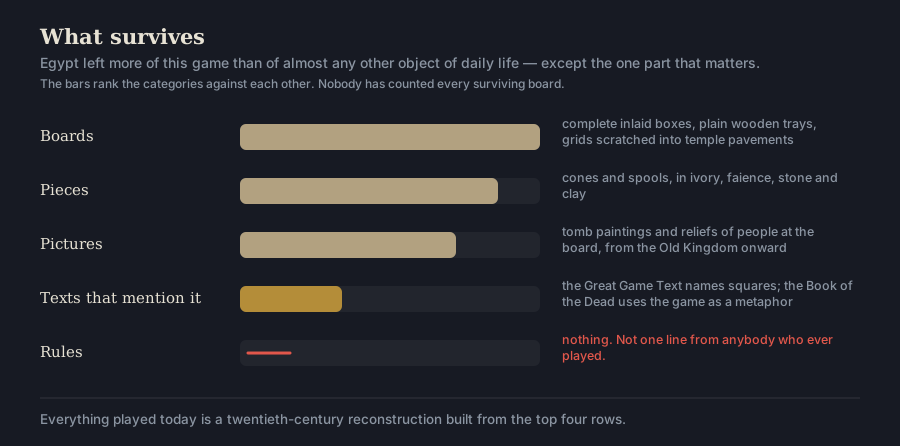
The one written source that comes closest is the so-called Great Game Text, a New Kingdom composition surviving in several fragmentary copies. It names squares. It talks about the game in religious terms. It does not say how far a piece moves, what happens when two land together, or how the turn passes.
So: boards in quantity, pictures across two thousand years, texts that use the game as a metaphor — and no instructions.
How the modern game got its rules
The reconstruction happened in three steps, all within living memory:
R. C. Bell (1960) gathered the surviving boards into a catalogue of the world's board games and proposed a workable set of rules — the first attempt to make senet playable again rather than merely described.
Timothy Kendall (1978) went further, working from the boards themselves and the number of pieces found with them. His version has seven pieces a side on squares 1 to 14, and it is his reading that gives the last five squares their function.
Peter Piccione (1980) came at it from the texts, particularly the Great Game Text, and reached a different arrangement of the details.
They disagree — about the number of pieces, about how the throwing sticks translate into movement, about what exactly happens at the House of Water. That disagreement is not a scandal. It is what honest reconstruction looks like when the source material is a pile of boards and no manual.
What everyone agrees on is the frame: thirty squares in three rows, movement decided by throwing sticks rather than dice, pieces that interact when they meet, and a last stretch where exact numbers matter.
Why it disappeared
Senet fades out of the Egyptian record in the Roman period. There is no dramatic ending — no ban, no replacement, no last recorded game. Board games travelled along the same routes as everything else, and Egypt gained Roman games and lost its own.
That is what makes the 1,700-year gap in the timeline above so complete. Nobody carried the rules forward, because nobody knew they would be worth carrying.
Playing it now
The version on this site is the five-piece one that turns up in museum shops and classroom Egypt units. Kendall's seven-piece layout is a switch under the board.
Nothing about it is a claim to be the rules. It is a reasonable reconstruction of a game that was played for three thousand years, and it plays well, which is the only test any reconstruction can actually pass.
For a table rather than a screen, there is a printable board with the throwing sticks to cut out — both reconstructions, four styles, and an ink-saving version for a class set.