
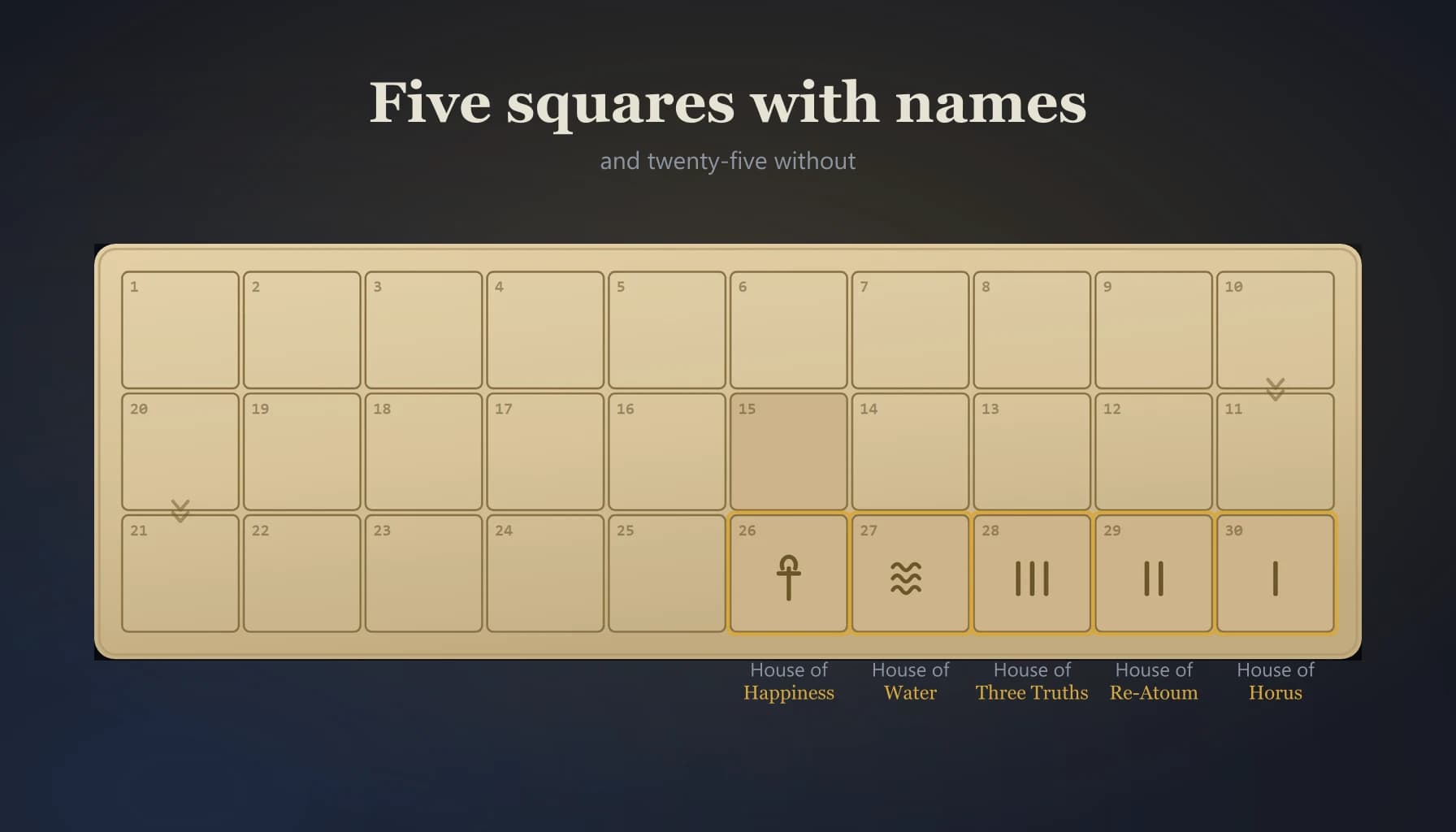
A senet board has thirty squares. Twenty-five of them are blank. Five carry marks, and those five have names — the House of Happiness, the House of Water, the House of Three Truths, the House of Re-Atoum, the House of Horus.
The tempting reading is that the marks are decoration and the names are mysticism. They are neither. Every one of them is doing two jobs at once: it is a station on the journey through the underworld and a rule you have to play around.
Where the names come from
Not from the boards. Most surviving senet boards carry marks on the last five squares and nothing else — no captions, no explanations.
The names come from texts, chiefly the New Kingdom composition modern scholars call the Great Game Text, which survives in several fragmentary copies. It talks about the squares of the board in religious language: what a piece arriving there means, what the player has achieved, what is at stake.
What it never does is say how far anybody moves. That is the strange shape of the evidence: Egypt left us the theology of the board and not its mechanics. The full picture is in the history of Senet.
Square by square
15 — the House of Rebirth
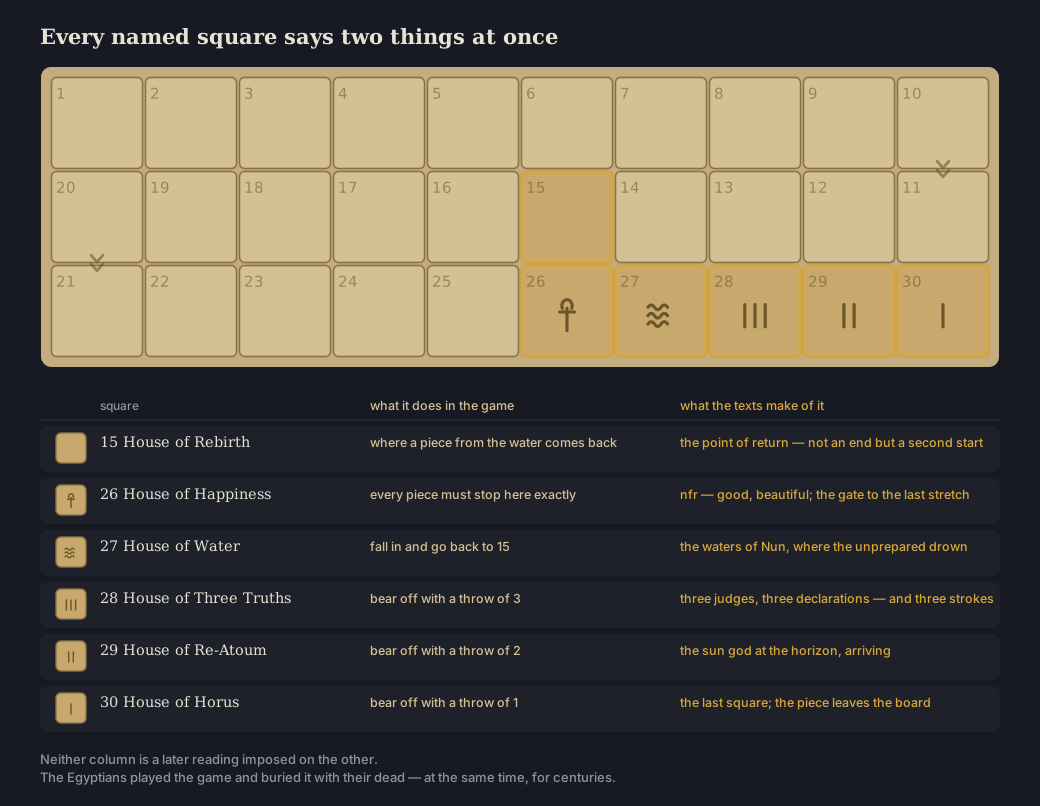
The odd one out: it usually carries no mark on surviving boards, and yet the rules cannot do without it. It is where a piece that falls into the water comes back.
That is the whole Egyptian idea of the Duat in one mechanic. The underworld is not a place you fail out of; it is a place you re-enter. A piece that drowns is not removed from the game — it is put back at the point of return and made to do the journey again.
26 — the House of Happiness
The sign is nfr, one of the most common signs in the language: good, beautiful, complete. It appears on jewellery, on names, on temple walls.
In the game it is the gate. Every piece has to stop here exactly — no piece may pass it. That makes the last stretch a bottleneck and turns the endgame from a race into a traffic problem. Pieces queue in front of 26.
Read the other way, that is the point. Arrival in the afterlife is not something you drift into on a good throw. You stop, you are counted, and only then do you go on.
27 — the House of Water
Three wavy lines: water, the sign for n, the waters of Nun out of which everything was made and back into which the unprepared dissolve.
Land here and the piece goes back to square 15. Not off the board — back to the House of Rebirth, to start the last third again.
The mechanical detail is worth noticing: square 27 can only be reached from 26, with a throw of one, because 26 is a mandatory stop and nothing may pass it. You cannot blunder into the water from a distance. You get there from the gate itself, on the commonest single throw there is. Four times in sixteen, the piece standing at the threshold of the afterlife falls in.
28, 29, 30 — three, two, one
Here the double reading is at its tightest, and it is the detail most articles about senet miss entirely.
The House of Three Truths is marked with three strokes. The House of Re-Atoum with two. The House of Horus with one.
Read as theology: three declarations before the judges, then the sun god at the horizon, then Horus and the end of the road.
Read as a board: three, two, one is the throw you need to bear a piece off from that square. The marks are the instructions. An Egyptian player looking at the last three squares could read the required throw straight off the board.
A symbol that is also a user interface. It is the single most elegant thing about the object.
Thirty squares, thirty of what?
A common claim is that the thirty squares stand for the thirty days of an Egyptian month, and that senet was a calendar as well as a game.
It is plausible — the Egyptian civil month did have thirty days, and Egyptian religious objects rarely have arbitrary numbers. It has also never been demonstrated. Nothing in the Great Game Text ties a square to a day, and thirty squares in three rows of ten is exactly what you get if you want a board that fits in a box and takes about twenty minutes to play.
Treat it as an attractive idea, not a fact. The distinction matters on a subject where the facts are thin enough already.
Why senet went into the grave
By the New Kingdom, senet boards were burial equipment. Tutankhamun had four of them. The tomb of Nefertari has her painted at a board, playing against nobody you can see.
The reason is not that Egyptians thought the dead needed entertainment. It is that the game had become a rehearsal. Spell 17 of the Book of the Dead shows the deceased at a senet board, playing for the right to continue — and winning that game is part of what gets you through.
The board is a map of the passage. The pieces are you. The throwing sticks are whatever it is that decides these things.
And it is still a good game
None of that is why senet lasted three thousand years — longer than any other board game, which is a claim worth unpacking. It lasted because the mandatory stop at 26 creates real tension, because a lone piece can be swapped by anyone within range, and because a throw of one at the wrong moment sends your best piece fifteen squares backwards.
The theology was added to a game that already worked.
Play Senet — the board, the sticks and all five named squares →