
Print & Play
Printable Senet Board
Thirty squares, four throwing sticks to cut out, and the rules on a third sheet. The oldest board game we have found, on a page — and ten counters from a drawer.
Style
Pale stone with engraved squares — what most surviving boards look like.
Which reconstruction
The version museums and school sets use. Pieces alternate on squares 1 to 10.
Paper
On the board
Extra sheets
For a PDF, pick Save as PDF in the print dialog.
Set up
5 pieces a side, alternating on squares 1 to 10. Odd squares move first.
Throw
Four sticks or four coins. Count the marked sides; none showing is a 5. A 1, 4 or 5 throws again.
Meet
Land on a lone enemy and swap places. Two side by side are safe; three in a row block everybody.
Finish
Stop on 26 exactly. 27 sends you back to 15. Bear off with the number of strokes on 28, 29, 30.
Senet · thirty squares · 5 pieces a side· playnook.io/games/senet
The four throwing sticks
Senet is not thrown with dice. Four flat sticks, each painted on one side: count the painted sides showing, and if none show the throw counts as five.
Or use four coins
Heads counts as a painted side. Four heads is a four; no heads at all is a five. The odds come out identical — it is the same four binary lots.
What each throw is worth
| 1 | 4 in 16 | move 1 — throw again |
| 2 | 6 in 16 | move 2 |
| 3 | 4 in 16 | move 3 |
| 4 | 1 in 16 | move 4 — throw again |
| 5 | 1 in 16 | move 5 — throw again |
A two is six times as likely as a four — and the two rarest throws are the ones that let you throw again.
Senet — quick rules
Setting up
5 pieces a side, alternating on squares 1 to 10. One player takes the odd squares and moves first; the other takes the even squares and starts one step ahead everywhere.
The path
Square 1 is top left. The track runs right along the top row, back leftwards along the middle, then right again along the bottom to 30 and off the board.
Moving
Throw the sticks and move one piece that many squares. Throws of 1, 4 and 5 let you throw again. If no piece can use the throw, it is lost and the other player throws.
Swapping
Land on a single enemy piece and the two change places. Two pieces of the same colour side by side cannot be swapped, and three in a row block the path for everybody. You may never land on your own piece.
The last five squares
26 — House of Happiness. Every piece must stop here exactly. No piece may pass it.
27 — House of Water. Fall in and the piece goes back to square 15, or the first free square below it.
28, 29, 30.Bear off with exactly 3, 2 or 1 — the number of strokes printed on the square. Or straight from 26 with a 5.
Winning
First player to bear off every piece wins. A game runs about 130 moves.
Where these rules come from
No Egyptian rulebook survives. Boards, paintings and texts do — the rules are twentieth-century reconstructions, mainly by Timothy Kendall (1978) and Peter Piccione (1980). This sheet uses the 5 pieces a side version.
Full rules, diagrams and a computer opponent: playnook.io/games/senet
The history behind the board is in the history of Senet, and what the named squares meant is in what the Senet board means.
What you get
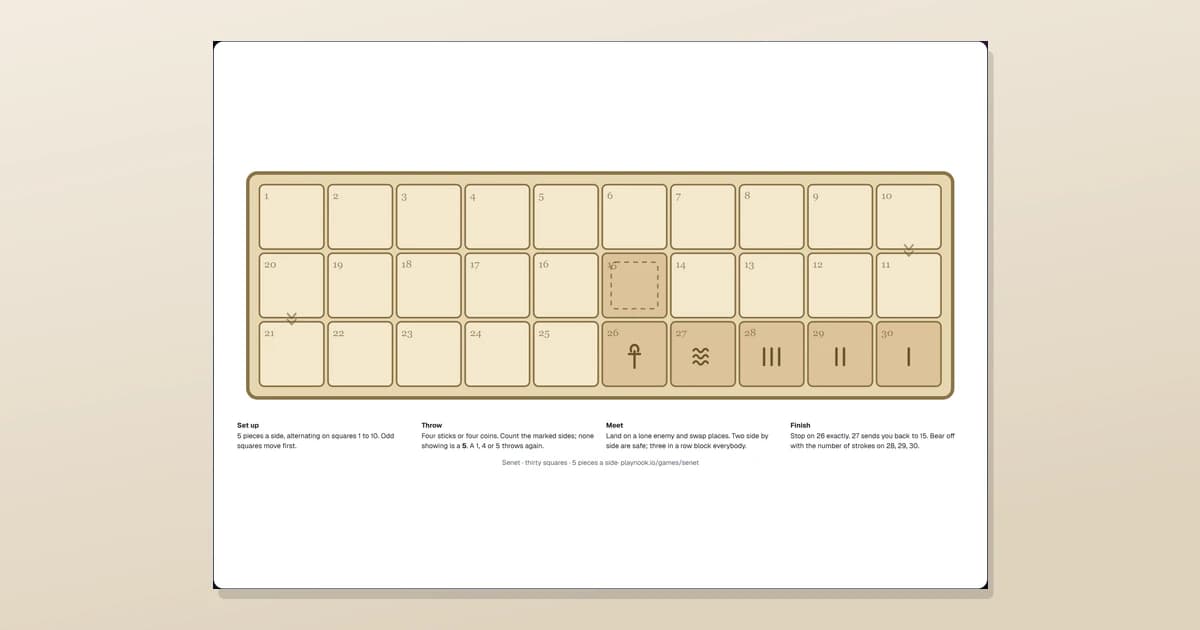
The board prints across a landscape page — thirty squares at a size that takes a real counter, not a diagram of a board. Square numbers are optional, the two turns in the track are marked with chevrons, and the six squares that matter are picked out.
The sticks sheet is the part no other printable board needs. Senet is not thrown with dice: four flat sticks, painted on one side, and you count the painted sides showing. The sheet prints four strips to cut out and fold, with the odds table beside them — and the note that four coins do the same job.
The rules sheet fits the whole game on one page: the path, the swapping, the three squares in a row that block everybody, and the last five squares where exact numbers decide it.
The marks are the instructions
Squares 28, 29 and 30 carry three, two and one stroke. That is not decoration — it is the throw you need to bear a piece off from that square. Surviving Egyptian boards are marked this way, which turns out to be lucky: it is the only part of the rules the Egyptians actually wrote down, and they wrote it on the board.
Square 26, the House of Happiness, carries the nfr sign, and square 27 the three wavy lines of water. Both are on the printed board, and both do something: everything must stop on 26, and anything landing on 27 goes back to 15. What the senet board means takes all six named squares one at a time.
Four styles
Limestone is what most surviving boards look like — pale stone with engraved squares. Papyrus is warmer and lighter on the toner, the one for a class set in colour. Lapis inlaygoes dark blue and gold, after the gaming boxes from Tutankhamun’s tomb. Ink saver drops the fills entirely — outlines only, so thirty boards cost almost nothing to print.
Two reconstructions, and why there are two
No Egyptian rulebook survives. Senet was played for three thousand years and buried in quantity, and not one line about how it worked came with it. Everything played today is a reconstruction, and the reconstructions disagree.
The default here is the five-piece version used by museums and school sets, with pieces alternating on squares 1 to 10. The menu also offers Timothy Kendall’s 1978 arrangement — seven pieces a side on squares 1 to 14, which makes the queue in front of square 26 considerably worse. The board is identical either way; only the starting row changes. The history of Senet has the full account of who reconstructed what, and from what.
For a classroom
Senet turns up in Egypt units for good reason: it is the oldest board game anybody has found, it was buried with Tutankhamun, and the board is a map of the journey through the underworld. It also plays in about twenty minutes and the rules fit on one page.
For a class set, print the ink saver style on plain paper and the sticks sheet on something stiffer — card stock folds into a much better stick. Ten counters per board is the whole equipment list, and the odds table on the sticks sheet doubles as a probability lesson: four binary lots, sixteen outcomes, and a distribution nothing like a die.
Play it first
If you want to see a turn before you print anything, Senet in the browser plays the same reconstruction against a computer opponent or a friend online, with every rule the sheet describes.