Roll two dice, close any open numbers that add up to the total, and keep rolling for as long as you can cover what you throw. When nothing covers your roll the turn ends, and whatever is still standing is your score. Low wins. Close everything and you have shut the box.
- 11.16 average score a turn under perfect play, nine tiles
- 1 in 14 turns shuts the box — 1 in 10 with the one-die rule
- 1 in 276 with twelve tiles instead of nine
- 512 positions, all solved exactly
How do you play Shut the Box?
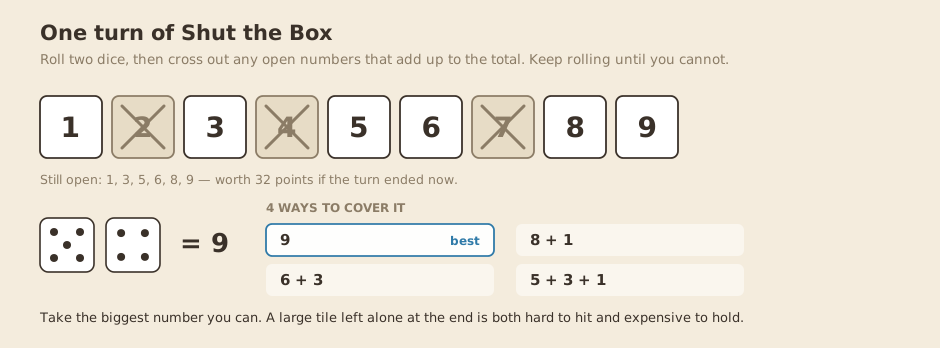
- Roll both dice. Add them up — that total is what you have to cover.
- Close any combination of open numbers that adds up to it. One number or several, your choice. A 9 can be the 9, or 6+3, or 5+3+1.
- Roll again, and keep going for as long as every roll can be covered.
- When a roll cannot be covered, the turn ends. Add up what is still open: that is your score, and low is good.
Three rounds each, scores added up, lowest total wins. Both players take a whole turn at a time — nothing you do touches the other player's box, which is why this is a race against a number rather than a fight.
You can play that race against a friend over the internet: open a table, send them the four-letter code, and you are playing. No account, no sign-up. The server throws the dice rather than either browser, so you both see the same roll — and there is a chat window while you watch each other push your luck.
What is a good score in Shut the Box?
Single figures. The nine-tile game has only 512 possible positions, which is small enough to evaluate every one of them exactly rather than sample them, and under flawless play the average turn leaves 11.16 points standing.
That figure is also the ceiling, and it is worth knowing before you blame yourself for a bad round. Shutting the box happens about once in fourteen turns with two dice throughout. Most turns end with eight to fifteen points on the board no matter how well you play.
Which numbers should you close first?
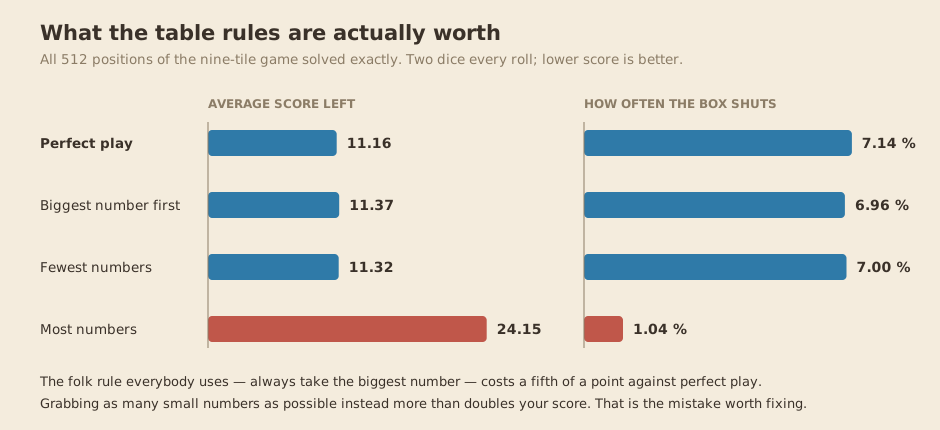
The big ones — but the interesting part is how little it matters. Always taking the biggest available number averages 11.37 against 11.16 for perfect play. Whatever you have been doing at the kitchen table is very nearly optimal, and nobody needs to study this game.
Is there an unlucky number in Shut the Box?
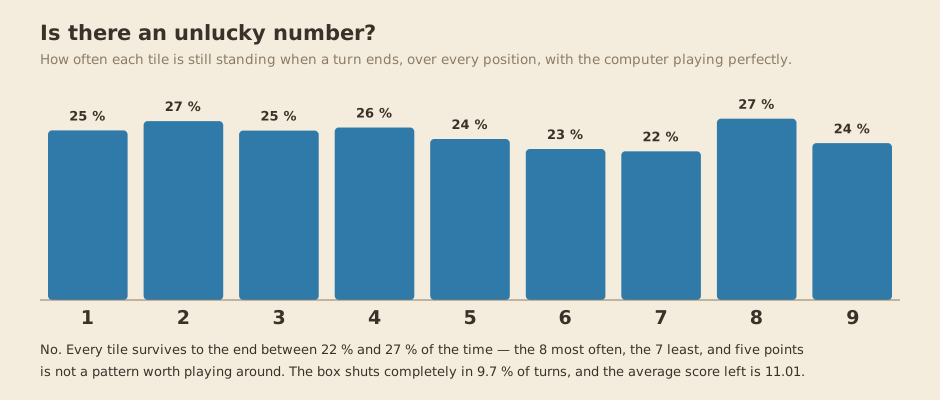
Everyone has one. The maths does not: across every position, each number is the one left standing between 22 % and 27 % of the time. The 8 survives most often and the 7 least, and five percentage points is noise, not a pattern. That is a nice thing to be able to settle at a table.
Should you use the one-die rule?
Once every number above 6 is closed, a common house rule lets you roll a single die instead of two. Yes — but only as a choice, and that distinction is worth more than any other decision in the game.
| How the rule is used | Average score | Box shuts |
|---|---|---|
| Table rule, two dice always | 11.37 | 1 in 14 |
| Table rule, one die whenever allowed | 12.27 | 1 in 18 |
| Perfect play, deciding each time | 11.01 | 1 in 10 |
Taken automatically it makes you worse on both counts, which is how most tables play it. With 5 and 6 left, two dice can roll an 11 and finish the game; one die cannot, and you have thrown that chance away. The rule of thumb: take one die when what remains cannot be covered as a pair.
How many numbers should the box have?
| Numbers | Average score | Box shuts |
|---|---|---|
| 1 to 9 | 11.16 | 1 in 14 |
| 1 to 10 | 16.65 | 1 in 25 |
| 1 to 12 | 35.08 | 1 in 276 |
Nine is the classic and the right default. Ten looks like a small change and is not: the 10 can never be covered by a single die, so the endgame hardens. Twelve is a different game altogether — every roll of two dice can be covered by one tile, so turns run long and shutting it is a genuinely rare afternoon.
How strong is the computer?
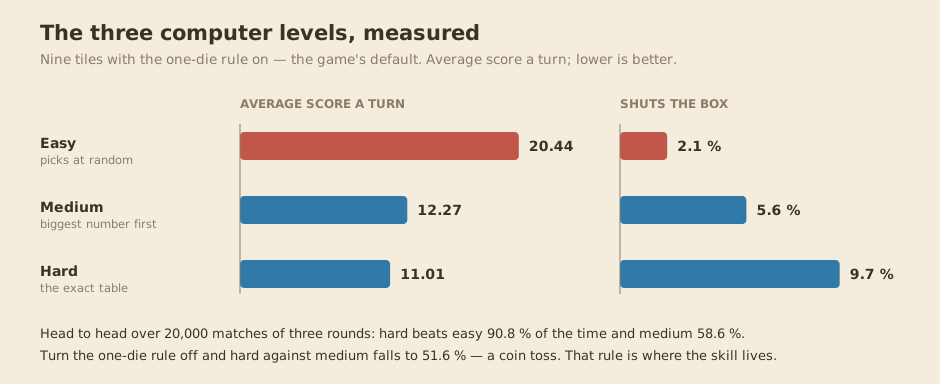
The levels differ in judgement, not in how far they look ahead — searching deeper is meaningless when a die reshuffles the position every roll. Easy has no preference at all, medium follows the table rule, and hard holds the exact value of all 512 positions and decides the dice count by comparing them.
Over 20,000 matches, hard beats easy 90.8 % of the time and medium 58.6 %. Turn the one-die rule off and hard against medium falls to 51.6 % — a coin toss. That is the honest measure of this game: the whole advantage of perfect play lives in one house rule.
Where does Shut the Box come from?
A pub game from the Normandy coast, played on a wooden tray with hinged tiles that fall flat when you close them — which is where the name comes from, and why a printed sheet works just as well as the box. Fishermen are usually credited with spreading it along the Channel, and it turns up in British pubs through the twentieth century as a bar game played for rounds.
It has since become a fixture in primary classrooms, and deservedly: every roll asks which of the open numbers add up to this total, and the child works that out to make their own move rather than to fill in a worksheet.
If you would rather play it on paper, the printable Shut the Box sheets give you the same game in 9, 10 or 12 numbers, six or ten games to a page.
Other dice games worth two players
Dice games for two players compares seven of them by how much skill is genuinely in each — Shut the Box among them, and Pig, which is solved exactly.