
Play with a pencil
Printable Shut the Box
The pub game that needs a wooden box — except it does not. Two dice, a printed row of numbers to cross out, and a score box for every game.
Size
The classic box. Shutting it completely happens about once in fourteen games, which is often enough to keep trying.
Style
Pale blue rules on warm paper — what the game looks like in a school exercise book.
Paper
Sheets
For a PDF, pick Save as PDF as the printer in the print dialog.
Quick rules
- Set up. One sheet, two dice, and a pencil. All the numbers start open. Players take a whole game each in turn rather than alternating rolls — this is a game you play against a score, not against the person opposite.
- Your turn. Roll both dice and cross out any combination of open numbers that adds up to the total. A roll of 9 can be 9, or 6+3, or 5+4, or 4+3+2 — you choose. Then roll again, and keep going for as long as you can cover the roll.
- How a turn ends. The moment you roll a total you cannot make from the open numbers, your turn is over. Add up everything still open: that is your score, and low is good. Cross out every number and you have shut the box — a score of nought, and an outright win.
- The one-die option. A common house rule: once every number above 6 is crossed out, you may roll a single die instead of two. Agree on it before you start. It is worth having, but only if you treat it as a choice — see below.
- Which numbers to cross out first. The big ones. Covering 9 and 8 early is worth far more than tidying away 1 and 2, because a large number left alone at the end is both hard to hit and expensive to hold. Playing the other way round — taking as many small numbers as you can each roll — more than doubles your average score.
- What perfect play is actually worth. We solved all 512 positions exactly. With flawless play the box shuts about once in fourteen games and the average score is 11.2. Just taking the biggest number every time scores 11.4 — so the folk rule everybody uses is within a quarter of a point of perfect. The mistakes that cost real points are elsewhere.
playnook.io
What you get on the sheet
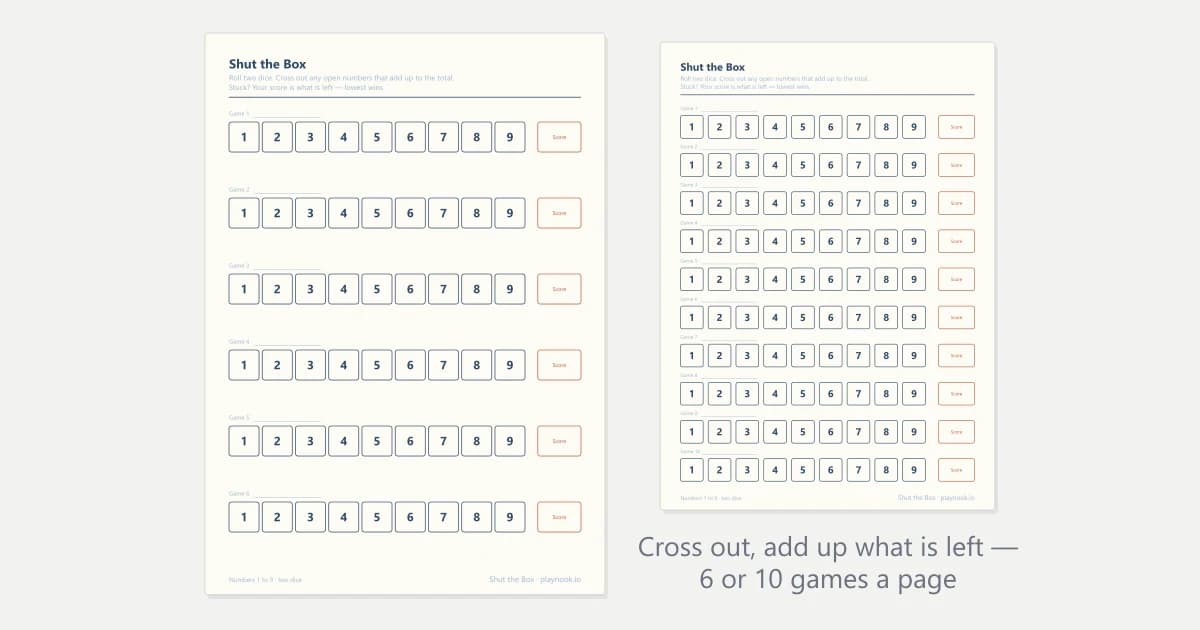
Each game is one row: a line for a name, the numbers in boxes to cross out, and a score box at the end. Six games to a page for big boxes and small hands, or ten when a group is working through a set. Both come in a notebook style and an ink-saving black-and-white version, on A4 or US Letter.
The number of tiles is a choice rather than a fixed layout, because it is not a cosmetic setting — it changes the game completely, as the table further down shows. Every PDF we could find offers one size and says nothing about what that size does.
How do you play Shut the Box?
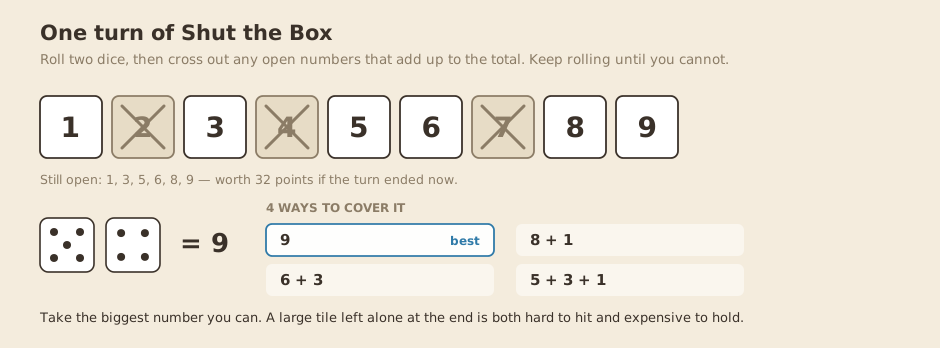
Your turn
Roll both dice and cross out any combination of open numbers that adds up to the total. A roll of 9 can be the 9 by itself, or 6+3, or 8+1, or 5+3+1 — whichever of those the sheet still has open. Then roll again, and keep going for as long as you can cover what you roll.
How the turn ends
The moment you roll a total you cannot make from the numbers still open, your turn is over. There is no rescue and no second roll: the dice decide when you stop, and the only thing you controlled was which numbers you left standing.
What you score
Add up everything still open. That is your score, and low wins — this is golf, not darts. Cross out every number and you have shut the box: nought, and an outright win that ends the round on the spot.
Which numbers should you cross out first?
The big ones. This is the one piece of advice the game actually has, and we can now say exactly what it is worth, because the nine-tile game is small enough to solve completely rather than to estimate.
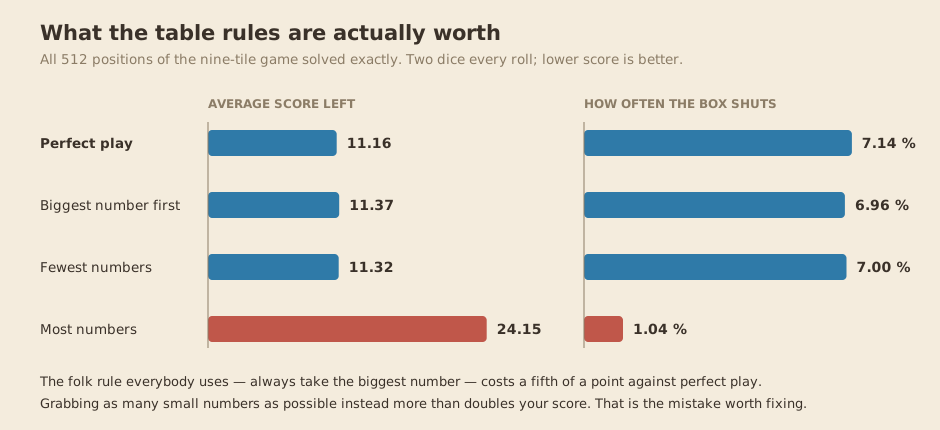
Two things fall out of that, and the second is the useful one.
The folk rule is almost perfect. Always taking the biggest number you can scores 11.37 against 11.16 for flawless play — a fifth of a point. Nobody needs to study this game. Whatever you have been doing at the kitchen table is fine.
The opposite habit is a disaster. Covering as many small numbers as you can each roll — which feels productive, because more boxes get crossed — leaves an average of 24.15 and shuts the box once in ninety-six games instead of once in fourteen. That is the mistake worth naming, and it is the one children make first, because crossing out four boxes looks better than crossing out one.
How often can you actually shut the box?
Less often than the shouting suggests. These are exact figures, not estimates from a sample — every position of every version below has been evaluated:
| Sheet | Average score | Box shuts | With the one-die rule |
|---|---|---|---|
| 1 to 9 | 11.16 | 1 game in 14 | 1 in 10 |
| 1 to 10 | 16.65 | 1 game in 25 | 1 in 19 |
| 1 to 12 | 35.08 | 1 game in 276 | 1 in 211 |
All of them assume perfect play, so they are ceilings rather than expectations. If you have shut a twelve-tile box, it was a genuinely rare afternoon.
Is the one-die rule worth using?
The usual house rule is that once every number above 6 is crossed out, you may roll a single die instead of two. It is worth having — and it is worth being careful with, which nobody mentions.
Used as a choice, it lifts the chance of shutting a nine-tile box from 7.14 % to 9.76 %: from one game in fourteen to one in ten. That is the single biggest improvement available anywhere in this game.
Used automatically — one die every time it is allowed, which is how it is usually played — it makes you worse on both counts: the average score rises from 11.37 to 12.27 and the box shuts less often, not more. With 5 and 6 open, two dice can roll an 11 and finish the game; one die cannot, and you have thrown that away for nothing.
The rule of thumb: take one die when what is left cannot be covered as a pair, and two when it can.
Which sheet should you print — 1 to 9, 10 or 12?
Nine is the game everyone pictures, and the right default. It is short, shutting the box is rare enough to be an event and common enough to stay believable, and the arithmetic stays inside the number bonds to ten.
Ten looks like a small change and is not. The 10 can never be covered by a single die, so the one-die endgame gets harder and the average score jumps by more than five points.
Twelve is a different game. Every roll of two dice can be covered by one tile, so turns run long and scores run high — and shutting it is a once-in-276-games event. Print it for a group that already finds nine too easy.
How to print a blank Shut the Box sheet
1. Pick the numbers and the layout
Choose 1 to 9, 10 or 12, then six or ten games a page. Six gives large boxes that a young child can write in; ten suits a table of adults working through several rounds.
2. Choose paper and ink
A4 or US Letter, notebook style or the ink saver. For a class set the ink saver is plain black on white and costs almost nothing for thirty copies.
3. Print, with or without the rules
The rules page is a single sheet and can be switched off if the table already knows the game. Press Print, or choose “Save as PDF” in the print dialog to keep a copy.
Shut the Box in the classroom
This is one of the few traditional games that earns its place in a maths lesson honestly. Every roll asks the same question — which of the open numbers add up to this total — and the child answers it to make their own move, not to satisfy a worksheet. That is number bonds and mental addition, with the motivation already attached.
It also has a decision in it, which most classroom dice games do not. Cover the 9, or take 6+3 and keep the 9 for later? That question has a right answer, the answer is not obvious, and a class can find it by playing thirty games and comparing scores. The figures above exist so that the experiment has something to be checked against.
Where these numbers come from
The nine-tile game has 512 possible positions, the twelve-tile game 4,096. That is small enough to evaluate every one of them exactly instead of playing sample games, so that is what we did: each position is worth the average of what the 36 dice outcomes lead to, and working backwards from the shut box gives the exact value of the full one.
Because a solver that is subtly wrong still produces plausible-looking numbers, the result was then checked against two million randomly played games using the biggest-number rule. The solver says 11.373 points and 6.96 %; the two million games gave 11.374 and 6.95 %.
Shut the Box: questions people ask
How do you play Shut the Box without the box? Exactly the same way. Print a sheet, roll two dice, and cross out open numbers that add up to the total instead of folding tiles down. The arithmetic is the whole game, and paper does it just as well as wood.
How many numbers does Shut the Box have? Nine in the classic box. Ten and twelve tile versions exist and are genuinely different games — twelve is far longer, because every roll of two dice can be covered by a single tile.
What is a good score in Shut the Box? Anything under about 11 beats an average turn. We solved the nine-tile game exactly: with perfect play the average score left is 11.16, so a single-figure score is a good turn and shutting the box entirely happens about once in fourteen games.
Can you roll one die instead of two? It is a common house rule once every number above 6 is crossed out, and it is worth having — but only as a choice. Taking it automatically every time actually makes you worse, both on score and on how often you shut the box.
Which numbers should you cross out first? The biggest ones you can. Covering 9 and 8 early beats tidying away 1 and 2, because a large number left alone at the end is both hard to hit and expensive to hold. Taking as many small numbers as possible instead more than doubles your average score.
Is Shut the Box good for teaching addition? It is one of the better ones, because the child does the arithmetic to make their own move rather than to answer a question. Every roll asks which combinations of the open numbers add up to the total — that is number bonds, disguised as a turn.
How do I get it as a PDF? Press Print, then choose “Save as PDF” as the printer in the print dialog. Every browser has that option built in.
More dice and paper games
Prefer a screen? Shut the Box is playable here against three computer levels or a second player, with the same choice of 9, 10 or 12 numbers — and it works out the odds as you go.
Keeping score for something else tonight? There are sheets for Farkle, five-dice games and Bunco, and Yatzy is playable here against the computer.
If it is the paper you are after rather than the dice, the paper games pack collects the pencil sheets in one place, and games you only need paper for explains what to do with them. For another game whose whole point is that it can be solved exactly, see Nim and the rest of Math & Logic.