
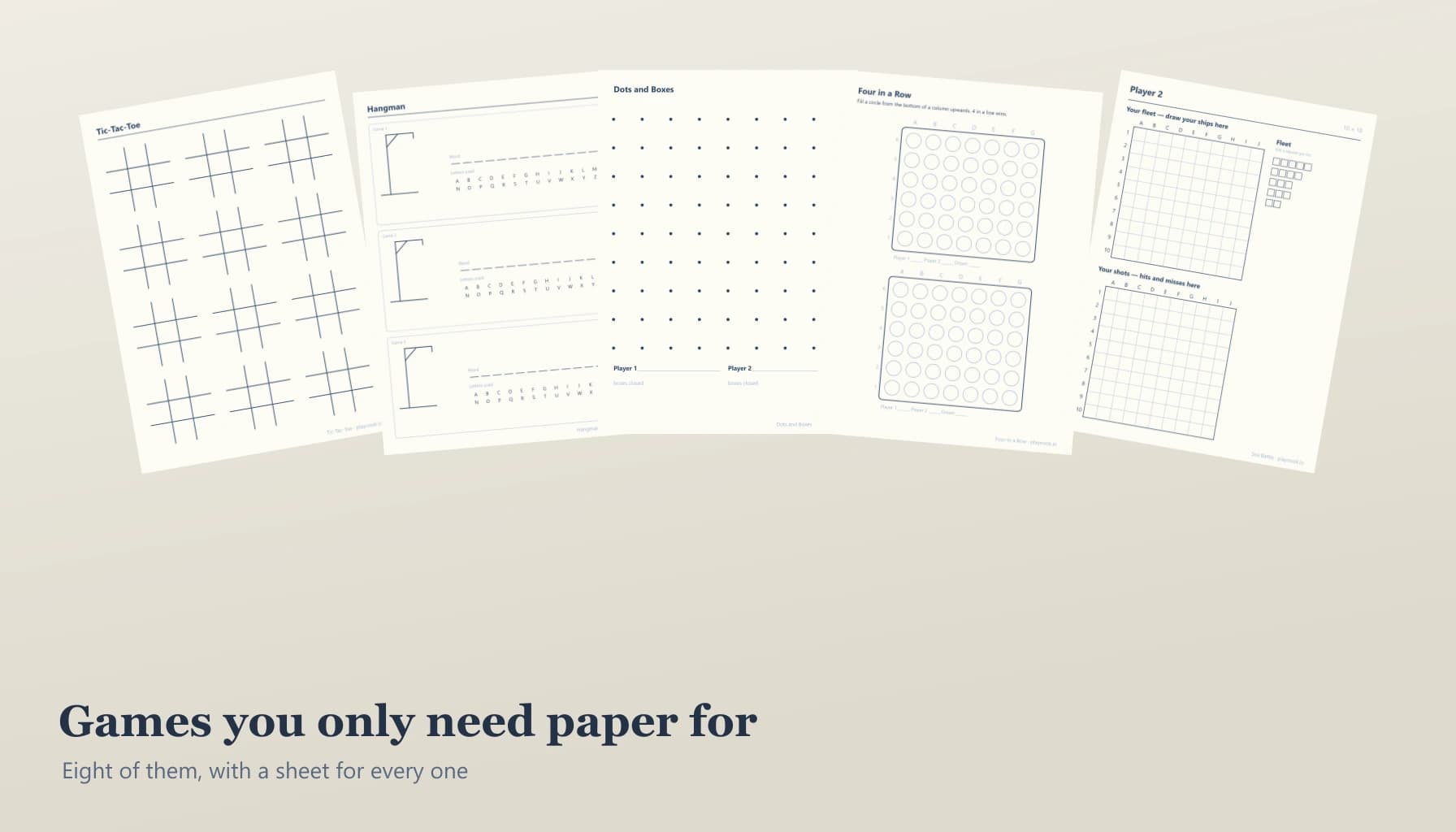
Every list of pen-and-paper games has the same problem: it tells you that dots and boxes exists, and then you have to go and draw forty-nine dots by hand.
This one has the sheets attached. Eight games, the rules for each, an honest word about which are actually worth your time — and for every one of them a grid you can print, or a version you can play in the browser if there is no printer in the building.
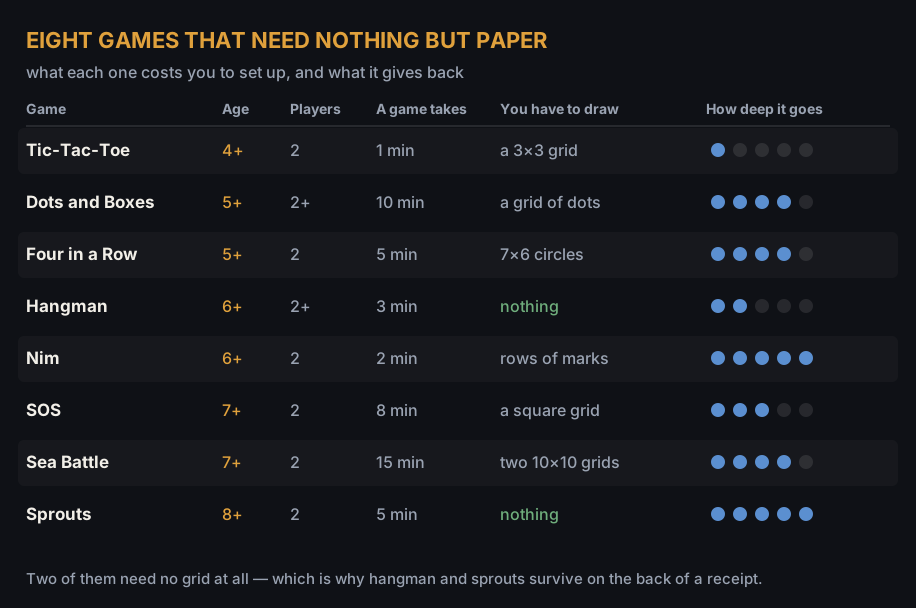
Print the whole stack in one go — tick what you want, press Print once. Free, no email address. Or take them one at a time below.
The two everybody already knows
Tic-tac-toe
Nine squares, X and O, three in a row. It is on the list because it is the first game a child can play properly — the rules take ten seconds and there is nothing to misunderstand.
It is also, honestly, a solved and rather dead game: two competent players draw every single time, and a five-year-old works that out by themselves at around game thirty. That is not a reason to skip it. That moment of working it out is the first strategic thought most people ever have.
When it stops being interesting, the natural next step is four in a row, which is the same idea with gravity added and nowhere near as easy to exhaust.
Print: tic-tac-toe sheets — twelve grids to a page, because a game lasts a minute and children want another.
Hangman
One player thinks of a word and draws a dash for each letter; the other guesses letters, and every wrong guess adds a line to the gallows.
Its real merit is not the guessing, it is the choosing. A good hangman word is not a long one, it is one with rare letters and a common shape — and picking one teaches more about spelling than any exercise. It also needs no grid at all, which is why it survives in waiting rooms and on the back of receipts.
Print: hangman sheets — three games to a page, with the alphabet to cross off, which is the part people forget to draw and then argue about.
The four that reward thinking
Dots and boxes
A grid of dots. On your turn draw one line between two neighbouring dots; if your line completes the fourth side of a box, write your initial in it and go again.
This is the best game on the list for a mixed-age table, and the reason is the endgame. Once the board is mostly drawn it becomes a set of chains of boxes, and whoever is forced to open the first long chain loses. Strong players deliberately give away a short chain to avoid opening a long one — a move that looks like a blunder to a beginner and is the entire game.
A five-year-old can play it on the first attempt. An adult can lose to the chain rule for years without noticing it exists.
We solved the small boards outright to see how bad that blind spot really is. On a three by three grid there are 177,280 positions in which a box is sitting there for the taking and taking it is the losing move — and in every one of them, refusing wins by exactly as much as taking loses.
Play: dots and boxes online — three grid sizes, three computer levels, or two players on one device. Print: dots and boxes grids — three sizes and a sheet of four small grids for quick games.
Four in a row
Choose a column; your disc falls to the lowest empty space. Four in a line wins. On paper you fill circles from the bottom of a column upwards, which is the same thing.
The good part is the part nobody explains: if a column simply fills up, it is already settled who ends up on which row. Counting from the bottom, the player who moved first collects the odd rows and the second player the even ones. A threat sitting on the wrong row is not a threat, it is a square you are about to hand over.
The game is also completely solved, and the answer is sharper than most people expect: the first player wins by opening in the centre column — and loses by opening in either of the outer two.
Print: four in a row boards — four board sizes, two boards to a page, counters to cut out. Play: in the browser, including the Pop Out variant.
Sea battle
Two grids each: one for your fleet, one to record your shots. Hide your ships, call squares, and the first to sink the whole enemy fleet wins.
It is the only game here with hidden information, which makes it the only one where bluffing has no place at all — there is nothing to bluff about, only to deduce. The good players are not lucky, they search systematically and never fire at a square they have already ruled out.
Where to hide them is worth knowing: we measured it over 300 games against a computer that reasons about positions, and pushing ships to the edges bought 52 shots of survival against 45 for a random arrangement. Against a human who has read the same advice, the answer reverses.
Print: sea battle grids — one sheet per player, with the fleet to tick off. Play: in the browser, with the ten-ship Russian fleet as well as the classic one.
SOS
A square grid. On your turn write either an S or an O in any empty square. If your letter completes S-O-S in a line, mark it as yours and go again. Most squares are full at the end, so the winner is whoever scored more.
It looks like tic-tac-toe and is a completely different animal, because you choose your letter as well as your square. The trap is that nearly every square you fill helps the next player: write an O beside a lone S and you have handed over a free score. Late in a game the skill is picking the least generous move available, which is a strange and excellent thing to have to learn.
Print: SOS grids — in the pack, three sizes from 5×5 up.
The two that are secretly mathematics
Nim
Rows of marks — 1, 3, 5 and 7 is the classic arrangement. On your turn cross out as many as you like from one row. Agree before you start whether taking the last mark wins or loses, because both versions are played and an argument about it afterwards is the usual way this game ends.
Nim is completely solved, and the solution is short enough to fit in a diagram:
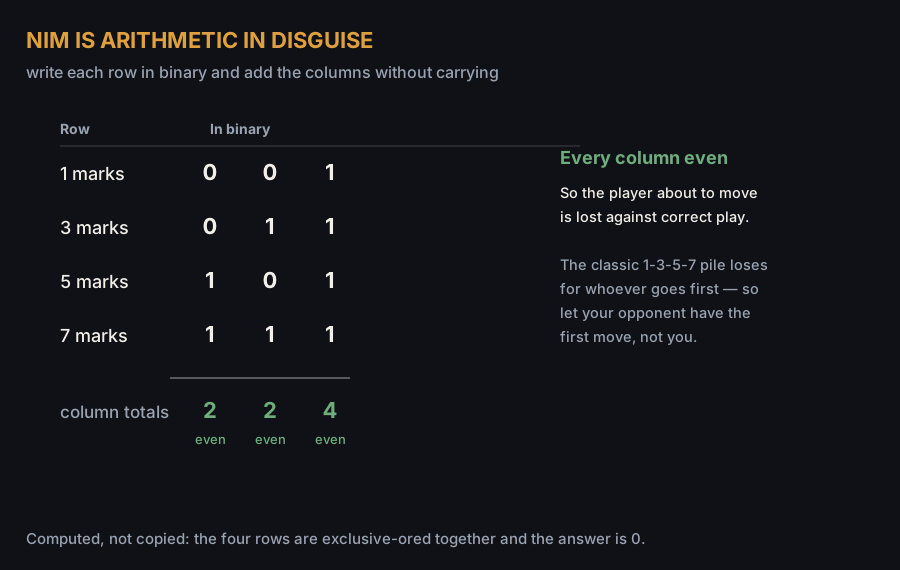
That is the whole theory. Everything else — the advice to leave two equal rows, the feeling that some positions are "dead" — follows from that one test.
It is the best game here for a child who likes being told there is a trick, and the only one where you can prove you will win before you make a move.
Print: Nim sheets — in the pack, three games to a page.
Sprouts
Two spots on a blank sheet. On your turn draw a curve from one spot to another (or from a spot back to itself), without crossing any existing line, and put a new spot somewhere along the curve you just drew. No spot may ever have more than three lines meeting at it. Whoever cannot move loses.
Invented in 1967 by John Conway and Michael Paterson at Cambridge, and it is the strangest game on this list — the board grows as you play, and no two games look alike.
It also has the neatest property of anything here: it always ends, and you can work out when.
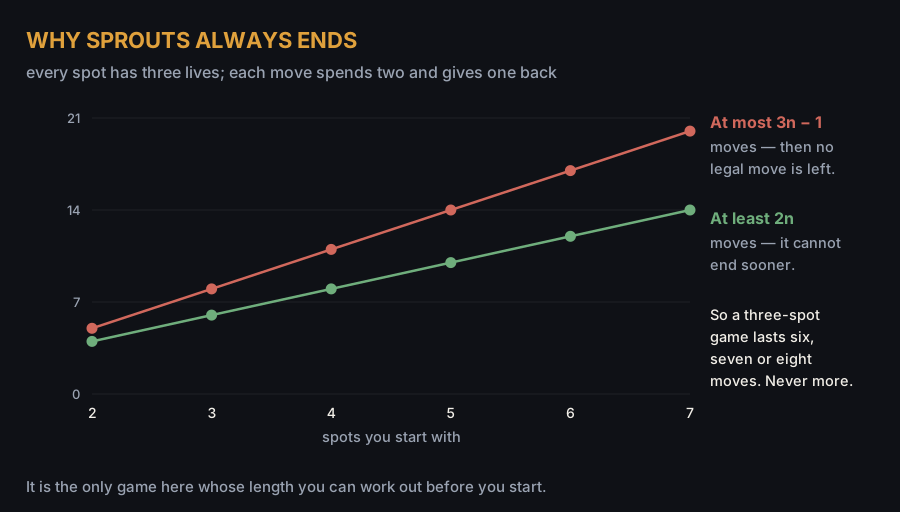
Count the "lives": each spot can take three lines, so n spots start with 3n lives. Every move uses two lives (one at each end) and adds a spot that brings three, but immediately spends one on the curve passing through it — a net loss of one life per move. Start with 3n and you get at most 3n − 1 moves.
That is the sort of thing that makes a game worth keeping. It costs nothing to set up, it fits on any scrap, and it comes with a small theorem.
Print: sprouts sheets — three, four or five starting spots.
The ones we did not include, and why
For completeness, since they turn up on every other list:
- Paper football and racetrack — good games, but both want a specific printed track to be any fun, and at that point you are not playing a paper game, you are playing a printed one.
- Categories, also called Scattergories — excellent with a group and needs no sheet at all beyond a list of headings you can write yourself.
- Mastermind on paper — one player writes a secret number, the other guesses. Perfectly good, but it is really the same deduction as sea battle in a smaller space.
- Ultimate tic-tac-toe — nine boards inside a board, and genuinely deep. It is the one on this list of exclusions we might yet add a sheet for.
Print all eight at once
Every game above has its own page with size options. If you just want a stack of paper for a car journey or a wet afternoon, there is one page that does the lot:
The printable paper games pack — tick the games you want, choose notebook or ink saver, press Print once. Nine sheets, free, no email address, no watermark.
Which is worth saying plainly, because most of the first page of search results for this is a PDF you have to pay for.