
Play with a pencil
Printable Sprouts
Two rules, three dots, and a game that cannot go on forever. Four boards to a page with room to draw badly.
Size
Longer, and the advantage swaps to the first player.
Style
Pale blue rules on warm paper — what the game looks like in a school exercise book.
Paper
Sheets
For a PDF, pick Save as PDF as the printer in the print dialog.
Quick rules
- Set up. Start with the printed spots. Two players take turns.
- Move. Draw a curve from one spot to another, or from a spot back to itself. The curve may bend however you like but must not cross itself, cross another curve, or pass through a spot. Then put a new spot somewhere along the curve you just drew.
- The only limit. No spot may have more than three line-ends touching it. A spot with three is dead — cross it out to keep track. The new spot you add in the middle of a curve already has two, so it has one left.
- Winning. The player who cannot move loses. There is no draw and the game always ends: a game from n spots lasts at least 2n moves and at most 3n − 1.
- Who should win. With perfect play the second player wins from three spots, and the first player wins from four and five. Nobody plays perfectly, which is the point — the board becomes a tangle within four moves.
playnook.io
What you get
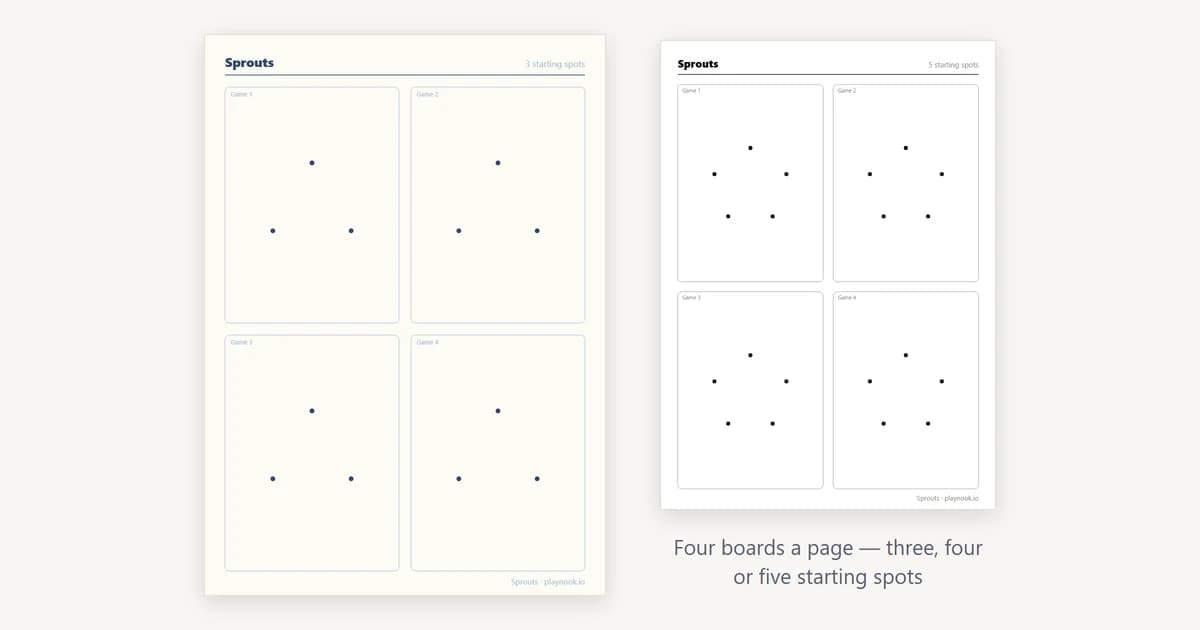
Four bordered play areas to a page, each with its starting spots already placed in a ring so there is drawing room on every side. Three, four or five spots, plus a rules sheet — which for this game genuinely fits in five lines.
Invented in a common room in 1967
Sprouts was made up by John Conway and Michael Paterson at Cambridge, reportedly on an afternoon when they were meant to be doing something else. Conway later said that for weeks afterwards you could not walk through the mathematics department without seeing people hunched over spots and curves. Martin Gardner put it in Scientific American in 1967 and it escaped into the world.
It belongs on a printable sheet rather than a screen because the whole game is a drawing. The board is whatever you have made of it, and no two games look alike.
Why it always ends
This is the part that makes mathematicians happy and is worth explaining to a child, because the proof is short enough to follow. Every spot may carry at most three line-ends. Each move uses two free ends and creates a new spot with exactly two ends in use — so every move reduces the total number of free ends by exactly one.
Start with n spots and you have 3n free ends. The supply falls by one a move, so the game cannot last longer than 3n − 1 moves, and a separate argument shows it must last at least 2n. From three spots: between six and eight moves, always. No draws, no infinite games, no exceptions.
How to be good at it
The one habit worth building is watching the regions. Every closed curve divides the paper, and a spot with free ends on the wrong side of a line might as well not exist. Strong players deliberately draw curves that seal opponents’ spots into regions where they cannot be reached.
Cross out spots as they die — three ends and they are finished. Keeping that visible is most of the bookkeeping, and it is why the printed sheet leaves the areas generous.
For teachers
Sprouts is the rare game whose proofis classroom material. The rules take twenty seconds, the games take three minutes, and the question “why can this never go on forever?” leads to a real argument that a class can construct themselves in about ten minutes. It is topology disguised as a doodle.
The sheets you print are yours to use, in class or commercially.
Frequently asked questions
What is Sprouts? A pencil game with two rules, invented at Cambridge in 1967 by the mathematicians John Conway and Michael Paterson. You join dots with curves and add a new dot on each curve you draw. It looks like a doodle and behaves like a theorem.
How many starting spots should I use? Three is the classic and lasts at most eight moves — long enough to see the idea, short enough to play ten times. Four and five give much longer games and, oddly, hand the advantage to the other player.
Can a curve cross another line? No, and that single restriction is what makes the game. A curve may bend and loop however you like, but it must not cross itself, cross another curve, or pass through a spot. Within four moves the board is divided into regions and half the moves you want are already impossible.
Does the game always end? Yes, and provably so. Every move adds one spot and uses up two free ends while creating two, so the supply of free ends falls by one each turn. A game starting from n spots lasts at least 2n moves and never more than 3n − 1.
Who wins with perfect play? From three spots the second player wins; from four and five the first player does. It alternates in a pattern that has been computed by machine well past twenty spots and never proved in general. Nobody plays perfectly anyway — that is rather the point.
How do I get it as a PDF? Press Print, then choose “Save as PDF” as the printer in the print dialog. Every browser has that option built in.
More games that need nothing but paper: Dots and Boxes — the other one with a serious endgame — Hangman sheets and Sea Battle grids.