
Print & Play
Printable Four in a Row Board
Four board sizes, not one — because the size changes the game. Counters to cut out, and the rules on the back.
Size
Forty-two circles and four in a row. The board everyone means when they say the name.
Style
Pale blue rules on warm paper — what the game looks like in a school exercise book.
Paper
Sheets
For a PDF, pick Save as PDF as the printer in the print dialog.
Quick rules
- Set up. Print one board. Two players, ideally two colours of pencil — or cut out the counters on the third sheet and drop them in, which is closer to the real thing.
- Move. Choose a column and fill the lowest empty circle in it. You never choose the row: gravity does, exactly as it would if you dropped a disc into a slot.
- Winning. Four of your own in a line — across, up, or diagonally. On the nine-wide sheet it is five. Fill the board without a line and the game is drawn.
- Start in the middle. More lines of four run through the centre column than through any other, and it is not close. With perfect play the first player wins by opening there — and loses by opening in either of the outer two columns.
- Odd rows and even rows. The rows are numbered from the bottom for a reason. If a column simply fills up, the first player ends up on the odd rows and the second on the even ones. Keep your threats on the rows that will be yours: odd if you started, even if you did not.
playnook.io
What you get
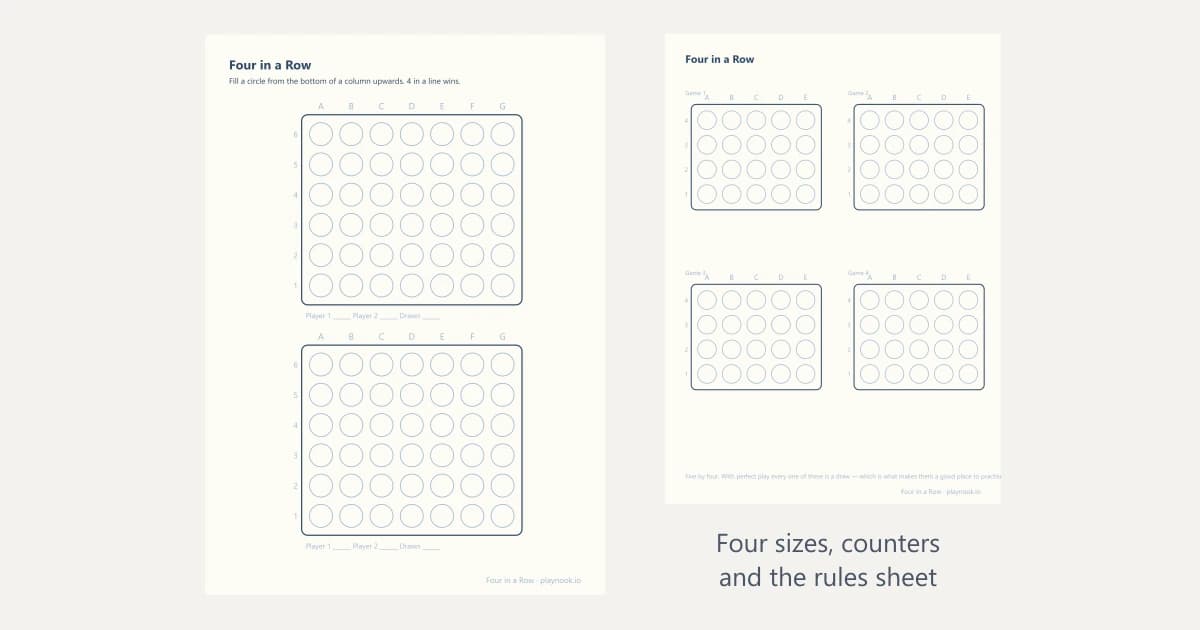
The board sheet fills a portrait page with a framed grid of open circles, lettered columns across the top and rows numbered up from the bottom. The four small boards sheet puts four five-by-four games on one page, which is what you want for a class or for a quick series. The counters sheet prints enough discs for the board you chose, with spares, each inside a dashed square because a square is far easier to cut out than a circle.
Four sizes, and they are not decoration
Almost every printable version of this game offers exactly one board: seven by six. That is the standard, and it is here — but the size genuinely changes the game, and it is worth knowing which one you are handing to somebody.
- 7 × 6 — the standard. With perfect play the first player wins, but only from the centre column.
- 9 × 6, five in a row — two columns wider, and you need five. The width is what makes the fifth disc reachable; on a seven-wide board five in a row is nearly impossible.
- 5 × 4 — a couple of minutes a game. With perfect play it is a draw whatever either player does, which makes it a good board to practise threats on: nobody can be losing from the start.
- 8 × 7 — one more of each. Slower, more open, and the diagonals get a lot more dangerous.
Why the rows are numbered from the bottom
It looks like a detail and it is the key to the whole game. If a column simply fills up from the bottom, who ends up on which circle is already decided before either player gets there: counting the bottom row as row 1, the first player collects the odd rows and the second player the even ones.
So a threat — three of yours with a gap that would complete the line — is worth completely different amounts depending on which row that gap sits in. If you moved first you want your threats on odd rows; if you moved second, on even rows. A threat on the wrong row is not a threat at all, it is a circle you are about to hand over. Number the rows from the top and that sentence stops making sense, which is why this sheet numbers them from the bottom.
Two styles
Notebook is pale blue on warm paper — what the game looks like drawn in a school exercise book. Ink saver is plain black on white: thirty copies cost almost nothing, and a coloured pencil shows up better against it.
Both print on A4 and US Letter. If you laminate the board, a dry-wipe pen turns it into a board you can use all term.
For a classroom
This is one of the few games where a five-year-old and an adult can both play properly on the first attempt, and where the first real idea — take the middle — is something a child can be shown in one sentence and then verify for themselves. The four-small-boards sheet gives a pair of children four games out of one page.
The five-by-four board is worth knowing about for teaching: because it is a guaranteed draw with correct play, a child who loses on it lost to something specific they can be shown, not to the board.
Frequently asked questions
What size is a four in a row board? The standard board is seven columns wide and six rows high — forty-two circles — and you need four in a line to win. This sheet prints that one, plus three others: a nine-wide board where you need five in a row, a quick five by four, and an eight by seven for a longer game.
How do you play it on paper? Exactly as you would with discs, except you fill circles instead of dropping them. On your turn pick a column and fill the lowest empty circle in it — you never choose the row, which is the whole point of the game. Two colours of pencil are ideal; two different marks, a cross and a circle, work just as well.
Do I need the counters? No. The board works with a pencil alone and can be filled in directly. The counters sheet is there for anyone who wants the real feel of dropping something in, and for reusing a laminated board. Coins do the same job — heads against tails is the fastest thing in any house.
Why are the rows numbered from the bottom? Because the strategy depends on it. If a column simply fills up, it is already settled who ends up on which row: counting the bottom row as row one, the first player collects the odd rows and the second player the even ones. A threat sitting on a row that will be yours is one you only have to keep alive. Numbering from the top would reverse every explanation of that.
Which column should you start in? The centre, and it is not a close call. More lines of four run through the middle column than through any other. On the standard board with perfect play from both sides the first player wins by opening in the centre, draws by opening one column either side of it, and loses by opening in any of the four outer columns — which surprises most people.
Is this Connect 4? It is the same game. Connect 4 is a trademark of its owner and this is not that product; this is the generic four-in-a-row board, which is older than the boxed version and has always been played on paper too. Nothing here carries a brand, which is also why you can print it for a whole class without asking anyone.
Is it really free? Yes. Print as many copies as you like, at home or for a school. No account, no watermark, no email address.
How do I get it as a PDF? Press Print, then choose “Save as PDF” as the printer in the print dialog. Every browser has that option built in.
Or play it on a screen
Four in a Row in the browser plays the same game against a computer opponent or a friend online, and adds a rule the paper version cannot do: Pop Out, where you pull one of your own discs out of the bottom of a column and everything above it drops down.
Printing more than one thing? The paper games pack puts this board and seven other games into one print job, and the guide to paper games explains the rules of each.
While you are here, print a sea battle grid or a dots and boxes sheet — the other two games that need nothing but paper — or one of the printable boards if you would rather cut out some pieces.