
Play with a pencil
Printable Tic-Tac-Toe
Six big grids, twelve, or twenty-four to a page. The sheet to fold into a pocket before a long journey.
Size
The usual sheet. A dozen games is about one car journey.
Style
Pale blue rules on warm paper — what the game looks like in a school exercise book.
Paper
Sheets
For a PDF, pick Save as PDF as the printer in the print dialog.
Quick rules
- Set up. One player is X, the other O. X goes first. Swap who starts after each game — it matters more than it looks.
- Move. Write your mark in any empty square. Marks never move once written.
- Winning. Three of your marks in a row: across, down or diagonally. If every square is filled and nobody has three, the game is a draw.
- Why so many draws. The game is solved: with correct play by both sides it is always a draw. That is not a flaw, it is the lesson — the first player who fails to block loses, so a draw means both of you played well.
- The two things to know. Take the centre if it is free; it belongs to four of the eight winning lines. And when you cannot win this move, check whether your opponent can win next — blocking always comes before building.
playnook.io
What you get
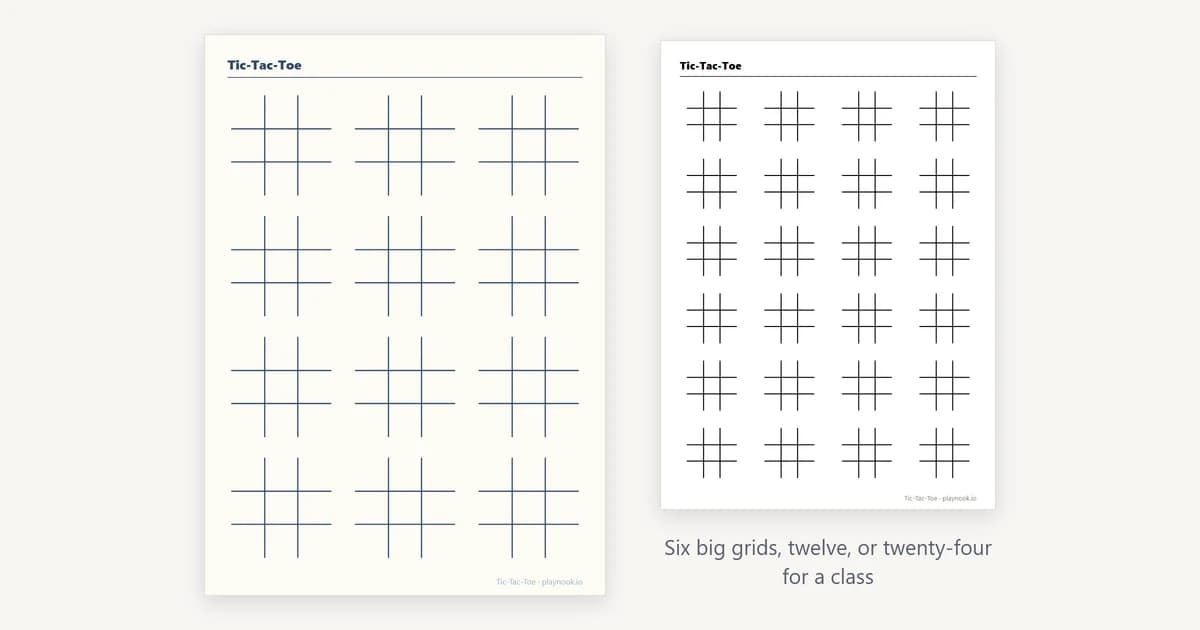
Rows of grids drawn the proper way — four crossing lines, no outer box — in three densities. Six for small hands, twelve for a journey, twenty-four for a class. Nothing else on the page, because nothing else is needed.
A game that is meant to be solved
Tic-tac-toe is a draw with correct play from both sides, and everyone works that out eventually, usually around the age of eight. That is not the game failing — it is the game doing its job. It is the shortest possible demonstration that a game can be figured out, and the moment a child realises it, they have learned something that applies to every board game they will ever play.
It is also a draw far less often than that makes it sound. Across all 255,168 games that can be played, only 18.1% are drawn — a draw needs both players to avoid every trap, while a win needs one of them to slip once. We counted that and four other numbers that get quoted interchangeably in how many tic-tac-toe games there are.
The two rules that make a player
Take the centre. It sits on four of the eight winning lines; a corner is on three, an edge on two. If the centre is gone, take a corner.
Block before you build.Every move, look at your opponent’s marks first. The player who is thinking only about their own line is the player who loses. And the winning idea, once both of you can block, is the double threat — one mark that completes two possible lines at once, so only one of them can be stopped.
When it stops being enough
Sooner or later every game ends in a draw and the sheet loses its charm. The natural next step is Gomoku: the same instinct — get your marks in a row — on a 15×15 board where five in a row wins. Draws essentially vanish, the double threat becomes the whole game, and there is a printable board for that too.
For teachers and long journeys
This is the lowest-effort printable there is and one of the most used. It needs no explanation, works for any two children, and fits in a pocket. As a lesson it quietly teaches forced moves, blocking and the idea of a solved game — a lot of thinking for a page of crossing lines.
The sheets you print are yours to use, in class or commercially.
Frequently asked questions
How many grids should I print? Six big grids for children who write large. Twelve is the usual sheet and lasts about one car journey. Twenty-four fits a whole class with four games each, or a best-of-twenty-four if the journey is longer than you hoped.
Who wins tic-tac-toe? Nobody, if both players know what they are doing — the game is solved and correct play always ends in a draw. That is why it is a good first strategy game for children and a poor one for adults: the moment both sides stop making mistakes, it is over as a contest.
Does going first matter? Yes. The first player cannot be beaten with correct play and has more ways to win if the opponent slips. Swap who starts after every game, which is why the sheets print an even number of grids.
Is the centre really the best first move? It is the strongest single square: it belongs to four of the eight winning lines, against three for a corner and two for an edge. But a corner opening sets more traps against a weak opponent, because it creates two threats at once more often.
What if it gets boring? It will, and that is the moment to move up. Gomoku is the same instinct on a bigger board — five in a row on a 15×15 grid, no draws to speak of, and the strategy never runs out.
How do I get it as a PDF? Press Print, then choose “Save as PDF” as the printer in the print dialog. Every browser has that option built in.
More paper games: Dots and Boxes, Hangman sheets and Sea Battle grids.