
Print & Play
Printable Gomoku Board
Fifteen lines by fifteen, five in a row to win. The board on one sheet, stones on a second, the rules on a third — or just bring a pencil.
Style
What the board looks like when someone made one — the default worth printing.
Paper
Sheets
For a PDF, pick Save as PDF as the printer in the print dialog.
Gomoku · five in a row · playnook.io
Pieces
Cut along the dashed lines — thirty stones a side. Most people skip this sheet: a pencil works, and so do two kinds of coin or two colours of dried bean.
Gomoku · playnook.io
Gomoku — quick rules
An open three. Black threatens five at either end — White must block now.
- Set up. The board starts empty. Stones go on the intersections, not in the squares. Black plays first.
- Place. One stone per turn on any empty intersection. Stones never move and are never captured — everything you put down stays where it is.
- Win. Five of your stones in an unbroken line, horizontally, vertically or diagonally. A row of six or more counts as well in the free game.
- Watch the open three. Three in a row with an empty point at both ends wins next move unless it is blocked, because your opponent cannot cover both ends at once. Block a three before you build your own.
- The double threat. The real weapon is one stone that makes two fours, or a four and an open three, at the same time. One can be blocked; two cannot.
- Black is favoured. Playing first is a proven advantage in the free game, which is why clubs add opening restrictions. With a pencil at the kitchen table, just take turns going first.
Play online: playnook.io/games/gomoku
What you get
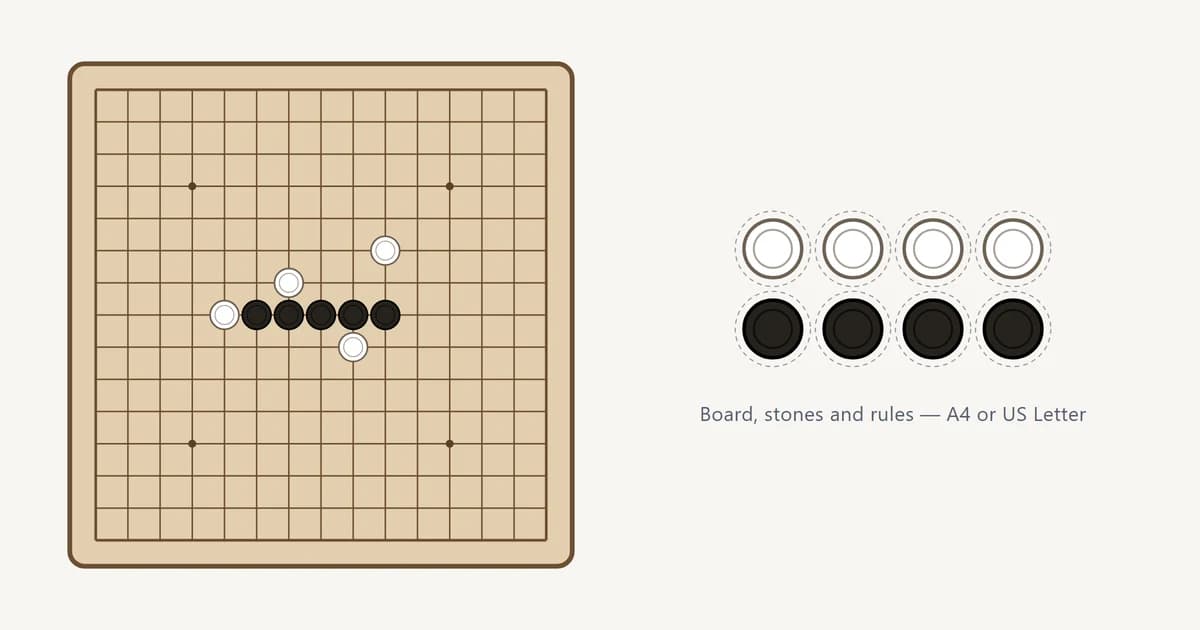
The board is a full-page 15×15 grid with the five star points marked, the same layout a bought set uses. The stone sheet prints thirty a side, which is more than most games need. The rules sheet holds the whole game plus the one position every beginner has to learn to recognise.
You probably do not need the stones
This is the printable where the scissors are optional. Gomoku never moves a piece and never removes one — every stone stays where it lands — which means a pencil does the job perfectly. One player writes X, the other O, straight onto the intersections. Two players, one sheet, no cutting, and the finished game is a record of itself.
Print the stone sheet if you want to play the same board more than once, or if you are setting up for a classroom where paper counters survive better than rubbed-out pencil. Two kinds of coin, dried beans or bottle caps all work — you need roughly thirty of each.
The one thing to teach first
Beginners lose to the same shape every time: the open three. Three stones in a row with an empty point at bothends threatens five next move at either end, and one block cannot cover two ends. The rules sheet prints that position, and it is worth ten minutes of anyone’s attention — spotting it is most of what separates a first game from a tenth.
The move that actually wins games is a stone that makes two threats at once: a four and an open three together, or two fours. One threat gets blocked; two do not.
Four styles
Carved wood is the default and looks like a bought board. Parchment stays light on the toner, cloister stone is the quiet grey version, and ink saver prints outlines only — the grid as plain lines, so a class set of thirty costs almost nothing. In that mode the stones keep a filled centre on purpose: without it, black and white are impossible to tell apart on a board this fine.
For teachers and classrooms
Gomoku is the rare game with a thirty-second explanation and no luck in it at all. There is nothing to set up, no equipment to lose, and a game takes five minutes — so a whole class can play a round-robin in a single lesson with nothing but printed grids and pencils. Underneath it teaches forced moves, double threats and reading one step ahead, which is the same skill every abstract game asks for.
The boards you print are yours to use, in class or commercially.
Frequently asked questions
What size is a Gomoku board? Fifteen lines by fifteen lines, which gives 225 intersections. Stones go on the intersections, not inside the squares. Some clubs play on a 19×19 go board instead, but 15×15 is the standard for Gomoku and the size this template prints.
Do I have to cut out the stones? No, and most people should not bother. A pencil is faster: one player writes X, the other O, straight onto the intersections. Print two boards and you have two games. The stone sheet is there for people who would rather push pieces around, and dried beans or two kinds of coin work just as well.
Does six in a row count as a win? In the free game, yes — any unbroken line of five or more wins, and that is what the rules sheet says. Tournament Renju treats an overline as a loss for Black, along with other opening restrictions. For a kitchen-table game, keep it simple: five or more wins.
Is Gomoku the same as Five in a Row? Yes. Gomoku is the Japanese name — goh moku means five pieces. It is also played as Gobang, Omok in Korea and Wuziqi in China, with small differences in the opening rules. The board and the goal are the same everywhere.
Is the first player favoured? Yes, and it is proven: the free game on this board size is a first-player win with perfect play. It makes no practical difference between two casual players, but it is why competitive rule sets add opening restrictions for Black. At home, just take turns going first.
How do I get it as a PDF? Press Print, then choose “Save as PDF” as the printer in the print dialog. Every browser has that option built in.
Rather play right now? Play Gomoku online against the computer — same 15×15 board, three difficulty levels and an undo button. The rules and strategy guide goes deeper into the shapes. While you are here, print a Nine Men’s Morris board or an Alquerque board too.