
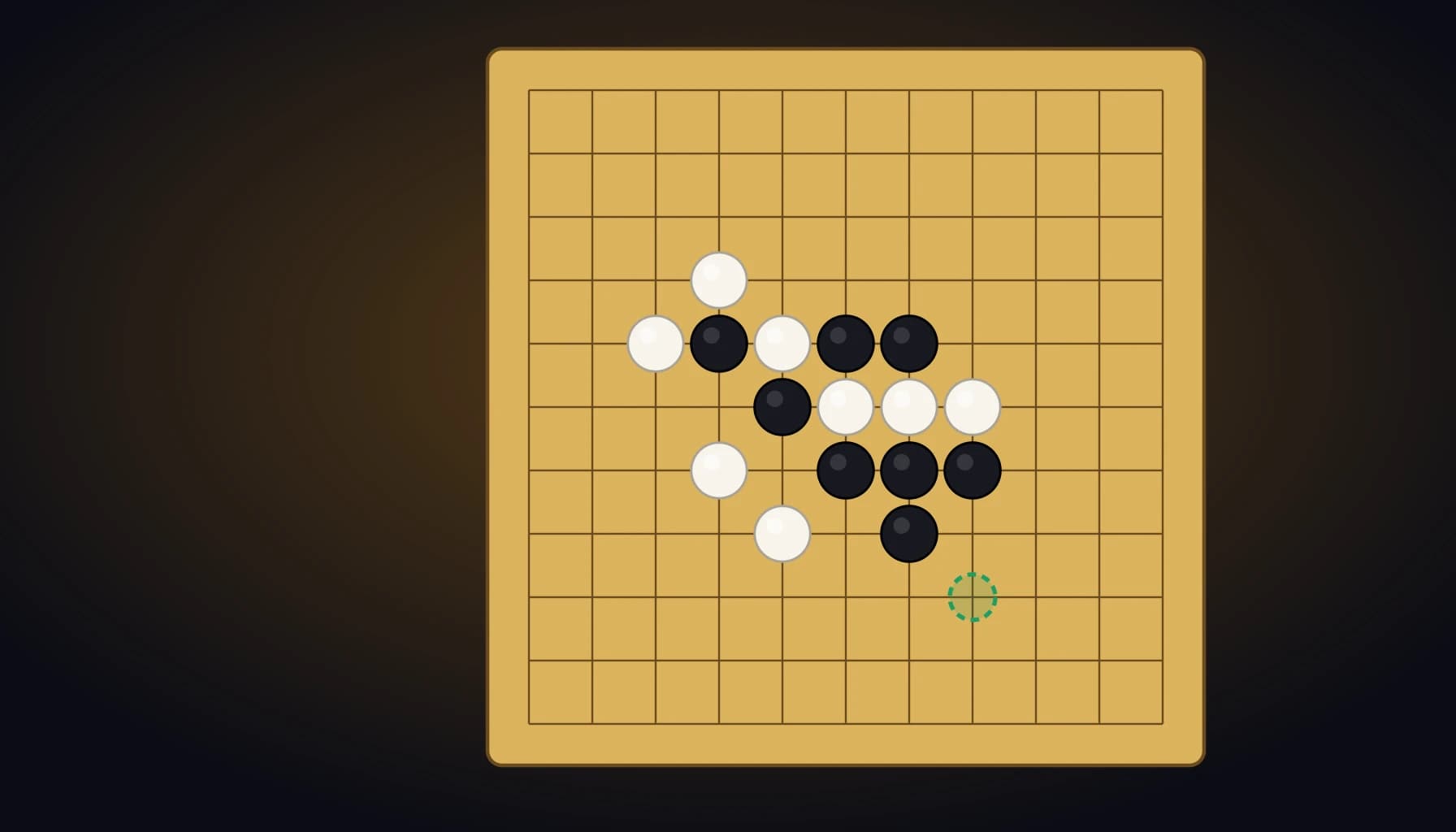
Gomoku has one rule: place a stone, and the first player with five in an unbroken line wins. Nothing is captured, nothing moves, nothing is hidden.
It is also a game where a competent player will beat a beginner in about twelve moves, every time, using a single idea. That idea has a name — the fork — and once you can see it, you are playing a different game.
Five names for one game
The Japanese gomoku narabe (五目並べ) means roughly "five pieces in a row", and it is the name that travelled. In China the game is wuziqi (五子棋), in Korea omok, and in older English books Gobang. Modern apps usually say Five in a Row.
They are the same game, played on the intersections of a grid with the stones of a Go set. Tournament Gomoku uses a 15×15 board; a borrowed Go board at 19×19 works perfectly well for a friendly game, and the site's version plays on the standard 15.
The rules, in full
- The board starts empty. Black plays first. Stones go on the intersections, not in the squares.
- A placed stone never moves and is never removed. There is no capture in Gomoku — it borrows Go's equipment and none of its rules.
- Five in a row wins, horizontally, vertically or diagonally.
- Nobody can move twice. If the board fills with no five, the game is drawn, which on a 15×15 board essentially never happens between beginners and sometimes happens between experts.
The one rule worth agreeing before you start is the overline: six or more of your stones in a row. In free-style Gomoku that counts as a win. In the stricter rule sets it does not count at all — a line of six is just a line of six, and you still need an exact five somewhere.
The threat hierarchy
Everything in Gomoku is threats. Learning the four shapes below is most of what separates a beginner from a competent player, and it takes about ten minutes.
The open three
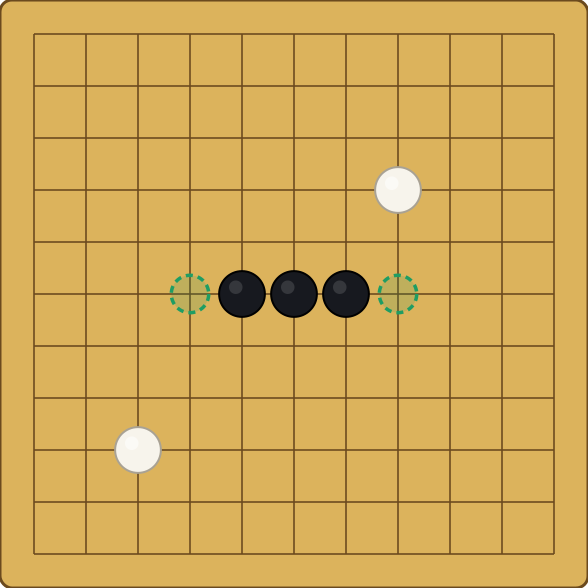
Three stones with both ends free. It is not a win, but it must be answered immediately, because if Black gets to extend it the position becomes unstoppable. Almost every Gomoku game is a conversation in open threes.
The open four
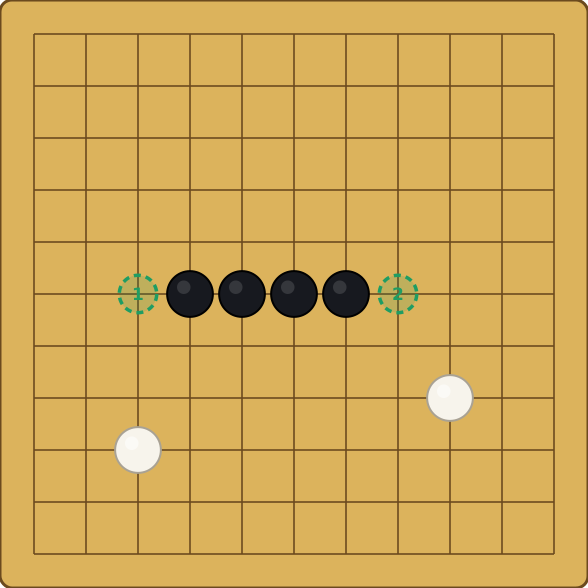
Four stones with both ends free. There are two points that make five, and your opponent gets one move. This is not a threat — it is a result. Reaching an open four is the whole objective of the middle game, and the entire defensive effort goes into making sure it never happens.
The closed four
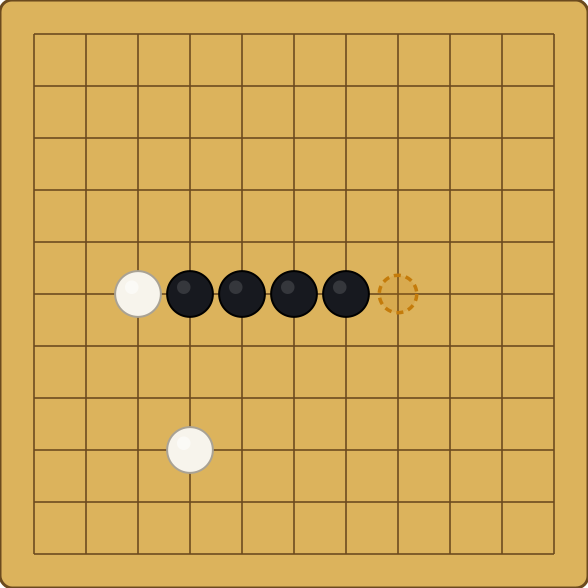
Four stones with one end blocked. Only one point completes the five, so the opponent simply plays it. A closed four is a forcing move — the opponent has no choice — but it wins nothing by itself. Beginners spend them for the pleasure of seeing the opponent forced; strong players hoard them, because a forcing move is only worth playing when it builds something else at the same time.
The fork
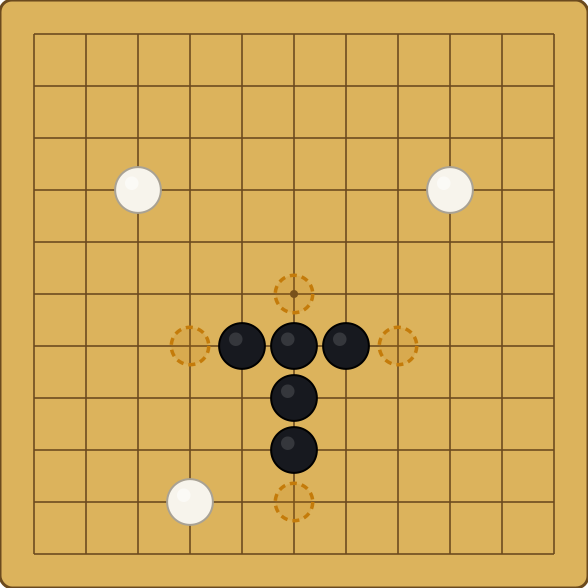
Two open threes at once. Your opponent has one move and two lines to stop. This is how essentially every decided game of Gomoku ends, and building one is the entire art of the game.
The fork does not have to be three-and-three. Four-and-three is stronger still: the four forces a block, and while your opponent is busy blocking, the three becomes a four.
The uncomfortable fact: Black wins
Free-style Gomoku on a 15×15 board is a first-player win. This is not an opinion. In 1993 the Dutch researcher Victor Allis proved it computationally: with perfect play, Black forces a win, and the proof shows how.
That is a serious problem for a competitive game, and it is why serious Gomoku is never played free-style. Three fixes are in circulation:
- Renju forbids Black — and only Black — from making a double three, a double four, or an overline. White may do all three. The handicap is precise enough that Renju is played as a professional sport in Japan.
- Swap2 is the modern tournament standard and is much simpler. One player puts down three stones (two black, one white) in any arrangement. The other then chooses: take black, take white, or add two more stones and hand the choice back. Whoever sets up an unbalanced position risks being handed the worse side of it.
- Pro and Long Pro restrict how far Black's second stone may be from the centre.
For a game at the kitchen table, none of this matters much — the theoretical win is far beyond what either of you will find. It matters the moment both players know what a fork is.
How to actually get better
Play near the centre early. A stone in the middle sits on more lines than one near the edge, so it contributes to more potential fives. Edges are where threats go to die.
Count your opponent's threats before you build your own. The commonest loss in Gomoku is a player one move away from a fork who never noticed the fork already pointed at them. Check every line through your opponent's last stone before you do anything else.
Block on the side that helps you. An open three has two ends. Blocking is compulsory, but which end you block is free — take the one that also extends a line of your own. Defence that builds nothing is how you lose slowly.
Do not spend fours for fun. Every closed four you make fills one of your own lines and hands your opponent a stone in a useful place. Play a four when it sets up the next threat, not because it feels forcing.
Watch the diagonals. Nearly every missed threat in a beginner's game is diagonal. Rows and columns are easy to see; the diagonals are where you lose.
Common questions
Is Gomoku just big noughts and crosses? The shape is similar and the depth is not. Noughts and crosses is a draw in nine squares; Gomoku on 225 intersections has an opening theory, a professional scene and a proof of first-player advantage that took a research team to produce.
Does an overline win? In free-style, yes. In Renju and most tournament rules, no — six in a row is not five in a row. Agree before you start.
How many stones do we each get? As many as you need. Nothing is captured, so a Go set's 181 black and 180 white stones cover any game many times over.
Can it end in a draw? In theory yes, when the board fills with no five. In practice it is rare, and rarer the weaker the players.
Which rule set should I use at home? Free-style. The first-player advantage only becomes real between players who both see forks coming, and by then you will want Swap2 anyway.
Ready to try it? Play Gomoku against the computer — three difficulty levels, a ghost-stone preview so you can see the shape before you commit, and an undo button for the fork you walked into. If you like the idea of lines but would rather move pieces than only place them, Nine Men's Morris is the same instinct in a different game. Away from a screen, the printable Gomoku board needs nothing but a pencil — X against O, straight onto the intersections.