
Print & Play
Printable Alquerque Board
The board draughts came from, on one sheet — with the twenty-four men on a second and the rules on a third. Nobody sells this board; here it costs a sheet of paper.
Style
What the board looks like when someone made one — the default worth printing.
Paper
Sheets
For a PDF, pick Save as PDF as the printer in the print dialog.
Alquerque · 12 men each · playnook.io
Pieces
Cut along the dashed lines — twelve men a side, plus a spare. Two kinds of coin work just as well: twelve of one, twelve of the other.
Alquerque · playnook.io
Alquerque — quick rules
The starting position. Only the centre point stays empty.
- Set up. Fill the board except the middle point: each player takes the two rows nearest them, plus the two middle-row points on their own side. Twelve men each. White moves first.
- Move. One step along a drawn line to an adjacent empty point — sideways and backwards included. Diagonals exist only where a diagonal line is actually drawn, which is at every second point.
- Capture. If an enemy man stands next to yours with an empty point directly beyond it on the same line, jump it. The jumped man leaves the board for good.
- Capturing is compulsory. When a jump exists anywhere on the board, every quiet move is forbidden. A man that lands next to another jumpable man must carry on jumping, turning corners as it goes.
- Win. Take all twelve enemy men, or leave your opponent with no legal move at all.
- Draw. The same position three times, or sixty moves with nothing captured, ends the game level.
Play online: playnook.io/games/alquerque
What you get
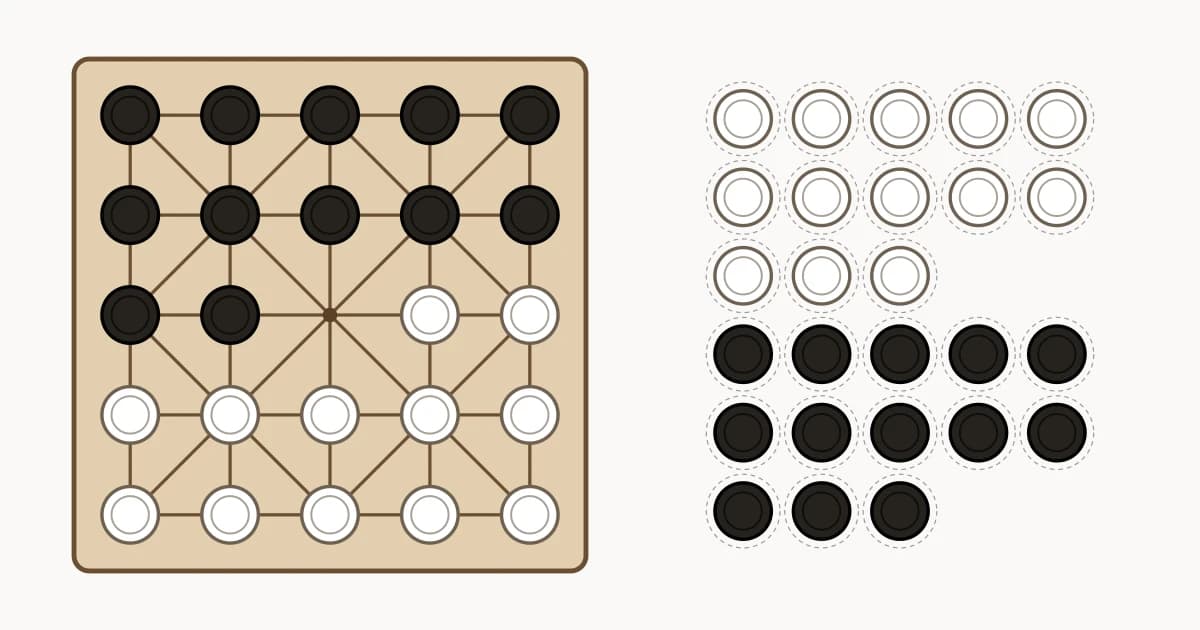
The board fills the page: twenty-five points, the full grid, both long diagonals and the inscribed diamond. The piece sheet prints twelve men a side plus a spare, on dashed cutting circles. The rules sheet carries the whole game on one page, with a diagram of the starting position — which matters here, because the setup is the one thing nobody guesses right.
The pattern is the hard part
Drawing a five-by-five grid is easy. Getting the diagonals right is not, and a board with the wrong ones is a different game. Alquerque uses both corner-to-corner diagonals and the diamond joining the midpoints of the four edges — no more, no less. The result is a board where every second point has eight neighbours and the points between them have four.
That alternation is the whole tactical texture of the game. Men standing on the eight-neighbour points see more, threaten more and escape more easily; the four-neighbour points are where pieces get trapped. Print it once and it is right forever.
Setting up: twelve each, one empty point
Each player fills the two rows nearest them and the two middle-row points on their own side. That is twelve men each, twenty-four on a twenty-five point board, and exactly one empty point — the centre. Every game of Alquerque begins with a board this full, which is why the first few moves feel like prising a door open.
Every capture is compulsory
If a jump exists anywhere on the board, you must take it. That single rule is what makes the game sharp: because your opponent has no choice, you can offer a man deliberately and steer their piece into the landing square you want. Sacrificing one man to set up a three-man counter-chain is not a clever trick here, it is the standard tactic.
Four styles
Carved wood is the everyday set. Temple slab prints it as sandstone and blade — boards of this pattern have been found scratched into Egyptian temple slabs and Roman paving, so it is closer to the truth than the wood is. Parchment stays pale and light on the toner, and ink saver drops the fills entirely for a class set.
For teachers and classrooms
Alquerque is a gift for a history lesson, because it is the missing link people can actually hold: the Moors carried it into Spain, Alfonso X had its rules written down in 1283, and somewhere in the twelfth century somebody moved the pieces onto a chessboard and invented draughts. Print the ink-saver style for a class set and let the pupils cut their own men. The boards you print are yours to use, in class or commercially.
Frequently asked questions
Where do I buy an Alquerque board? You largely cannot, which is why this page exists. Alquerque sets are made by a handful of craft workshops and almost never sold in shops. Printing one costs a sheet of paper.
Which diagonals belong on the board? Both long diagonals from corner to corner, plus the diamond that joins the four edge midpoints. Together they give every second point four extra neighbours and leave the rest with four. Getting this pattern wrong is the most common mistake in hand-drawn boards.
How is Alquerque different from checkers? The jumping capture is identical. But Alquerque is played on the points of a lined board, men move in every direction the lines allow including backwards, and there are no kings. Checkers appeared when these rules were moved onto the chessboard.
What do I use as pieces? The second sheet prints twelve men a side plus a spare. Two kinds of coin work just as well — twelve 5c and twelve 10c — as do buttons or two colours of dried bean.
Is it really free? Yes. Print as many copies as you like, at home or for a whole classroom. No account, no watermark.
How do I get it as a PDF? Press Print, then choose “Save as PDF” as the printer in the print dialog. Every browser has that option built in.
Rather play right now? Play Alquerque online against the computer — compulsory captures, chain jumps, no scissors. While you are here, print a Surakarta board or a Nine Men’s Morris board too.