
Print & Play
Printable Surakarta Board
The one board nobody can draw by hand — all eight corner loops, in their right places and in two colours. Board, men and rules on three sheets.
Style
Javanese indigo on cream, with the two circuits in their own colours.
Paper
Sheets
For a PDF, pick Save as PDF as the printer in the print dialog.
Surakarta · 12 men each · playnook.io
Pieces
Cut along the dashed lines — twelve men a side, plus a spare. They are smaller than on the other boards, because 36 points on one page leave less room per point.
Surakarta · playnook.io
Surakarta — quick rules
The starting position. Two full rows each, the middle two rows empty.
- Set up. Each player fills the two rows nearest them — twelve men each. The two middle rows start empty. White moves first.
- Quiet move. One step to an adjacent empty point, in any of the eight directions. A quiet move never captures anything; it puts you on the lines that do.
- Capture around the loops. Send a man along its row or column, around at least one corner loop, and take the first enemy man on the path. The whole path must be clear — your own man, or a line end without a loop, stops it.
- Two circuits. The small loops join the 2nd and 5th lines into one circuit; the large loops join the 3rd and 4th into another. The outermost lines have no loops, so a man on a corner can never be captured.
- Capturing is optional. Never forced, unlike draughts. That makes a quiet move which sets up two captures at once stronger than taking one man now.
- Win. Take all twelve enemy men, or leave your opponent with no legal move. A hundred moves without a capture is a draw.
Play online: playnook.io/games/surakarta
What you get
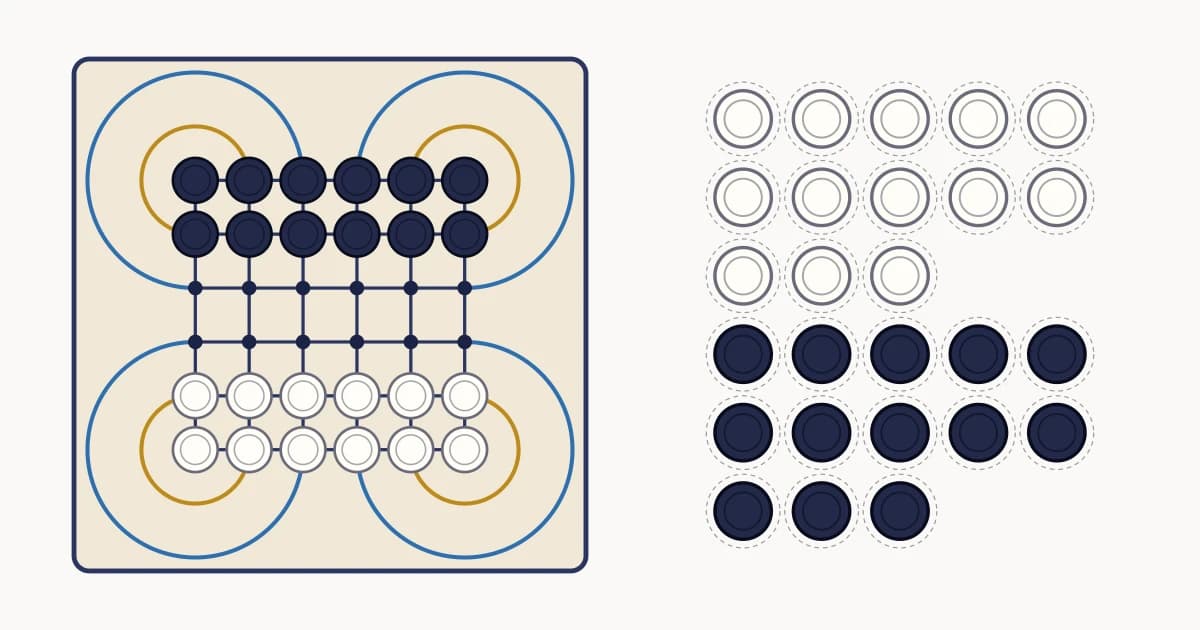
The board is a six-by-six grid of points with eight curved loops swinging out around the corners — four small, four large. The piece sheet prints twelve men a side plus a spare, and the rules sheet puts the whole game on one page beside a diagram of the opening position.
The loops are the reason this page exists
Every other board in this collection can be drawn with a ruler if you are patient. Surakarta cannot. Each loop is a three-quarter circle that has to leave the grid tangent to one line and rejoin it tangent to another, and if the radius is off, the circuit connects the wrong lines and the capture rule quietly breaks. That is why hand-drawn Surakarta boards on the internet are so often wrong, and why a printed one is worth the sheet of paper.
Here the small loops join the 2nd and 5th lines into one circuit and the large loops join the 3rd and 4th into another — drawn in two colours, because a beginner cannot see two racetracks in eight identical curves. The outermost lines have no loops, which is the whole reason a man on a corner point is untouchable.
Capture by momentum
A quiet move is one step in any direction and never takes anything. A capture sends your man down its row or column, around at least one loop, and onto the first enemy man in its path — provided the path is clear the whole way. It is, as far as anyone knows, a capture rule found in no other traditional game, and it is the reason the game has a following among programmers: pieces threaten each other from directions that look like nothing at all.
Captures are never compulsory. That makes the quiet move which sets up two loop threats at once stronger than taking a man today.
Four styles
Batik indigo puts the board in Javanese indigo on cream with the two circuits in gold and blue — the version to print if you print one. Carved wood is the everyday set, parchment stays light on the toner, and ink saver drops the fills and prints the large loops dashed, so the two circuits stay readable in pure black and white.
Making the pieces
Thirty-six points on one page means smaller men than on our other boards — about 14 mm. Print the piece sheet on card stock, or glue it to a cereal box before cutting, and they will be thick enough to pick up. Small coins work too, and are frankly easier.
Frequently asked questions
Why can I not just draw this board myself? The loops. Eight curves have to leave the grid at exactly the right lines and come back at exactly the right lines, or the capture rule stops working. Drawing them freehand with a compass is an afternoon; printing them is a minute.
Which lines do the loops connect? The small loops join the 2nd and 5th lines into one circuit, and the large loops join the 3rd and 4th into another. The outermost lines have no loops at all, which is exactly why a man standing on a corner point can never be captured.
Why are the loops in two colours? Because they are two separate racetracks, and a beginner cannot see that from the shape alone. Gold and blue make the two circuits readable at a glance. In the ink-saver style the large loops print dashed instead.
What do I use as pieces? The second sheet prints twelve men a side plus a spare. They are a little smaller than on our other boards — 36 points on one page leaves less room per point — so cut carefully, or use small coins.
Is the capture rule really unique? As far as anyone knows, yes. No other traditional board game captures by sending a piece around a looped circuit. It is capture by momentum rather than by jumping or flanking.
How do I get it as a PDF? Press Print, then choose “Save as PDF” as the printer in the print dialog. Every browser has that option built in.
Rather play right now? Play Surakarta online against the computer — every capture animates around the curves, which is the fastest way to understand what the loops do. While you are here, print an Alquerque board or a Shisima board too.