
Print & Play
Printable Shisima Board
Six pieces, nine points, and games that last a minute. The Kenyan pond on one sheet, the men on a second, the rules on a third.
Style
The shisima itself — the pond the game is named after.
Paper
Sheets
For a PDF, pick Save as PDF as the printer in the print dialog.
Shisima · 3 men each · playnook.io
Pieces
Cut along the dashed lines — three men a side, plus a spare. In Kenya the game is drawn in the dirt and played with bottle caps, which works here too.
Shisima · playnook.io
Shisima — quick rules
The starting position. The two side points and the centre stay empty.
- Set up. Sit opposite each other. Each player puts three men on the three rim points nearest them. The centre — the shisima — starts empty.
- Move. Slide one man one step along a line each turn: to a neighbouring rim point, or into the centre, or out of it again. Nothing is ever captured and nothing is ever added.
- Win. Three of your men in a straight line. On this board that always means two opposite rim points plus the centre — there are only four such rows in the whole game.
- The centre is everything. A man in the shisima blocks all four winning rows at once. But your own row needs the centre too, so you cannot simply camp there and wait.
- Draw. If the same position comes up three times, the game is drawn. Between two careful players that is the usual result.
- A game takes a minute. Play best of seven and swap who starts. The board is small enough that the second game is already a different game.
Play online: playnook.io/games/shisima
What you get
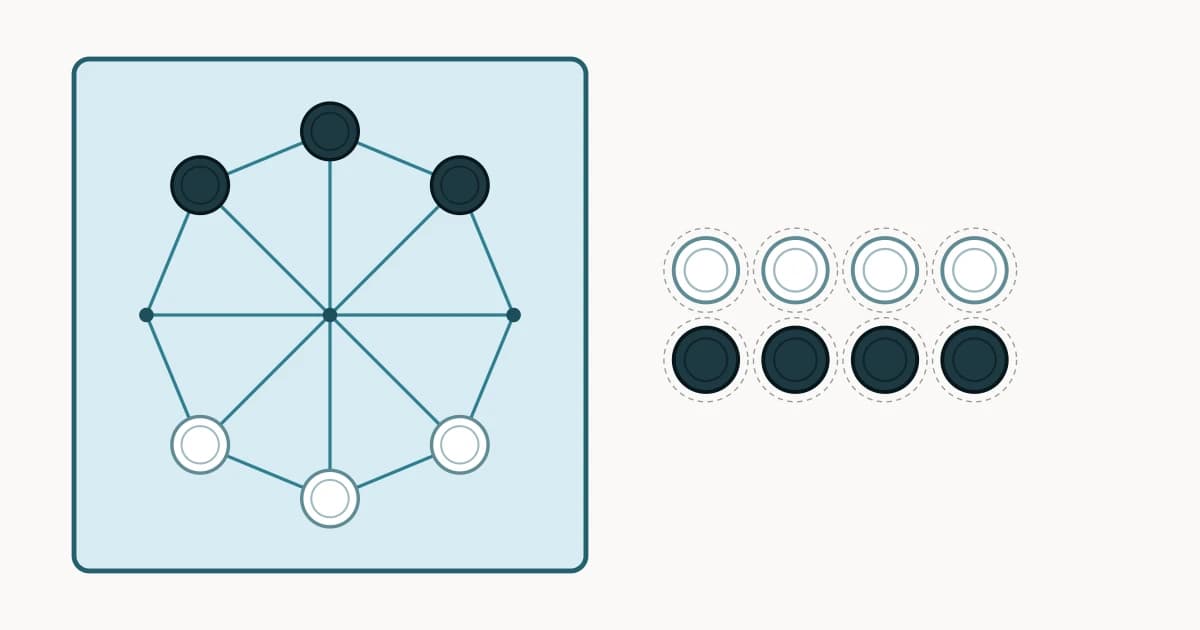
The board is the pond: an octagon of eight rim points with spokes running into the centre — the shisima itself. The piece sheet prints three men a side plus a spare. The rules sheet holds the whole game with room to spare, because there is not much of it: slide one man one step, get three in a row, done.
The smallest deep game you will print
Shisima has six pieces and nine points, and you can teach it in half a minute. What makes it worth printing is what happens next. Because nothing is ever captured and nothing is ever added, the position never simplifies — you cannot trade your way out of trouble, and there is no endgame to escape into. Every move is the whole game.
The four winning rows all run through the centre point, so both players are fighting over one square of paper. Sitting in the middle blocks every row your opponent has. It also blocks the one you are building, which is the joke at the heart of the game: the strongest point on the board is one you cannot afford to stay on.
Four styles
Still water prints the pond as a pond — pale blue, teal lines, the version that explains the name without a word. Carved wood makes it look like a bought set, parchment keeps it light on the toner, and ink saver is outlines only, so a class set of thirty costs almost nothing.
For teachers and classrooms
This is the printable to reach for when you have ten minutes and a room full of people who have never met each other. The rules fit on an index card, a game takes a minute, and a best-of-seven fits in a break. Underneath it teaches symmetry, forced moves and the idea that blocking and building can be the same move — which is a lot of mathematics for a board with nine points on it.
It also travels well as a lesson in itself: Shisima comes from the Tiriki people of western Kenya, where children draw it in the dirt and play with bottle caps. The boards you print are yours to use, in class or commercially.
Frequently asked questions
What does Shisima mean? Shisima means body of water in Tiriki, a language of western Kenya. The board is a pond, and the pieces are imbalavali — the water insects that dart across its surface.
How is it different from noughts and crosses? In noughts and crosses you place marks that never move, and the board fills up. In Shisima all six men are on the board from the start and one slides every turn, so the game never runs out of room. There are also only four winning rows, and every one of them passes through the centre.
Why does every winning row go through the middle? On an octagon the only straight lines of three points are the four diameters: two opposite rim points plus the centre. That is the whole design, and it turns the game into a fight over a single point.
What do I use as pieces? The second sheet prints three men a side plus a spare. In Kenya the game is drawn in the dirt and played with bottle caps or pebbles, which works here just as well.
What age is it good for? Six and up. The rules take thirty seconds to explain, a game takes a minute, and the strategy underneath is deep enough that adults lose to children regularly.
How do I get it as a PDF? Press Print, then choose “Save as PDF” as the printer in the print dialog. Every browser has that option built in.
Rather play right now? Play Shisima online against the computer — same pond, no scissors. While you are here, print an Alquerque board or a Nine Men’s Morris board too.