Five dice, three rolls a turn, fifteen categories to fill. This is Yatzy, the Scandinavian original — two extra rows Yahtzee doesn't have, and several categories that score differently even where the names match.
How to play Yatzy
Two players, fifteen turns each. On your turn, roll up to three times, holding whatever you want to keep between rolls, then lock a score into one of your fifteen still-empty categories.
How do you set up a game of Yatzy?
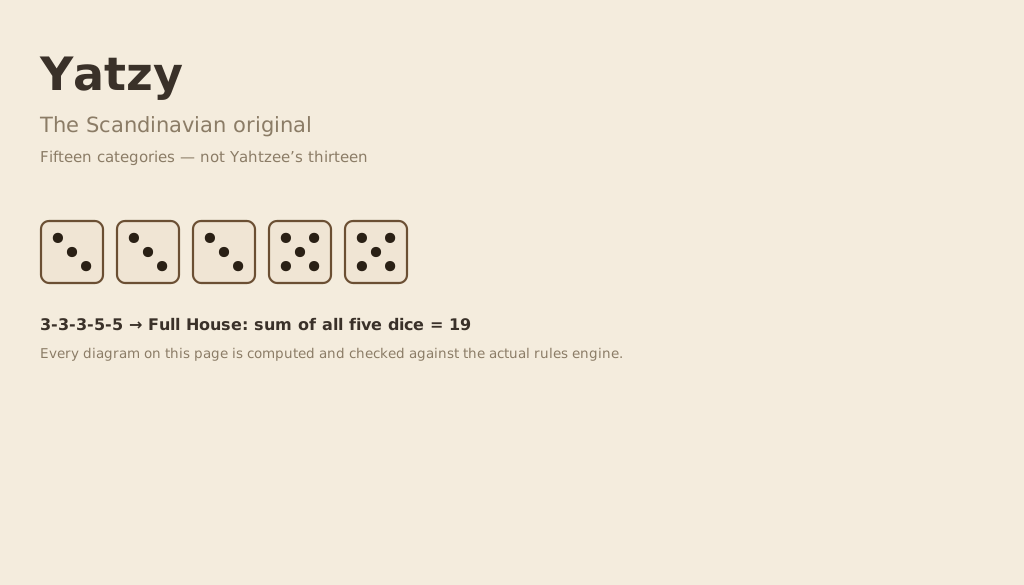
There's no setup beyond the scorecard itself: fifteen empty categories each, five dice, and whoever's turn it is rolls first. Roll, hold, reroll, repeat up to three times a turn, then score — even into a category worth nothing this time, if that's genuinely the best you can do with an empty boneyard of rolls left.
Moving: roll, hold, score
- Roll — all dice you haven't held. Up to three times a turn.
- Hold — click a die between rolls to keep it out of the next reroll. Toggle it back off if you change your mind before rolling again.
- Score — once you're satisfied (or out of rolls), lock this roll's value into any one of your fifteen still-empty categories. That category is done for the rest of the game, whatever the value.
The categories that actually differ from Yahtzee
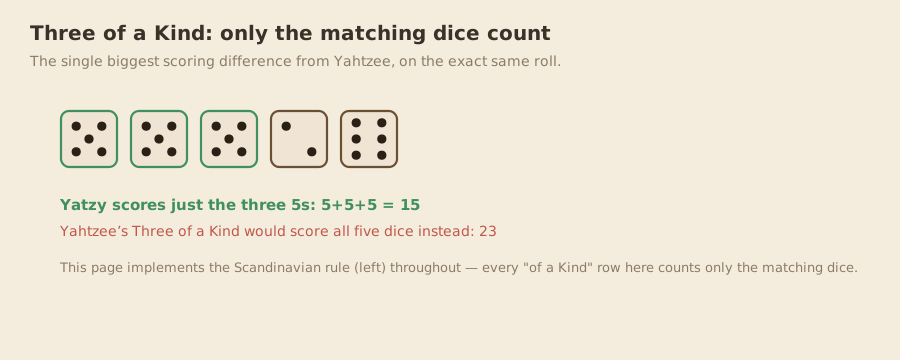
One Pair, Two Pairs, Three of a Kind, and Four of a Kind all count only the dice that actually match — not the full five-dice sum Yahtzee uses for its equivalents. Roll 5-5-5-2-6 and this page's Three of a Kind is worth 5+5+5=15, not 23. It's an easy thing to misjudge if you've only ever played the American version, and it changes real decisions: a near-miss roll is worth noticeably less here than it would be there.
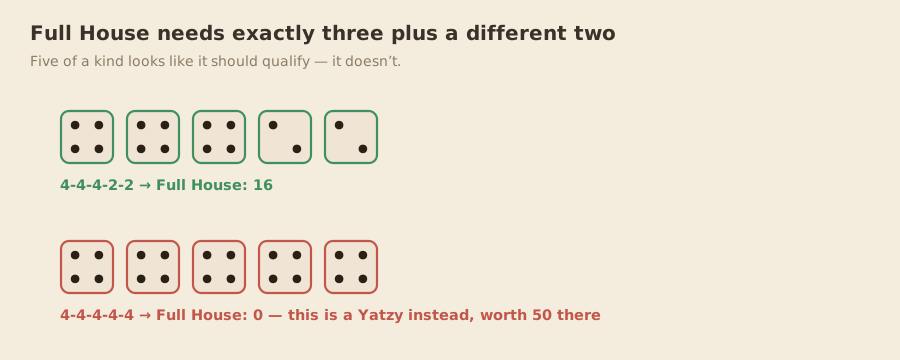
Full House needs exactly three of one number and two of a different one — five matching dice don't qualify, because there's no second, different value to pair with. Roll five of a kind and it scores zero under Full House; it belongs in the Yatzy category instead, where it's worth 50.
The straights are fixed values too, and lower than Yahtzee's: Small Straight (1-2-3-4-5) is worth 15, Large Straight (2-3-4-5-6) is worth 20 — Yahtzee's equivalents pay double, 30 and 40. Chance is the one category that's identical either way: the sum of all five dice, no restriction at all.
How does the upper section bonus work?
Score at least 63 across Ones through Sixes combined and the whole section earns a flat 50-point bonus on top. Sixty-three isn't an arbitrary cutoff — it's exactly what six categories would total if you rolled precisely three of each number, one through six, a natural midpoint the whole bonus structure is built around.
How do you win at Yatzy?
After both scorecards are completely full — fifteen turns each, thirty turns total — whoever has the higher grand total (upper section, its bonus, and every lower-section category combined) wins. Equal totals draw.
Yatzy strategy
What should you aim for on your first roll?
Look at what the dice already gave you before deciding what to chase. A pair or better on the first roll is usually worth building on — hold it and reroll the rest toward Three of a Kind, Four of a Kind, or Yatzy itself. A scattered, no-matches roll is the moment to gamble on a straight instead: hold whatever distinct values you already have toward either 1-2-3-4-5 or 2-3-4-5-6, since a straight pays a fixed amount regardless of which specific numbers you end up needing.
When should you deliberately take a zero?
Almost every real Yatzy game includes at least one turn where nothing useful comes up and something has to be sacrificed. The right instinct is to zero the category with the lowest ceiling among what's still open, not just whatever's most inconvenient in the moment — a zero in Ones costs you at most 5 points of potential; a zero in Yatzy costs you 50. This page's own computer opponent follows exactly that rule when it's genuinely stuck, and it's worth adopting deliberately rather than falling into by accident.
Is the upper section bonus worth chasing?
Usually, yes, and earlier than it looks necessary. Fifty points is larger than almost any single lower-section category, and the categories that build it — Fours, Fives, Sixes especially — are also some of the easiest to fill well on an ordinary roll. Falling a few points short of 63 because the upper section got treated as an afterthought is one of the most common ways a close game is lost.
Playing against the computer
How do the three computer levels differ?
Differently from every other computer opponent on this site, because Yatzy genuinely has no opponent move to search against — nothing you roll ever touches the other player's scorecard. So instead of scoring a move by simulating a reply, this AI estimates how promising each of its own still-empty categories looks from the current dice, holds toward whichever one looks best, and takes the strongest result available once it's done rolling. The easy level holds less precisely and sometimes locks in a weaker category than it had to; hard always takes the best read the heuristic can find. None of the three levels plays mathematically perfect Yatzy — that would need a much heavier expected-value calculation over every possible reroll — but the gap between levels is real and measurable: in our own matched-level testing, hard averaged 179 points a game against itself, more than double easy's average of 84, with medium roughly in between at 134.
The history of Yatzy
Yatzy's American cousin has an unusually well-documented birth: a Canadian couple invented a dice game to play with friends aboard their yacht in the late 1940s, and in 1956 the game entrepreneur Edwin S. Lowe bought the rights from them for the price of the first thousand copies made — trademarking it as Yahtzee the following year.
Yatzy's own history is fuzzier by comparison, and that fuzziness is itself the point: it was already being played across Sweden, Denmark, Norway, and Finland for decades before Yahtzee existed as a commercial product, passed down informally as a folk game rather than sold in a box with a patent behind it. Nobody owns Yatzy the way Hasbro owns Yahtzee — it's public domain, which is exactly why the fifteen- category Scandinavian scorecard could keep evolving on its own terms instead of freezing at whatever a single 1956 rulebook happened to say.
That's also the practical reason this page could build the real fifteen-category version at all: a public-domain ruleset can be implemented directly from how the game is actually played, rather than licensed or approximated around someone else's trademark. The two scorecards drifted apart gradually rather than by design — nobody sat down and decided Yatzy's Full House should score differently from Yahtzee's, it just kept being played that way long enough in enough households that the difference became permanent.
If you like this one
- Sea Battle — a completely different kind of luck: hidden placement instead of open dice
- Royal Game of Ur — another dice-driven race with three thousand years more history behind it
- Reversi — the computer opponent design this site defaults to everywhere a real opponent move exists to search
- Nim — the opposite kind of game entirely: zero luck, solved outright