
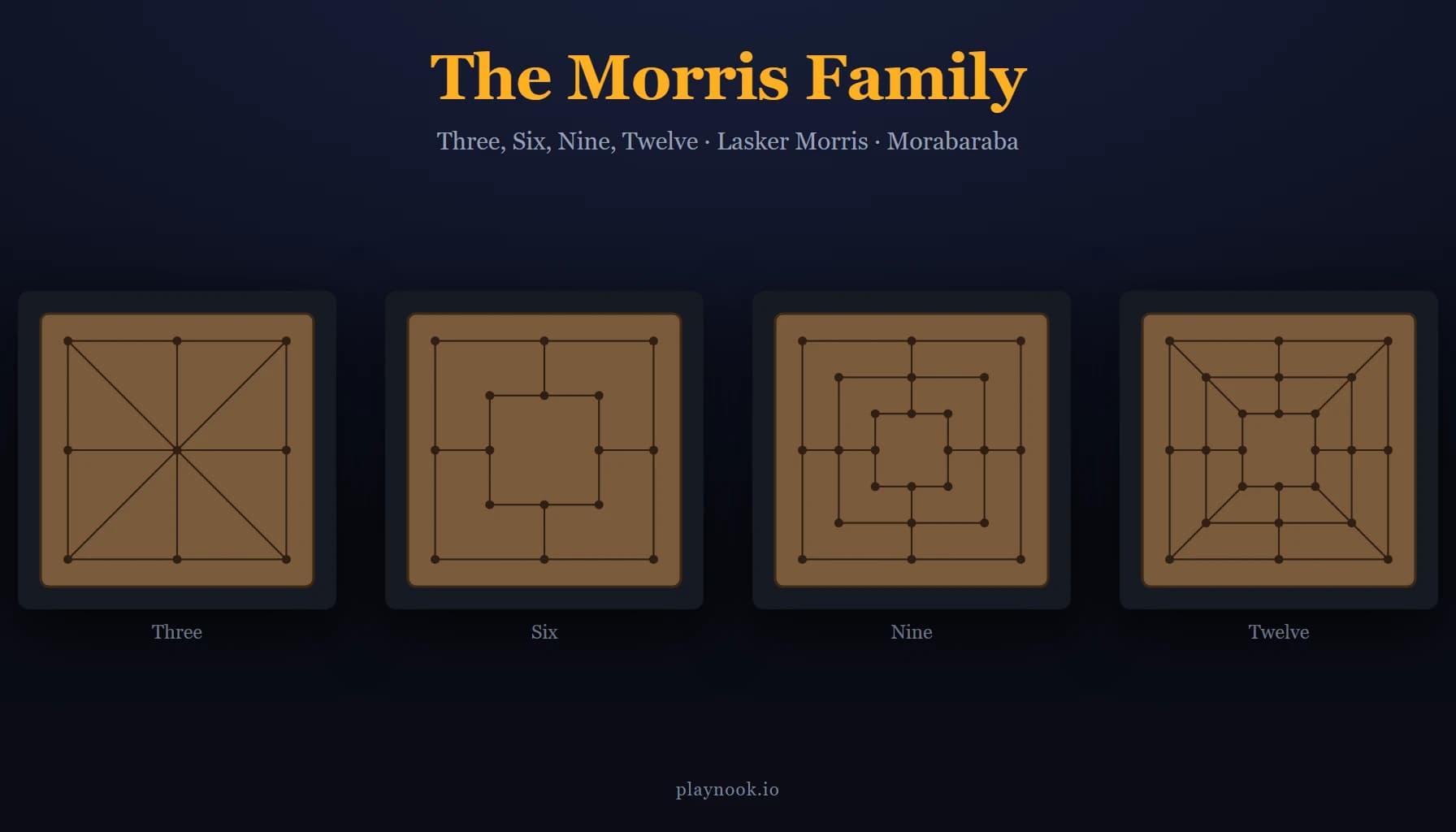
Ask someone to draw a Morris board and you will get three squares inside each other. That is the nine-piece game, and it is the one that travelled furthest.
But it is one of a family. The same idea — line up three, take one of theirs — has been played on a 3×3 grid, on two squares, on three squares with diagonals, and with anywhere from three to twelve pieces a side. One of those versions is a recognised sport with a national federation. Another was designed by a world chess champion who thought the standard game drew too often.
They are not all equally good, and it is worth knowing which is which before you spend an evening on one.
Three Men's Morris
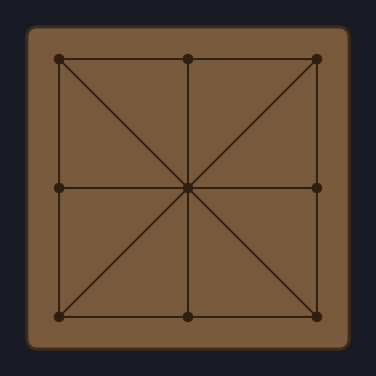
Nine points, three pieces a side, and eight possible lines of three — the rows, the columns and the two diagonals.
Place your three, and then you may move them. That last part is the whole point, and it is why this is not noughts and crosses: in tic-tac-toe the board fills and the game stops, here it never stops, because a piece that is in the wrong place can be walked somewhere better.
The Romans played it. Ovid recommends in the Ars Amatoria that a young woman learn the small three-in-a-row game, which is about as clear a statement of its popularity as you get from antiquity.
Worth playing? As a two-minute filler and as the way to teach a five-year-old the idea, yes. It is small enough that a determined pair will exhaust it in an afternoon. Our Kenyan game Shisima is the same idea on a prettier graph — nine points again, three pieces again, but every winning line runs through the centre, which changes the feel completely.
Six Men's Morris
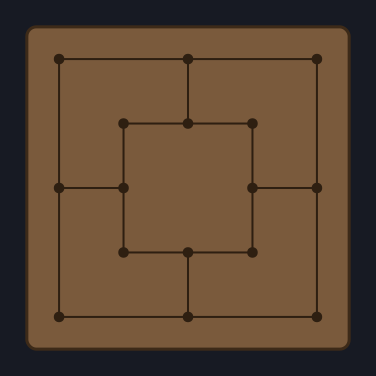
Drop the outer square. Sixteen points, six pieces a side, and — in the usual rule set — no flying: when you are down to three pieces you do not get to jump anywhere, you keep sliding.
That one omission changes the endgame entirely. In the nine-piece game, being reduced to three is a reprieve; you gain mobility exactly when you are losing. Here it is simply a slow death, and games are shorter and more decisive as a result.
Six Men's Morris was popular in medieval Europe and then largely fell out of use, which is a shame — it is sharper than its reputation.
Worth playing? Yes, if you find the nine-piece game drawish. Fewer pieces on a smaller board means the mills come faster and there is nowhere to hide.
Nine Men's Morris
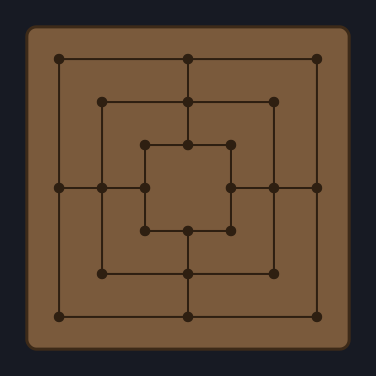
The one everybody means. Twenty-four points, nine pieces, sixteen possible mills, three phases — place, slide, and fly when you are down to your last three.
It is the balance point of the family: big enough for the double mill to be a real strategic resource, small enough that you can hold the whole board in your head. Play it here, against the computer or against a friend at a shared table.
Twelve Men's Morris
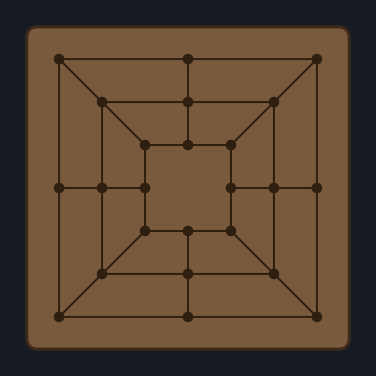
Same board, plus four diagonal lines joining the corners of the squares. Twelve pieces each.
The diagonals add four possible mills, taking the total from sixteen to twenty, and they connect the corner points, which in the standard game are the quiet backwaters where nothing happens. Twelve pieces on twenty-four points also means the board is half full before anyone has moved anything.
The result is a much more crowded, much more tactical game. Some find it overloaded; others think the nine-piece version is comparatively empty. It is a matter of taste, and you will know which camp you are in after one game.
Morabaraba
Twelve Men's Morris has a second life, and it is the liveliest corner of this whole family.
In South Africa and Botswana, essentially the same game is played as Morabaraba — and it is not a curiosity there. It is popular, particularly among rural youth, it has organised competition, and it is recognised as a sport in South Africa.
The pieces are not called men. They are called cows, and you place your twelve cows on the board, form mills, and shoot one of your opponent's cows each time you do. Reduce them to two cows, or leave them unable to move, and you have won. Down to three cows, a player may fly.
One thing this article got wrong when it was written: Morabaraba is not simply Twelve Men's Morris under another name. The board is the twelve men's board — with the four diagonals — and that is the whole difference. Twenty rows of three instead of sixteen, and the corners become the strongest points on the board rather than the weakest.
If you have ever wondered what a traditional board game looks like when it is genuinely alive rather than preserved — with players, tournaments and a federation rather than a museum case — Morabaraba is the example to point at. Very little has been written about it in English, which says more about who writes about board games than about the game.
Play Morabaraba → — twelve cows, the diagonals, and an opponent that knows the difference.
Lasker Morris
The one variant on this list with a named inventor, and the one most likely to change how you feel about the standard game.
Emanuel Lasker — world chess champion from 1894 to 1921, and a mathematician besides — proposed a version with ten pieces and one rule change:
On your turn you may either place a new piece or move a piece you already have on the board.
That is all. But it dissolves the wall between the placing phase and the moving phase, which in the standard game is the sharpest structural feature there is. You can no longer count on your opponent having to keep placing while you build; they can answer a threat by moving instead. Openings stop being memorisable sequences of placements.
Lasker's stated motivation was that the nine-piece game draws too readily between strong players. He was right about the problem, and the fix works: draws are less likely in his version.
It has also been solved, like its parent — the starting position is still a draw with perfect play. Which tells you that "fewer draws" is a statement about human players, not about the game tree. That is the right way to judge a game anyway.
Worth playing? This is the one I would recommend to anyone who has played a few dozen games of standard Morris and started to feel the openings repeat.
Which one should you play?
| If you want… | Play |
|---|---|
| Two minutes, or a game for a small child | Three Men's Morris |
| Something sharper and more decisive | Six Men's Morris |
| The balanced classic | Nine Men's Morris |
| A crowded, tactical board | Twelve Men's Morris |
| The version people actually compete at | Morabaraba |
| The cure for a game that feels worked out | Lasker Morris |
Print any of them
The printable Nine Men's Morris board does all four boards — Three, Six, Nine and Twelve — with the right number of pieces to cut out for each and a rules sheet, in carved wood, cloister stone, parchment or an ink-saving outline for a class set.
For Morabaraba there is now its own sheet — the printable Morabaraba board — with twelve cows a side and a rules sheet in the game's own terms: dark places first, you shoot rather than capture, and the two draw rules the European game does not have.
Lasker Morris needs no special board at all: print the nine-piece board, take ten pieces a side instead of nine, and allow placing or moving on any turn.
Common questions
Is Morabaraba the same as Twelve Men's Morris? Effectively yes — the board and the core rules match. The differences are in name and in culture: the pieces are cows, and in South Africa it is played competitively as a recognised sport.
Who invented Lasker Morris? Emanuel Lasker, world chess champion from 1894 to 1921. It gives each player ten pieces and lets them place or move on any turn.
Which Morris variant is the hardest? Twelve Men's Morris and Morabaraba have the most pieces and the most possible mills, so there is the most to calculate. Lasker Morris is arguably deeper rather than harder — the branching starts earlier and the openings are less settled.
Is Three Men's Morris just tic-tac-toe? No. You may move your pieces after placing all three, which means the game does not end when the board fills. That one rule is the whole difference, and it is a bigger difference than it sounds.
Do all the variants allow flying? No. The nine-piece game normally lets a player with three pieces left jump to any empty point; Six Men's Morris usually does not. Agree before you start — it is the rule that varies most between tables.