
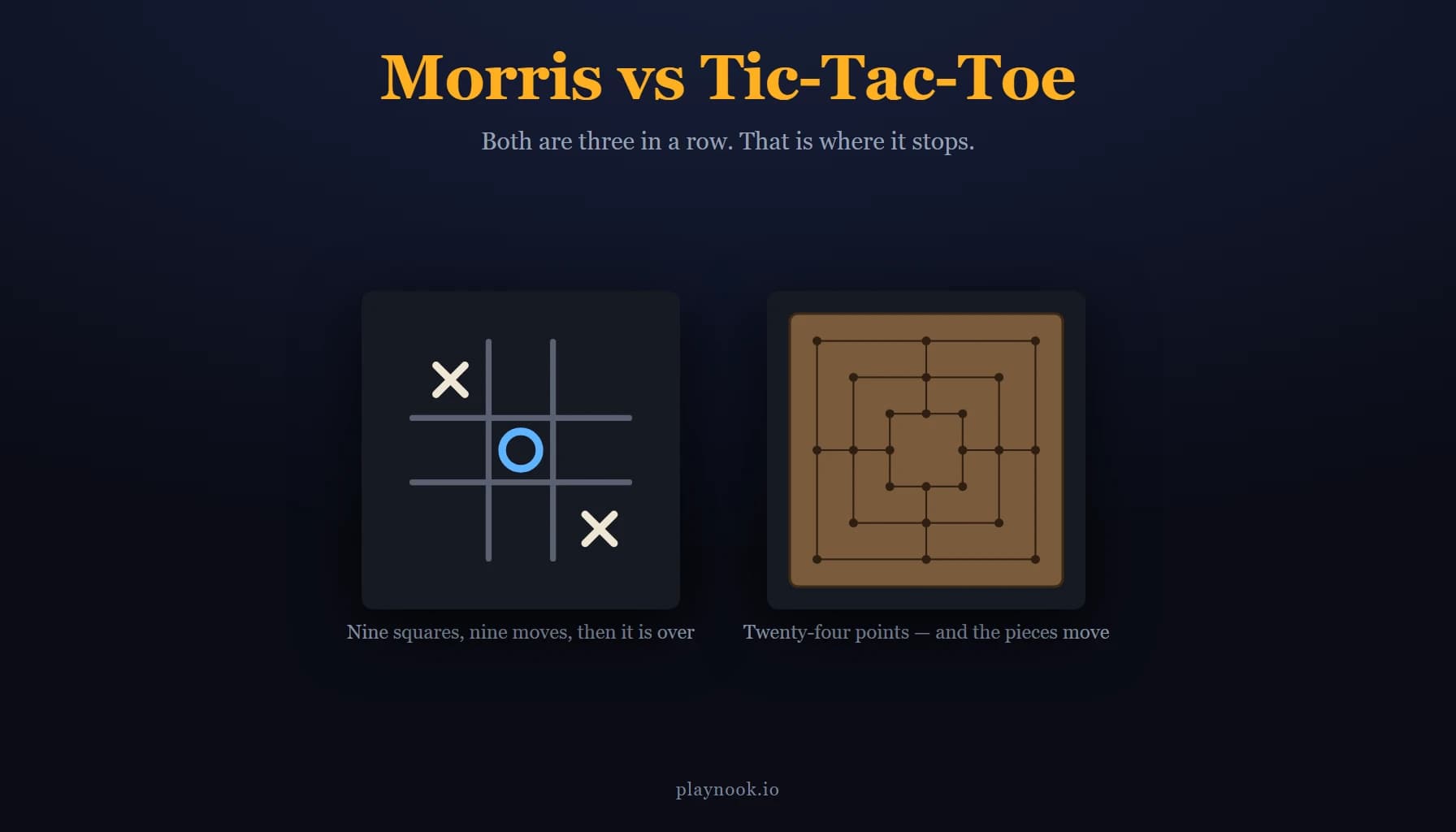
Show someone a Nine Men's Morris board for the first time and tell them the goal is three in a row, and you can watch the thought arrive: oh, it's noughts and crosses.
It is not, and the reason is worth more than a correction — because the difference between these two games is exactly the difference between a game children abandon at eight and one that people have been playing for two thousand years.
Where they actually agree
Not much, but let us be fair about it.
- Both are two-player, perfect-information games with no dice and no hidden cards.
- Both are won by making a line of three.
- Both are drawn with perfect play.
That last one usually surprises people, so it is worth stating plainly: Nine Men's Morris was solved in 1993, and the result is a draw. So is tic-tac-toe. By the crudest measure — "who wins if nobody errs" — the two games are equal.
Keep that in your pocket. We will come back to it, because it is the interesting part.
Where they part company: the pieces run out
In tic-tac-toe you have nine squares and you fill them. Nine moves, and the game is over whether anyone has won or not. Every move you make is permanent. Nothing you have placed can ever be improved, moved or lost.
In Nine Men's Morris, placing your nine pieces is only the first of three phases.
- Placing. Both players put down their nine pieces, one per turn.
- Moving. Once your pieces are all on the board, you slide one along a line to an adjacent empty point.
- Flying. Reduced to three pieces, you may jump to any empty point.
The moment the pieces run out, the game does not end. It changes gear. A piece in a useless corner is not a wasted move — it is a piece that can walk somewhere useful over the next few turns. That single fact makes the placing phase a question of structure rather than a race, and it is why good Morris players spend the opening building shapes that will still matter twenty moves later.
And the lines feed back
The second difference is bigger.
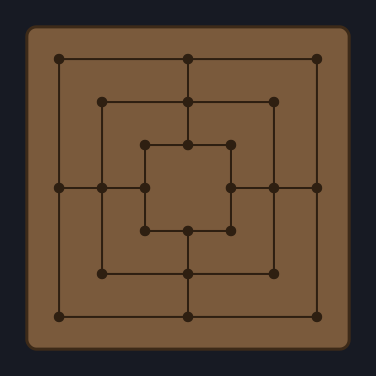
In tic-tac-toe, making a line ends the game. In Morris, making a line — a mill — lets you remove one of your opponent's pieces from the board, and then play continues.
That turns a win condition into an economy. Every mill you close makes your opponent weaker, which makes the next mill easier, which makes them weaker still. Positions snowball. There is a formation called the double mill, where two mills share pieces so that opening one closes the other, and a player who builds one can take a piece every second move for the rest of the game. Nothing in tic-tac-toe compounds like that; nothing in tic-tac-toe compounds at all.
And the removal itself is a decision, not an automatic step. Pieces standing inside a mill are protected and cannot normally be taken, so each capture is a choice about which of your opponent's plans to break — the piece that is about to complete a mill, or the one holding a junction you want.
The missing link is a real game
Here is what makes this comparison more than a list of differences: there is a game sitting exactly between the two, and it is old.
Three Men's Morris is played on a 3×3 grid — the tic-tac-toe grid, with the diagonals drawn in. Each player has three pieces. You place them, and then, when they are all down, you may move them.
That is the entire difference from noughts and crosses. And it is enough. The board no longer fills up and stops; the game continues until somebody actually makes a line. Suddenly the position matters more than the tempo, and blocking is no longer a permanent fix — your opponent can just walk around your block.
If you want to feel the gap between the two games in five minutes, play a few rounds of Three Men's Morris. It is the same nine points, and it is a completely different experience. Our Kenyan game Shisima is the same idea on a different graph — nine points, three pieces, and every winning line running through the centre — and it is more or less this comparison made playable.
So why is one game dead and the other not?
Both are drawn with perfect play. Both are solved. Yet children work tic-tac-toe out and abandon it, while Morris survived the Roman Empire, a Viking ship burial and several centuries of cathedral benches.
The difference is not the theoretical result. It is how far a human can see.
Tic-tac-toe has 255,168 possible games, which sounds like a lot until you notice that the useful strategy compresses to about five rules, and a bright eight-year- old will find all five without help. Once both players know them, every game is a draw and both players know in advance that it will be. There is nothing left to discover, so there is nothing left to play for.
Nine Men's Morris is drawn too — but no human being can hold the drawing line in their head. The solution took a computer. What two people at a table actually experience is a game full of traps they have not seen before: an opponent quietly assembling a double mill while you are busy blocking a single one, a piece you should not have placed on the outer square, an endgame where flying saves you at the last moment.
A game is worth playing if the mistakes are interesting. Tic-tac-toe has exactly one interesting mistake, and everybody learns it by nine. Morris has more than you can exhaust.
What to play instead of noughts and crosses
If you are looking for the thing to teach a child after tic-tac-toe, this is a strong answer, and it needs no equipment:
- Three Men's Morris — the same grid, one new rule. Start here.
- Shisima — nine points, three pieces, one minute a game, and a lovely bit of geometry underneath.
- Nine Men's Morris — the full game, once the idea of moving pieces has landed.
For paper, we have both: tic-tac-toe sheets with six, twelve or twenty-four grids to a page, and a printable Morris board that also prints the Three and Six Men's versions with pieces to cut out.
Common questions
Is Nine Men's Morris just a bigger tic-tac-toe? No. Pieces move after they are placed, and making a line removes an enemy piece instead of ending the game. Those two rules produce a completely different kind of play.
Are both games a draw with perfect play? Yes. Tic-tac-toe has been known to be drawn for as long as anyone has bothered to check; Nine Men's Morris was solved by Ralph Gasser in 1993 with the same result.
Then why is Morris still worth playing? Because no human can play it perfectly. A solved game is only ruined if the solution fits in a person's head, and this one does not — it took a computer weeks.
Which is better for a child? Tic-tac-toe to introduce the idea of a line; Three Men's Morris the moment they start drawing every game, which will be soon. The one added rule — you may move your pieces — is what keeps them interested.
What is a mill? Three of your pieces in a row along a drawn line of the board. Closing one lets you take an opponent's piece off the board. It is the mechanism tic-tac-toe has no equivalent of, and the full guide covers what to do with it.