Three Men's Morris is the smallest game in the mill family and the one that behaves least like the others. Nothing is ever captured. There is no mill that costs your opponent a piece — three in a row is simply the end. And when the six men are down and the board is not full, the game does not stop: it starts sliding.
The board is a noughts-and-crosses grid
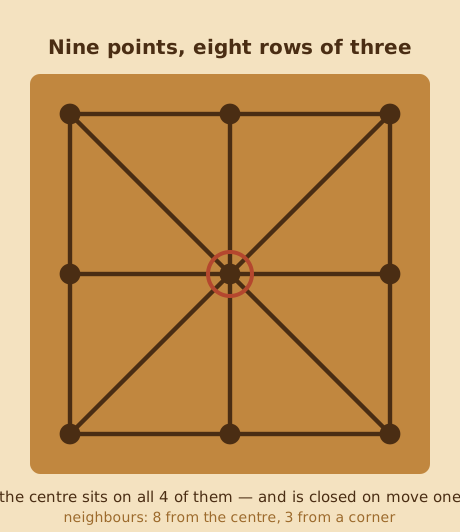
Nine points, and every line drawn: three rows, three columns, both diagonals. Eight rows of three — the winning lines of noughts and crosses, and for the same reason, since it is the same grid.
The centre is the busy point. It sits on four of the eight rows where a corner sits on three and an edge on two, and because all eight lines pass through it, it is a neighbour of every other point on the board. A man in the centre can slide anywhere; a man in a corner has three choices.
We solved the board, and it changed the rules
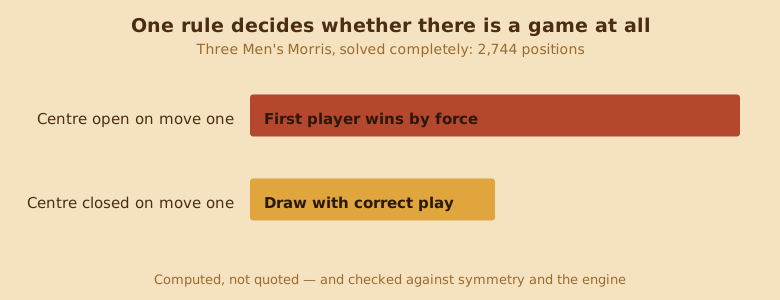
Many written rules for this game say the first player may not open in the centre. We wanted to know whether that mattered, so before building anything we computed it.
The game is small enough to solve outright. The sliding phase has 2,744 legal positions; working backwards from the ends gives every one of them a value, and the placing phase on top of that is a six-move tree. The answer:
- Centre open on move one — the first player wins by force.
- Centre closed on move one — the game is a draw with correct play.
So the restriction is not decoration. Without it there is nothing to play. Our board closes the centre on the first move and opens it immediately afterwards, and the status line says so rather than leaving you to wonder why the middle will not take your man.
Of the 2,744 sliding positions, 1,672 are won for whoever is to move, 528 are lost, and 544 are drawn. A position picked at random is far more often winnable than not — which is why the game feels sharp even though its starting position is level.
How we know the number is right
A figure like that is worth nothing if the program that produced it is wrong, so it was checked three ways:
- Against its own definition. For each of the 2,744 positions, the stored value must equal the best value available among its moves. No contradiction.
- Against symmetry. Rotating or mirroring a board cannot change who is winning. 5,488 pairs checked, no break.
- Against the game people actually play here. Both sides play perfectly using the solver's values, but on the engine that runs this page. The opening position comes out drawn, exactly as predicted.
A fourth attempt — a forward search with repetition detection — ran past its time limit and was abandoned. It was the wrong tool: with repetition, nothing can be remembered between branches.
How to play
Placing
Light places first, anywhere but the centre. After that first move the centre is open to either player. Take turns until all six men are down.
Sliding
With six men on nine points, three points are empty. A turn is moving one of your own men along a drawn line to an empty neighbouring point. There is no jumping and no flying — but a man in the centre borders everything, so it is never short of somewhere to go.
Winning
Three of your men in a row on a drawn line and the game ends at once. You can also win by leaving your opponent with no legal move at all, which takes some doing but does happen. Repeat the same position three times and it is a draw.
The trap that catches everyone once
Because nothing is captured, it is easy to think a strong-looking formation is safe. It is not — your opponent only has to complete their own row, and every man you move opens the point behind it. The commonest way to lose is to build a threat, watch it blocked, and slide the blocking man aside yourself.
Before you move, look at what the square you are leaving lets them do.
Where it sits in the family
| Points | Rows of three | Men | Capturing | |
|---|---|---|---|---|
| Three Men's Morris | 9 | 8 | 3 | none |
| Six Men's Morris | 16 | 8 | 6 | yes |
| Nine Men's Morris | 24 | 16 | 9 | yes |
| Twelve Men's Morris | 24 | 20 | 12 | yes |
| Morabaraba | 24 | 20 | 12 | yes |
It is the odd one out in the last column, and that single difference is what makes it a different game rather than a smaller one. All five run on the same rules engine here. There is a written guide to the morris variants, and a printable morris board that prints this one along with the rest.
Play a friend online
Choose With a friend online under the board and press Open a table. You get a four-character code — send it over, they type it in, and you are playing. There is a chat window built in. No account, no download, nothing to install on either side.