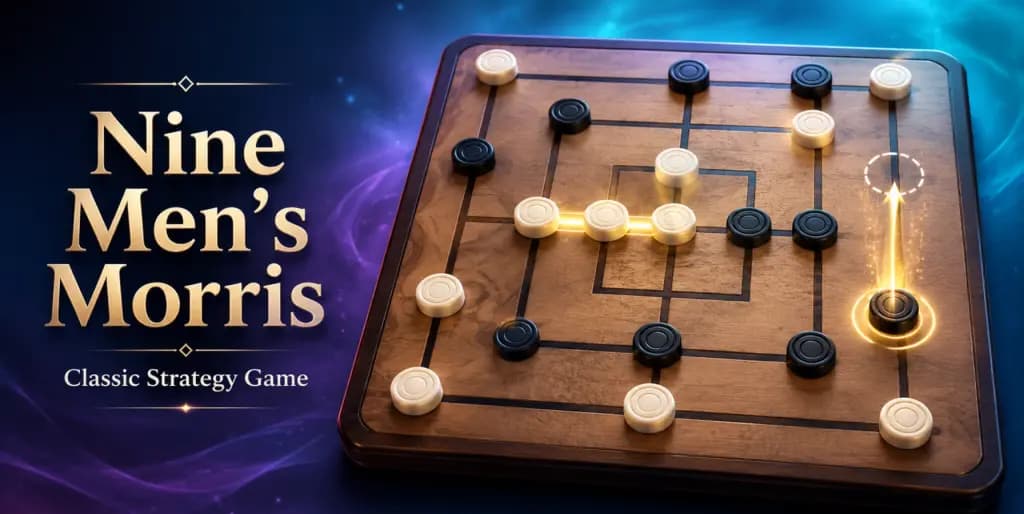
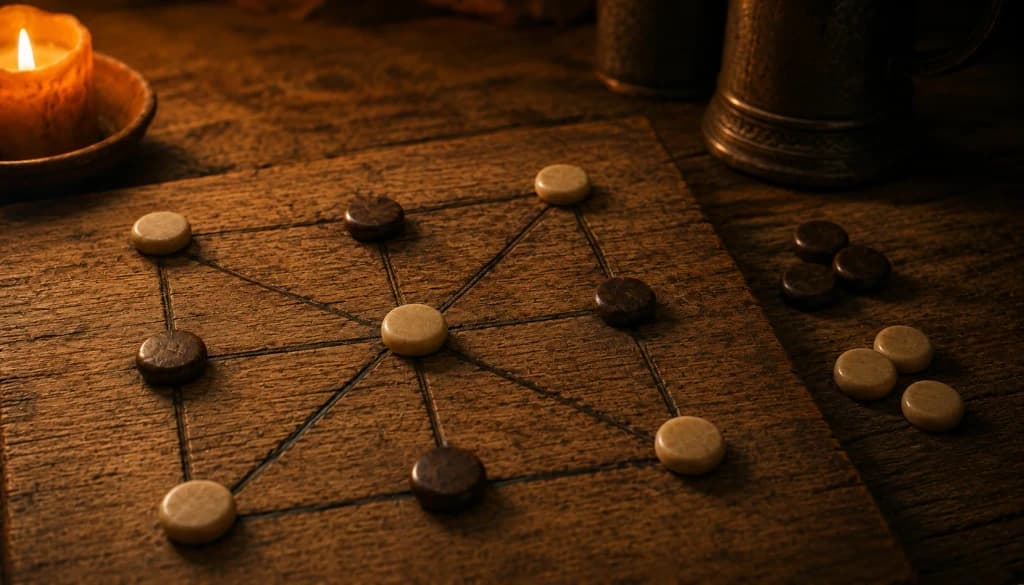
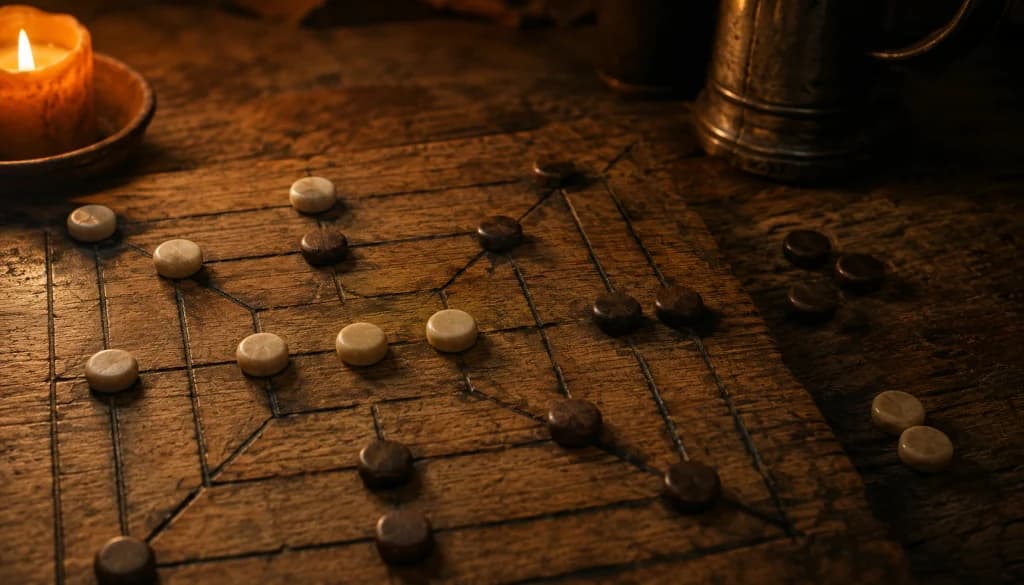
Six Men's Morris is the smallest board in the mill family and the quickest game in it. Two squares instead of three, six men a side instead of nine, and a rule missing at the end that changes how the whole thing is played. It is the version to teach someone with, and it is a good deal less forgiving than that makes it sound.
The board: two squares, sixteen points
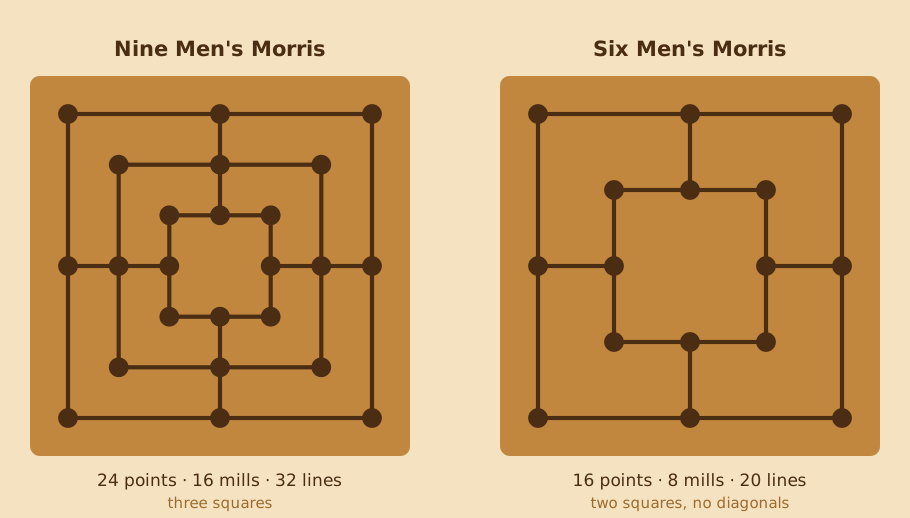
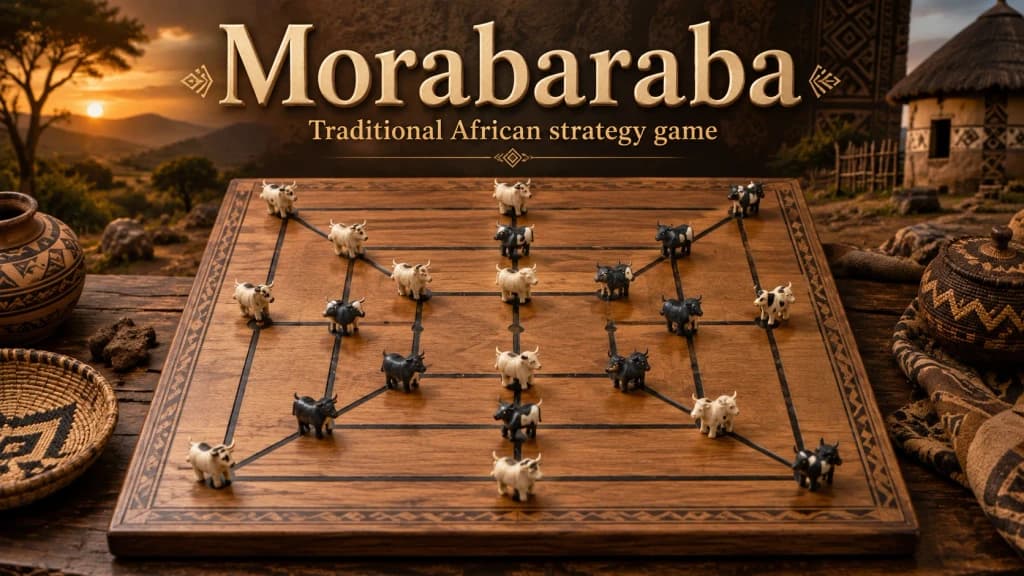
Take the mill board and remove the innermost square. What is left is sixteen points: two squares of eight, joined by a short line at the middle of each side. There are no diagonals — that is the other board, Morabaraba, and it goes the opposite way by adding four.
The board is small enough to hold in your head. Twelve men will occupy twelve of the sixteen points by the end of placing, so the moving phase begins with four empty points and almost nowhere to go.
Not every line can carry a mill
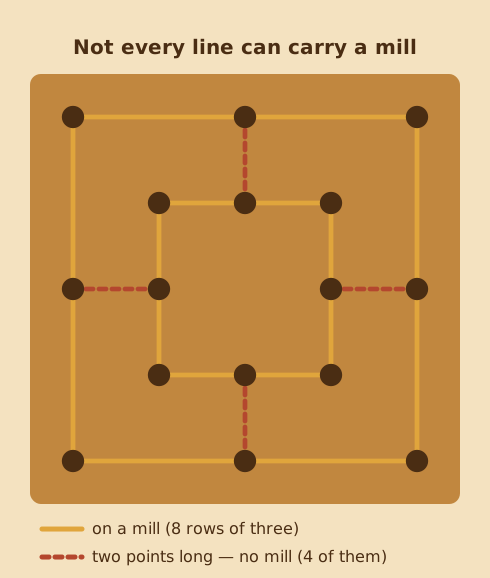
This is the one thing worth knowing before your first game. On the nine men's board, every drawn line is three points long and every one of them can hold a mill. Here that is not true. The four short pieces joining the outer square to the inner one are two points long, so no row of three ever runs along them.
The eight mills are the four sides of the outer square and the four sides of the inner square. Nothing else. A beginner spends their first game trying to build across the middle and cannot work out why it never counts.
How to play Six Men's Morris
Placing
Light places first. Take turns putting one man on any empty point until all six each are down. A mill made during placing takes straight away — you do not wait for the moving phase.
Making a mill and taking
Three men in a row on one of the eight mill lines lets you take one enemy man off the board.
- You may not take a man that is inside a mill — unless every one of theirs is inside one, in which case any of them may go.
- You may break your own mill and remake it next turn to take again. On a board this size, an open mill you can swing back and forth is close to decisive.
Moving
Once every man is placed, a turn is moving one man along a line to an empty neighbouring point. That includes the four connectors — they are perfectly good roads, they just cannot be mills.
There is no flying here
On the nine and twelve men's boards, a player reduced to three pieces may jump to any empty point. That rule does not exist in Six Men's Morris, and the reason is the board rather than tradition.
Count the neighbours. On the nine men's board four points have four neighbours each; here no point has more than three, and eight of the sixteen have only two. A cramped board with an escape hatch would be a different game — and a worse one, because the side that has been ground down would keep slipping away from a position it had already lost.
The practical effect: falling to three men is close to fatal, and a man shut in at a corner with both neighbours occupied is a man out of the game. Watch your mobility, not just your count.
Is Six Men's Morris a draw?
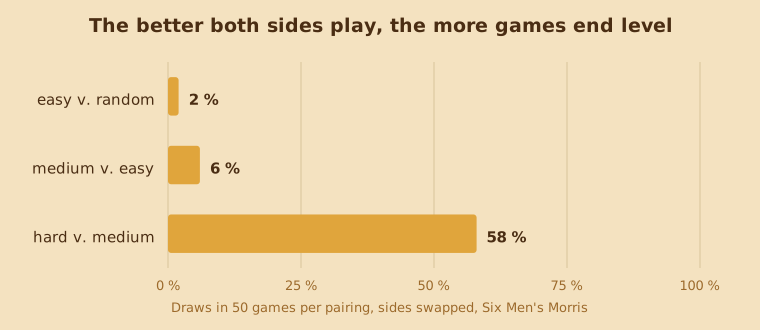
We measured our own three levels against each other, fifty games per pairing with the sides swapped so the first move does not decide it. The pattern is plain: 2% of games drawn at the bottom, 6% one rung up, and 58% at the top.
A draw rate that climbs with the strength of both sides is the usual signature of a game that is drawn with best play. We would not go further than that — this board has not been solved, and we have not solved it either. What the number does tell you is practical: against an opponent who knows the board, wins come from mistakes rather than from plans, and the way to win is to keep the position complicated enough that one gets made.
For comparison, a run of a thousand games with both sides playing at random ends drawn only 37% of the time. Random play is a poor guide to a real game, and here it points the wrong way.
The three levels
- Easy scores 87% against a player choosing at random — 43 wins, 1 draw, 6 losses in fifty. It sees mills and takes them, and misses most of what is coming.
- Medium scores 97% against easy, winning 47 of fifty and losing none. It plans a move or two ahead and rarely hands you a mill.
- Hard scores 63% against medium — and 58% of those games are drawn, with just four losses in fifty. It is beatable, but not by waiting for a blunder.
The levels differ in how much room they leave themselves, not in how deep they search. Searching deeper only makes an opponent unbeatable, which is no fun for anyone.
Six Men's Morris and its relatives
| Points | Mills | Men | Flying | |
|---|---|---|---|---|
| Six Men's Morris | 16 | 8 | 6 | no |
| Nine Men's Morris | 24 | 16 | 9 | yes |
| Morabaraba | 24 | 20 | 12 | yes |
All three run on the same rules engine here, which is why a mill means exactly the same thing on each of them. The differences above are the whole difference. If you want the full family, including the three and twelve men's boards, there is a written guide to the morris variants — and a printable morris board that prints any of the four to paper, with the men to cut out.
Play a friend online
Choose With a friend online under the board and press Open a table. You get a four-character code — send it over, they type it in, and you are playing. There is a chat window built in. No account, no download, nothing to install on either side.