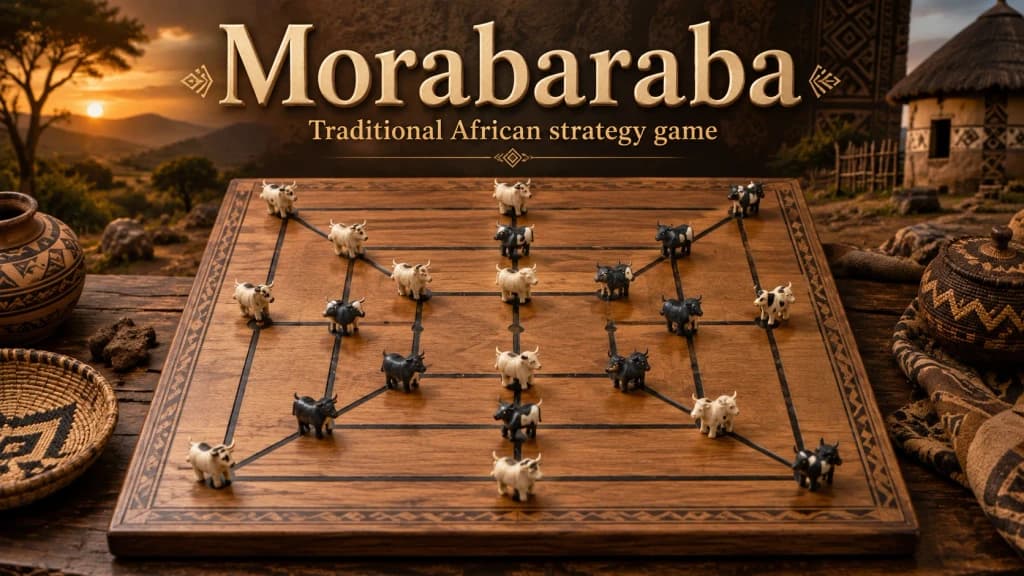
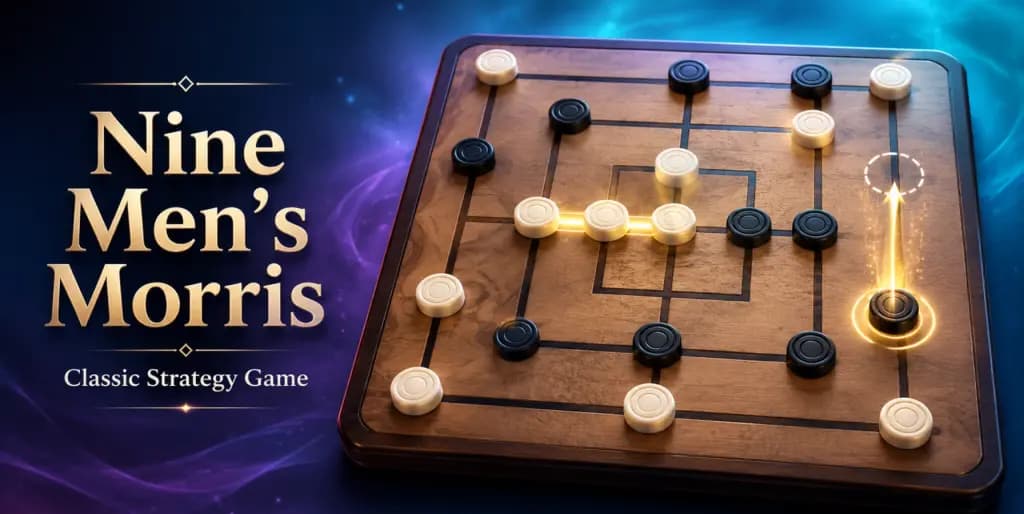
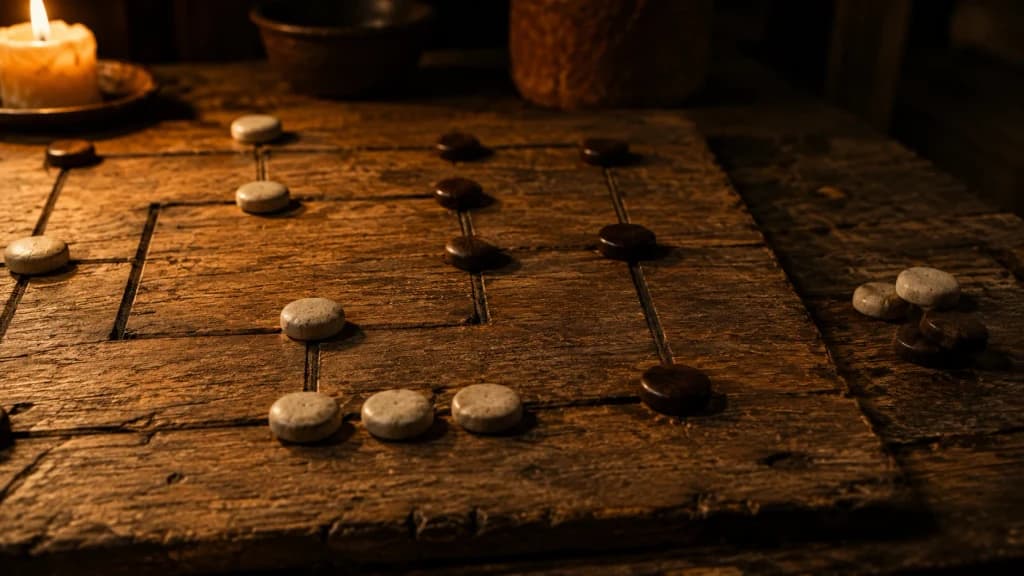
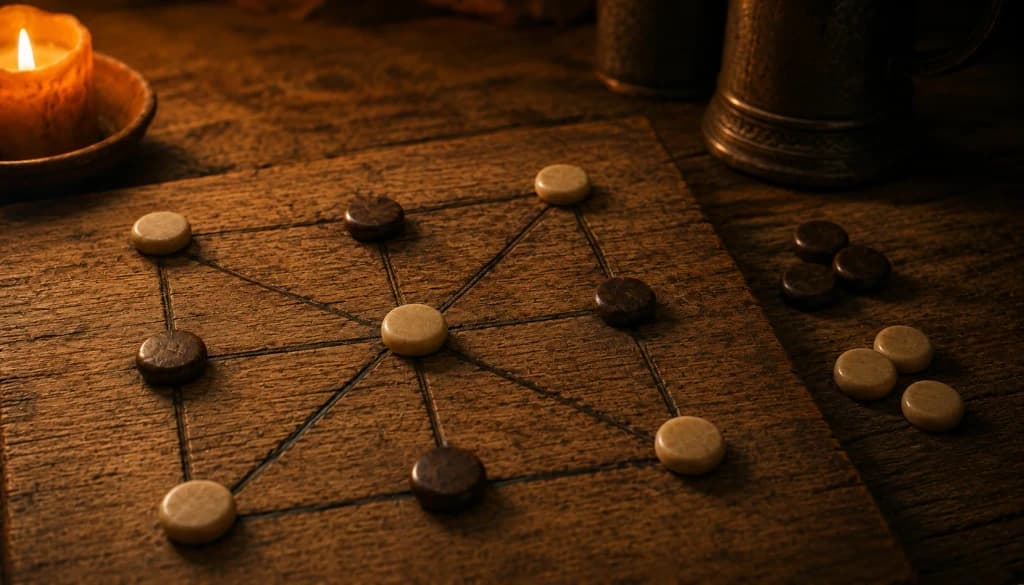
Twelve Men's Morris is the mill board with its corners joined. Four extra lines, three more men a side, and a board that is completely full by the time the last piece goes down. It is the same board that southern Africa plays as Morabaraba — and that is not an awkward coincidence to explain away, it is the most interesting thing about the game.
What the four diagonals do
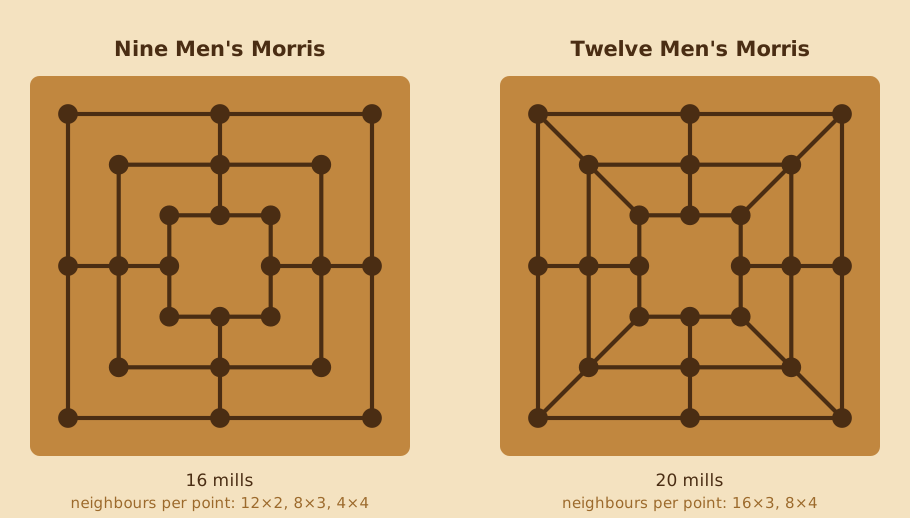
Both boards have the same twenty-four points. Adding the diagonals — corner to corner through all three squares — does more than add four mills:
- Sixteen of the twenty-four points now have three neighbours and eight have four. On the plain mill board, twelve points have only two.
- A corner sits on three lines instead of two. On a nine men's board the corners are where you put a man you have no plan for. Here they are prime.
- Twelve men each is exactly twenty-four. The board fills completely during placing, so unlike the nine men's game there is no comfortable moment where four points are still free and everything is still fluid.
Put together: threats arrive earlier, mills come faster, and there is less room to shuffle out of trouble.
The same board as Morabaraba — and the one rule that separates them
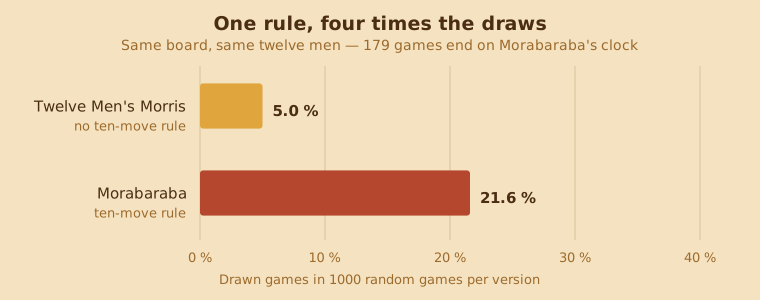
Southern Africa plays this board as Morabaraba, where the men are called cows — dikgomo — and it is an organised competitive sport in South Africa. Same twenty-four points, same four diagonals, same twelve pieces, same mills. Anyone who tells you they are different games is selling something.
Two rules do differ, and one of them turns out to matter a great deal:
- Morabaraba starts with dark. The European game starts with light. A convention, nothing more.
- Morabaraba has a clock on the endgame. If a player is down to three cows and nobody takes a piece for ten moves, the game is drawn. The European game has no such rule: a worn-down endgame runs until somebody makes progress, the position repeats three times, or fifty moves pass.
We measured what that second rule is worth. Running a thousand games of each version with both sides playing at random, Morabaraba drew 21.6% of them and this version 5.0%. The whole difference sits in one line of the breakdown: 179 of Morabaraba's games ended on that ten-move clock, and without it 166 of them went on to be decided by a capture instead.
So the clock is not a footnote. It is the rule that makes Morabaraba a drawish game in the endgame and this one a fight to the finish. If you want the version with the clock and the cows, it is right here.
How to play Twelve Men's Morris
Placing
Light places first. Take turns putting one man on any empty point until all twelve each are down. A mill made during placing takes straight away — you do not wait for the moving phase.
Making a mill and taking
Three men in a row on any drawn line is a mill, including on a diagonal, and it lets you take one enemy man off the board.
- You may not take a man inside a mill — unless every one of theirs is inside one, in which case any of them may go.
- You may break your own mill and remake it next turn to take again. A mill you can open and close is worth more than a mill that is stuck.
Moving and flying
Once every man is placed, a turn is moving one man along a line to an empty neighbouring point. Down to three men, a player may fly — move to any empty point rather than only a neighbour. That is the rule Six Men's Morris does without, and it is what keeps a three-against-many endgame from being over before it is over.
Where the game is won
The board fills. That single fact drives most of the strategy:
- Take corners early. With the diagonals they are on three lines each. On the plain mill board this advice would be wrong.
- Count neighbours, not men. A man with every neighbour occupied is a man you do not have. On a full board that happens constantly, and blockade is a real way to lose — it accounted for 61 of a thousand random games.
- An open mill beats a closed one. A mill you can swing open and shut takes a man every second turn. On a board this tight, that is usually the game.
The three levels, and how decisive this board is
We ran our own levels against each other, fifty games per pairing with the sides swapped. Two of the results are dull and the third is the interesting one:
- Easy beat a random player fifty games out of fifty. On a board where the diagonals make mills arrive this fast, even a shallow search is merciless.
- Medium beat easy fifty out of fifty.
- Hard scored only 57% against medium — 25 wins, 7 draws, 18 losses.
That last line is the character of the game. Compare Six Men's Morris, where the same program at the same two levels drew 58% of its games and lost just four of fifty. Here it drew 14% and lost eighteen. On the small board a strong opponent grinds towards a draw; on this one, somebody wins.
The levels differ in how much room they leave themselves rather than in how deep they search — searching deeper only makes an opponent unbeatable, which is nobody's idea of a game.
The morris family
| Points | Mills | Men | Flying | Endgame clock | |
|---|---|---|---|---|---|
| Six Men's Morris | 16 | 8 | 6 | no | no |
| Nine Men's Morris | 24 | 16 | 9 | yes | no |
| Twelve Men's Morris | 24 | 20 | 12 | yes | no |
| Morabaraba | 24 | 20 | 12 | yes | yes |
All four run on the same rules engine here, so a mill means exactly the same thing on every one of them and the table above is the whole difference. There is a written guide to the morris variants, and a printable morris board that prints any of the four to paper with the men to cut out.
Play a friend online
Choose With a friend online under the board and press Open a table. You get a four-character code — send it over, they type it in, and you are playing. There is a chat window built in. No account, no download, nothing to install on either side.