Seven flat pieces, cut from one square. Two large triangles, one medium, two small, a square and a parallelogram. Together they cover exactly the area of the square they came from, which has one consequence that shapes the whole puzzle: every silhouette needs all seven. There is never a spare piece and never a gap to leave.
What varies is only which way round they go — and that turns out to be harder than it sounds.
How to play tangram
Drag a piece onto the dark shape. It snaps to the corners of the shape and to the corners of the pieces already down, so a solution is either exact or not a solution at all. Tap a piece to pick it up, then Turn rotates it by 45°.
The rules, all three of them
Pieces may be turned to any angle. They may touch but never overlap, and they may not stick out of the outline. That is everything. No scoring, no clock, no limit on how long you take or how often you change your mind.
Why only the parallelogram can be flipped
Turn any of the other six pieces over and you get a shape you could have reached by rotating it instead — a right triangle looks the same from behind. The parallelogram does not. Its mirror image cannot be rotated back into the original, which makes it the only piece in the set with a handedness.
That is why it has a Flip button and nothing else does, and it is worth remembering when a shape looks one piece away from finished: sometimes the piece is right and only its handedness is wrong.
The seven tangram pieces and their sizes
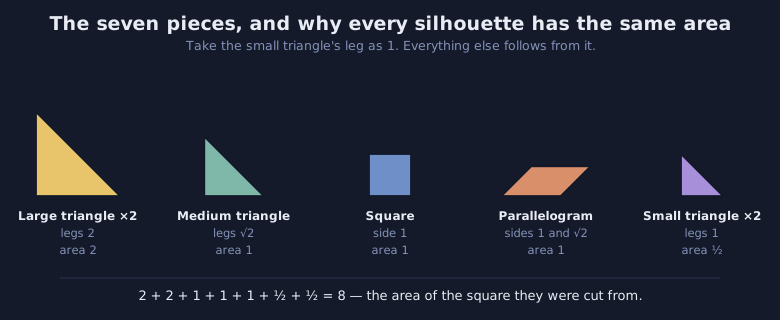
Nothing about the set is arbitrary. Every length is either 1, √2 or 2, and every angle is a multiple of 45°. That is also why the pieces fit together so willingly: any edge you place against another either matches it exactly or misses by a whole step.
It is the reason this version can be exact. Because the coordinates are always of the form a + b·√2, the whole game runs on pairs of whole numbers rather than decimals — so "solved" is a comparison of integers, with no tolerance that could either reject a correct solution or let a gap slip through.
How many tangram shapes are there?
Endlessly many if you count every outline — cats, boats, running figures, whatever anyone cares to draw. But if you ask for convex shapes, meaning shapes with no dents, the answer is a small number and a surprising one: thirteen.
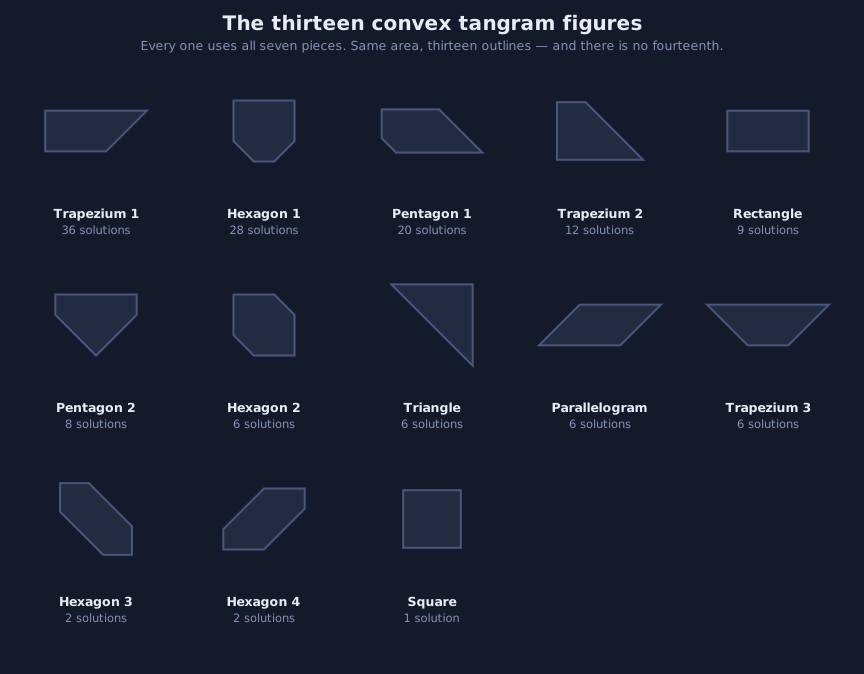
Fu Traing Wang and Chuan-Chih Hsiung proved that in 1942: one triangle, six quadrilaterals, two pentagons, four hexagons, and no fourteenth. We did not take the number on trust. Every convex outline the pieces could possibly make was enumerated, then each was tested for an exact cover with the seven pieces — and out came the same thirteen, in the same breakdown.
The first run gave twelve. The reason is worth admitting: we had capped how long an edge could be, on the reasoning that an area this small leaves no room for a long one. It does — one very flat quadrilateral has an edge half again as long as we allowed, and it was simply missing.
What is the solution to the tangram square?
There is one. Not one that is best, or one that is usual — one that exists.
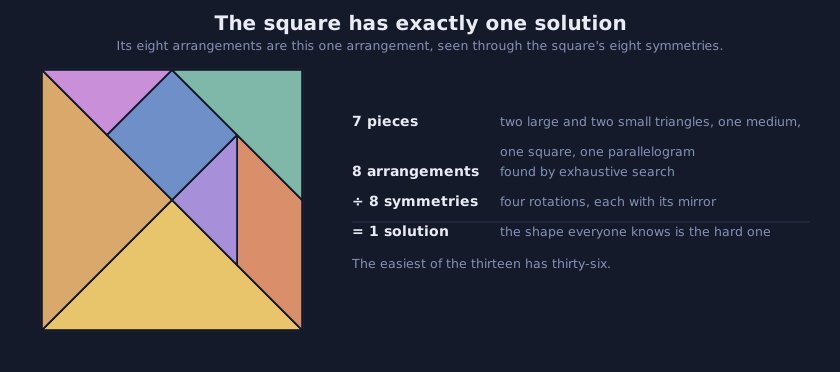
The search finds eight arrangements, which looks like eight ways to do it. But a square has eight symmetries — four rotations, each with its mirror — and folding the eight arrangements by those symmetries collapses them to a single one. Every solved tangram square you have ever seen is this arrangement, turned some way up.
That makes the most famous shape in the puzzle the least forgiving one on the list, and it is why the square is last here rather than first.
Which tangram shapes are hardest?
"Hard" is usually a matter of opinion. Here it is not, because the solutions can be counted: a shape with thirty-six ways to make it forgives a wrong turn, and a shape with one forgives nothing.
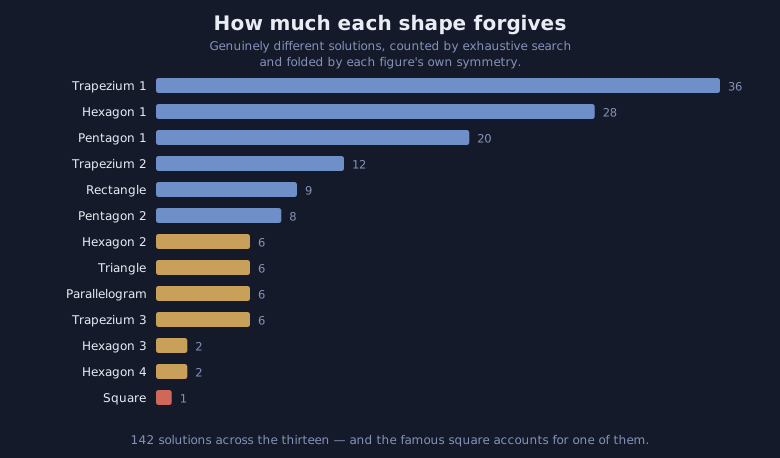
The order the shapes appear in on this page is that measurement, easiest first. Between the two ends sit the hexagons, which look intimidating and mostly are not — an outline with more corners gives the pieces more to hold on to.
Where does tangram come from?
The earliest printed reference is a Chinese book of 1813, and the puzzle was plainly older than that by then. It reached Europe and America around 1817 and became a genuine craze — puzzle books, imported sets, and the usual accusations of wasted time.
There is an older relative. A Japanese book of 1742, the Sei Shōnagon Chie no Ita, describes a seven-piece dissection puzzle close enough that some historians suspect a connection — seventy-one years before the first printed tangram. Its pieces are not identical, and it makes sixteen convex shapes rather than thirteen. Whether one puzzle led to the other is not settled, and anyone who tells you it is has gone past the evidence.
The longer version — why the puzzle is not ancient, not Egyptian and not named after a man called Tan, and what the 1818 craze actually looked like — is in the history of the tangram.
Play it on paper
Tangram is one of the few puzzles that loses nothing on paper — the pieces are straight-edged, they need no printing accuracy to speak of, and cutting your own set is a reasonable way to learn why the sizes are what they are.
If you like this one
Crates is the other puzzle here that rewards thinking a move ahead rather than trying things, and the 15 puzzle shares tangram's habit of looking simple until you count. If it is the mathematics you came for, peg solitaire has an argument that rules out twenty-eight of thirty-three endings before you move at all.