
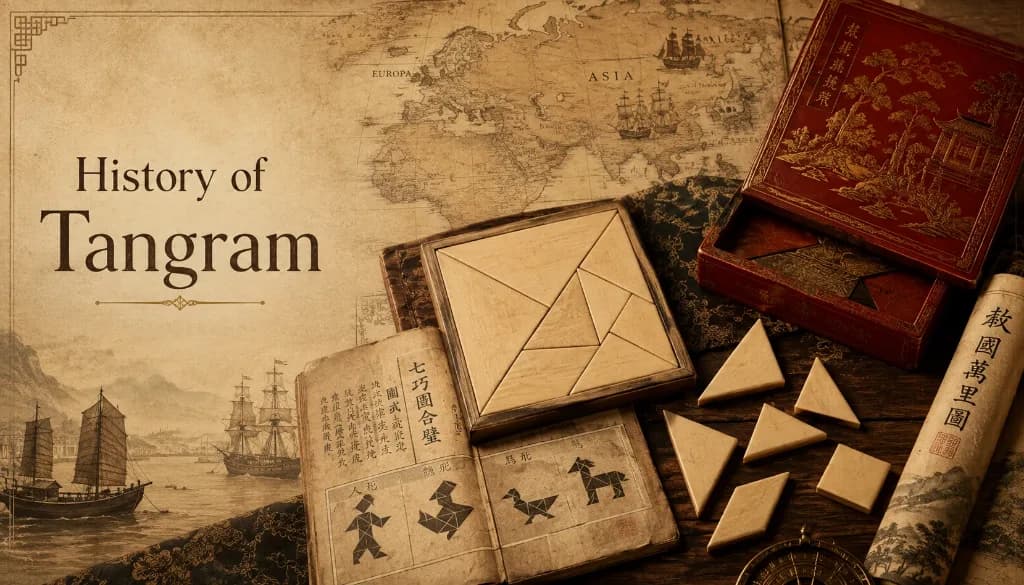
The tangram is usually introduced as ancient. Four thousand years old, invented by a man named Tan, brought from Egypt, known to Confucius — you will find all of those in print, some of them in books that ought to know better.
None of it survives contact with the record. What the record actually shows is a puzzle that appears suddenly, spreads absurdly fast, and turns out to be harder than anyone expected.
Who invented the tangram?
Nobody knows, and that is a real answer rather than a hedge. The earliest printed reference is a Chinese book of 1813, and the puzzle was clearly in circulation before then — a book of patterns is not how a puzzle begins, it is how a puzzle that already exists gets written down.
The story about Tan is an invention of the 1900s, and a traceable one: it was made up by Sam Loyd, the American puzzle writer, in The Eighth Book of Tan in 1903. He supplied four thousand years of history, a god named Tan, seven earlier books, and a connection to Pythagoras. It was a joke, and it was taken seriously for years.
It took until about 1910 to knock down, and the sentence that did it is worth quoting. Sir James Murray of the Oxford English Dictionary, writing after consulting Chinese scholars, reported that "the man Tan, the god Tan, and the Book of Tan are entirely unknown to Chinese literature, history or tradition." The story outlived its own debunking anyway, and you will still meet it.
How old is the tangram, really?
Two centuries, near enough. That is old for a puzzle and unremarkable for a game — the royal game of Ur is four and a half thousand, and senet older still. The tangram's reputation for antiquity comes from the invented story, not from anything on paper.
What is genuinely old is the idea. Cutting a square into pieces and reassembling them is a construction Chinese and Greek geometers both used, and a puzzle built out of that idea could have appeared at almost any point. It just did not appear, as far as anyone can show, until around 1800.
Is the Japanese puzzle older than the tangram?
This is the part that deserves more attention than it gets. In 1742, in Japan, a small book appeared under the pen name Ganreiken: Sei Shōnagon Chie no Ita — the ingenious pieces of Sei Shōnagon, named for a court lady who had been dead seven hundred years.
It describes a seven-piece dissection puzzle. Not the tangram — the pieces are cut differently, and the set behaves differently — but a puzzle of the same kind, seventy-one years before the first printed tangram.
Whether one led to the other is not settled, and the honest position is that nobody has the evidence either way. What is documented is that the Japanese set is the more expressive of the two: where the tangram makes thirteen convex shapes, the Sei Shōnagon pieces make sixteen. That count is Fox-Epstein and Uehara's, not ours — we could not get the exact piece set from a source we trust, so we did not recompute it and will not pretend otherwise.
Why did the tangram become a craze in Europe?
Because it travelled on trade ships out of China, and because it needs no instructions. Sets and pattern books reached Europe and America in the years after 1815, and the fashion peaked between then and about 1820 — there is a French caricature from 1818 mocking people for neglecting everything else over it, which is as reliable a sign as any that a craze is real rather than retrospective.
Then it did what fashions do, and settled into what it has been ever since: a thing in classrooms, a thing in nurseries, and occasionally a thing that mathematicians pick up and cannot put down.
What did mathematicians find in it?
The question they asked was not "what can you make" — that is endless — but "what can you make that is convex", meaning a shape with no dents. That question has an answer, and the answer is small.
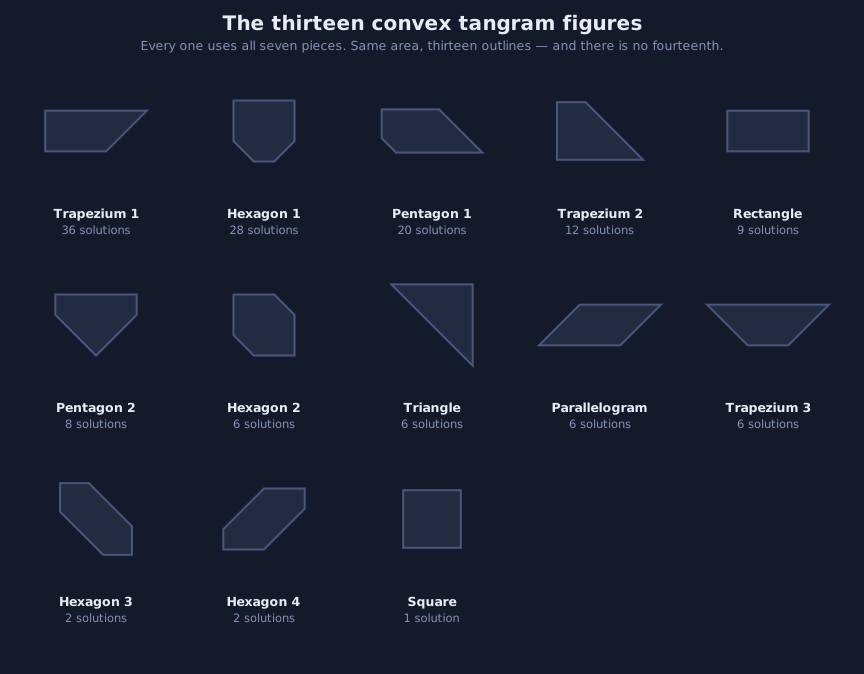
Thirteen. One triangle, six quadrilaterals, two pentagons, four hexagons. Fu Traing Wang and Chuan-Chih Hsiung proved it in 1942, and it is the kind of result that sounds like trivia until you try to prove it yourself — the difficulty is not finding thirteen, it is showing there is no fourteenth.
We ran the enumeration ourselves rather than copy the number, which is how we found the next thing.
Six shapes that look possible and are not
There are nineteen convex shapes with exactly the right area — that is, nineteen convex outlines you could tile with sixteen of the little half-squares the seven pieces are made of. Thirteen of them can be built. Six cannot.
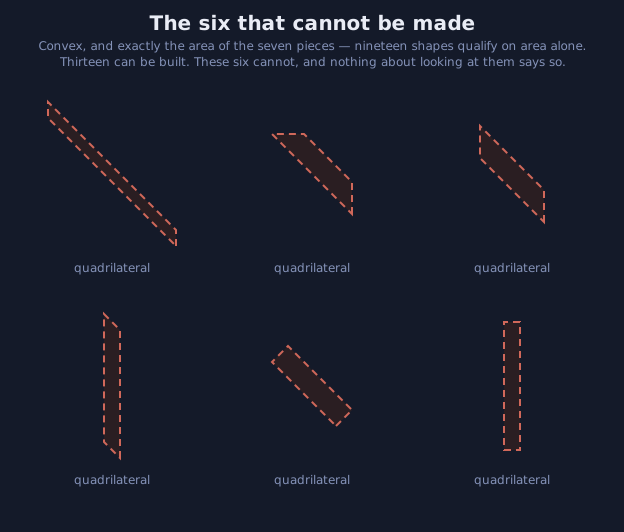
That gap is worth sitting with, because it is the practical warning behind every printed tangram puzzle book. A silhouette can have exactly the right area and still be impossible, and nothing about looking at it tells you which. If a puzzle in a book has no answer printed, you have no way of knowing whether you are failing or the puzzle is.
Why can't they be built?
We measured the six, and the pattern is clean but not the one we expected. Every one of the thirteen buildable shapes is at least 2 units wide at its narrowest — taking the small triangle's short side as 1. Every one of the six impossible ones is at most √2, about 1.41. Nothing falls in between.
The obvious explanation would be that the large triangle simply does not fit in a sliver that thin. That explanation is wrong, and it is worth saying so: a large triangle laid on its long edge is exactly √2 tall, so it fits a √2 strip perfectly well. Something subtler stops the other six pieces from filling in around it. We can show the boundary; we cannot yet show the reason.
Does the square have more than one solution?
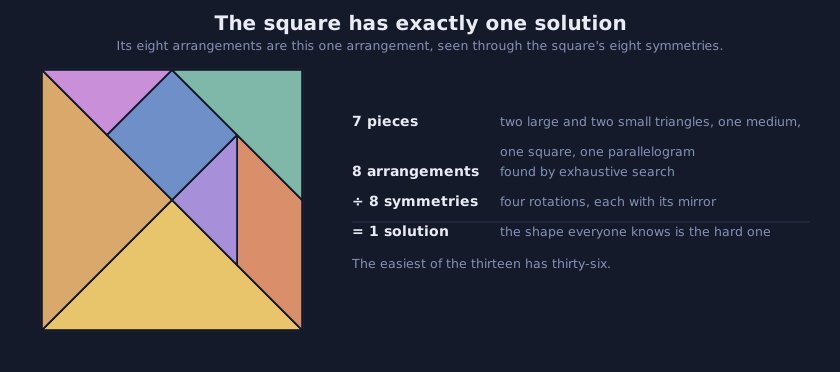
No — and this is the shape everybody starts with. Our search finds eight arrangements, but a square has eight symmetries, and folding the arrangements by those symmetries leaves exactly one. The easiest of the thirteen has thirty-six genuinely different solutions; the most famous has one.
That is a small corroboration of something written about the Japanese set: it is usually noted that Sei Shōnagon Chie no Ita can be squared in two distinct ways, unlike the tangram, which has one. We arrived at that one from the other direction, without using their number.
Where the puzzle stands now
It is a school object, mostly, and a rather good one — the area argument alone is worth a lesson. All seven pieces always, no spares, no gaps, because they were cut from one square and nothing was thrown away. Most of the frustration people feel with tangram comes from never having noticed that.
You can play it here with all thirteen convex shapes, ordered from the most forgiving to the square, or print a set and cut it out — the whole dissection can be folded rather than measured, which is how it was made at home for two hundred years.