
Print & Play
Printable Tangram
One sheet to cut the seven pieces from, and life-size puzzle sheets for all thirteen convex shapes. Everything is drawn to the same scale, so the pieces you cut out fit every sheet you print.
Paper
Size
The square prints 105 mm across. Every puzzle sheet uses the same scale, so the pieces you cut out fit all of them.
Sheets
Life-size puzzle sheets — lay the pieces straight onto them
Tangram — cut out the seven pieces
Cut along every line. Card stock lasts longer than paper, and the colours are there so you can tell the two large triangles apart while you work.
Square 105 mm — every puzzle sheet is drawn to match · playnook.io/games/tangram
The thirteen convex tangram shapes
These are all of them — there is no fourteenth. All thirteen have the same area, and the number under each is how many genuinely different ways there are to make it.
Trapezium 1
36 ways
Hexagon 1
28 ways
Pentagon 1
20 ways
Trapezium 2
12 ways
Rectangle
9 ways
Pentagon 2
8 ways
Hexagon 2
6 ways
Triangle
6 ways
Parallelogram
6 ways
Trapezium 3
6 ways
Hexagon 3
2 ways
Hexagon 4
2 ways
Square
1 way
Proved complete by Wang and Hsiung in 1942 — and recomputed for this sheet · playnook.io/games/tangram
Trapezium 136 different solutions
Life size for a 105 mm square — all seven pieces, no overlap, nothing sticking out · playnook.io/games/tangram
What you get
A cutting sheet with the square divided into its seven pieces, each in its own colour. A challenge sheet with all thirteen convex shapes on one page, small, with the number of solutions under each. And life-size puzzle sheets, one shape per page, drawn at exactly the size of the pieces you just cut out — so you lay the real pieces straight onto the outline instead of eyeballing it.
The colours are not decoration. Two of the seven pieces are large triangles and two are small, and telling them apart at a glance is most of what makes a paper set pleasant to use. They print in colour only because the sheet asks the browser explicitly — left to itself, a browser strips background colour out of anything it prints.
How to make a tangram out of paper
Print the cutting sheet, cut along every line, and you are finished. There is nothing to measure and nothing to glue. Two things are worth knowing before you start.
Use card, not paper, if it is for more than one afternoon
Ordinary printer paper works, but the sharp points of the triangles bend the first time somebody slides a piece across a table, and a bent point makes a piece look like it does not fit when it does. Card stock around 200 gsm solves it. Laminating is overkill unless it is going into a classroom.
Cut the long lines first
Scissors wander on short cuts. Take the diagonal first, then the line that splits that half, and only then the small pieces — each cut is easier when the sheet still has something to hold on to.
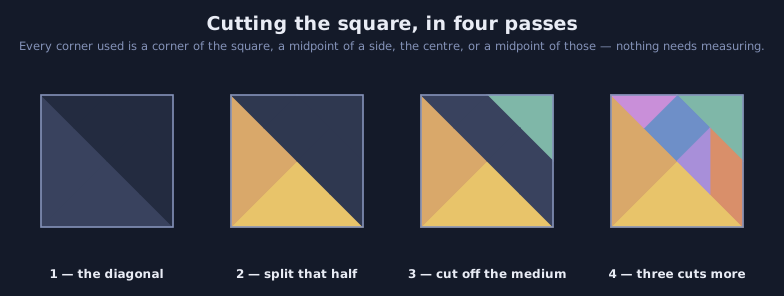
How do I cut a square into a tangram without measuring?
If you would rather cut your own square than print ours — a sheet of coloured card, a cereal box — you can, and you do not need a ruler for any of it. We checked every corner in the dissection: all ten of them are a corner of the square, the midpoint of one of its sides, the centre, or the midpoint of a line you have already drawn. Every one of those is a fold.
Fold the square corner to corner and you have the diagonal and the centre. Fold each side in half and you have the midpoints. Fold a drawn line in half and you have the last three points. That is the whole construction, and it is the reason tangram sets have been made at home for two centuries.
The seven pieces and their measurements
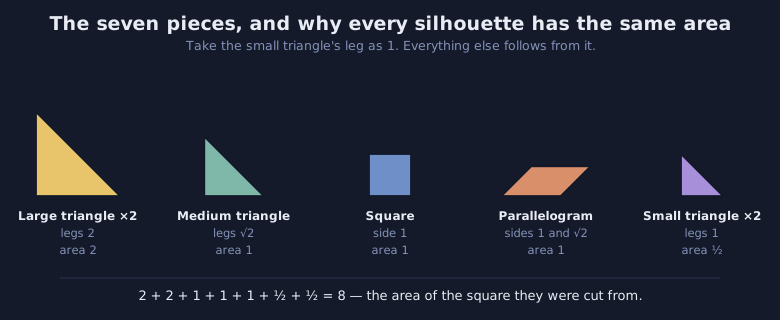
Every length in the set is 1, √2 or 2, and every angle is a multiple of 45°. The large triangle is four times the small one, not twice — which is the single most useful thing to know when a shape almost works and you are tempted to swap one for the other.
The areas add to eight. That is the consequence that runs through the whole puzzle: every silhouette the pieces can make has the same area, so every silhouette needs all seven, with nothing spare and no gap to leave.
Why there are exactly thirteen puzzle sheets
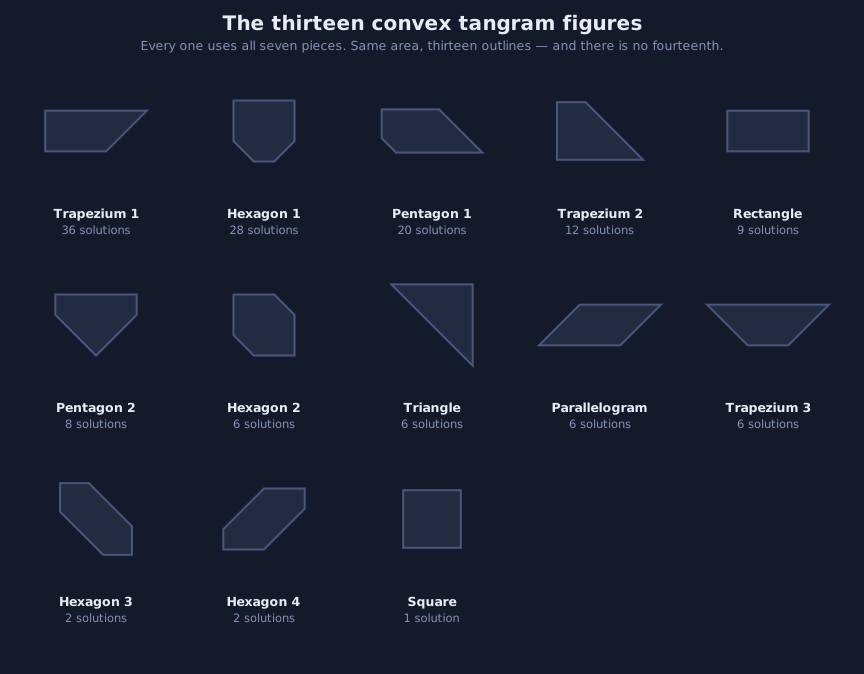
A shape is convex if it has no dents — stretch a rubber band around it and the band touches everywhere. Out of the endless silhouettes the seven pieces can make, exactly thirteen are convex. Wang and Hsiung proved it in 1942, and the sheets here are all of them: one triangle, six quadrilaterals, two pentagons, four hexagons.
We did not take the number on trust. Every convex outline the pieces could possibly make was enumerated and then tested for an exact cover, and the answer came out the same. It is worth saying because most printable tangram puzzles are drawings — and a drawn silhouette can have exactly the right area and still be impossible, with nothing about looking at it to tell you which. Every outline on these sheets was produced by a solver that actually placed the seven pieces.
Which shape should a beginner start with?
Not the square, whatever its reputation. We counted the solutions to each of the thirteen, and the square has exactly one — every arrangement that looks different is that one rotated or mirrored. The flattest trapezium has thirty-six genuinely different solutions and forgives almost any wrong turn. The sheets are listed easiest first for that reason.
What to do when a shape will not come out
Place the two large triangles first. They are half the area between them, so once they are down the puzzle is half solved, and there are usually only two or three places they can go. If everything fits but one piece, check the parallelogram: it is the only piece in the set whose mirror image cannot be reached by turning it, so sometimes the piece is right and only its handedness is wrong.
Printing it so the pieces actually fit
One setting matters more than all the rest: turn page scaling off. Set the print dialog to 100%, not “fit to page”. Every sheet here is drawn from a single number — the width of the square in millimetres — and if the printer shrinks one sheet to fit its margins and not another, the pieces will be a few millimetres out and nothing will line up.
The size control offers 90, 105 and as large as the paper allows. Large fills an A4 landscape page with the widest of the thirteen shapes and leaves a finger's width of margin; on US Letter it is a little smaller because the page is. If you are printing for a group, the small size lets two sets fit an envelope.
Using the sheets in a classroom
The challenge sheet — all thirteen on one page — works as a worksheet on its own: it is a complete, finite list, so a class can be told to find them all and there is a real end to it. The number under each shape gives you a difficulty order that is measured rather than guessed, which is unusual for a puzzle handout.
The one thing worth saying out loud to a class is the area argument. All seven pieces always, no spares, no gaps — because the pieces were cut from one square and nothing was thrown away. Most of the frustration in tangram comes from not having noticed that.
Play it on screen first
The tangram game has the same thirteen shapes with pieces that snap to corners, which makes it a quicker way to learn what fits where before committing scissors to card. It also has a hint that places one piece at a time.
If you like this sort of thing on paper, the peg solitaire board needs nothing but coins, and the paper games pack covers the ones that need only a pencil. On screen, Crates and the 15 puzzle are the closest neighbours, and the puzzle category has the rest.