Fourteen flat pieces, cut from a square. Put them back into a square.
That is the entire puzzle, and it has been the entire puzzle since the third century BC, when Archimedes wrote a treatise about it. Only fragments survive — the text was scraped off its parchment in the Middle Ages and written over with prayers, and what is left of it was read with X-rays in the 2000s.
What makes it worth playing is not the difficulty. It is the number.
How many ways can the Ostomachion be solved?
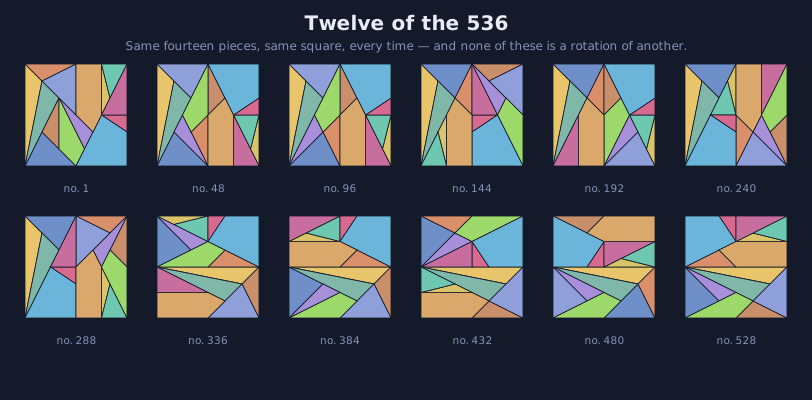
536. Not one solution, not a handful — five hundred and thirty-six genuinely different ways to make the same square out of the same fourteen pieces.
That number is recent. Bill Cutler settled it by exhaustive computer search in 2003, more than two thousand years after the question was probably first asked. We ran the search again for this page rather than copy the figure, and got the same answer twice over — which is also how we know the pieces on this page are the right ones.
How to play the Ostomachion
Drag a piece onto the square; it snaps to the grid, so it is either on a legal spot or obviously not. Tap a piece to select it, then Turn rotates it by 90° and Flip turns it over. On a keyboard that is R and E to turn and F to flip. Nothing is timed and nothing can be lost.
Start with the awkward pieces, not the big ones
The instinct is to place the large piece first because it takes up the most room. It is the wrong instinct here. Two of the fourteen have area 3 and are long thin slivers, and a sliver fits almost nowhere — it needs a corner or a seam of exactly the right angle. Place those two early, while the square is still open, and the rest of the puzzle arranges itself around them. Leave them until last and you will almost always find that the only gaps left are the wrong shape.
The second habit worth having: work from the edges inwards. Ten of the fourteen have a flat side of length four or more that wants to lie against the border of the square — nine of length six, and one of a full twelve, which can only be the left or right edge. Committing those removes a great deal of the search before it starts.
What this game actually asks of you
Not to solve the square. To solve it again, differently.
Every time you complete it, the page works out which of the 536 you have built and whether you have had that one before, and keeps the list. One is an afternoon. A dozen is a habit. Nobody gets all 536, and the counter is honest about that.
Turning it round is not a new solution
This is the part that has to be right or the whole counter is theatre. Before your arrangement is compared with the list it is folded through the square's own eight symmetries — four rotations, each with its mirror — and through the swap of each pair of identical pieces. Only then is it looked up.
So a finished square you rotate is the same solution, and it says so.
Why 536 and not 17,152?
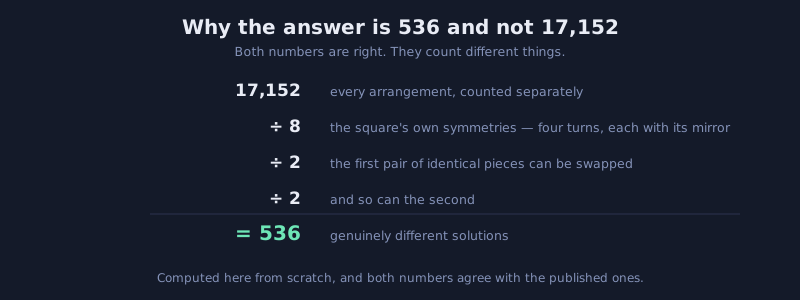
You will meet both numbers. They are both right.
17,152 counts every arrangement separately — each of the eight ways a solution can sit in the square, and each of the four ways the two pairs of identical pieces can be swapped. 536 folds all of that away. 536 × 8 × 2 × 2 = 17,152, and that factor of 32 is the whole difference.
Our search produced 4,288 arrangements with the identical pieces treated as interchangeable, which is 17,152 ÷ 4, and 536 after folding by symmetry. Getting both published numbers out of one run is what convinced us the piece set was correct.
The fourteen pieces
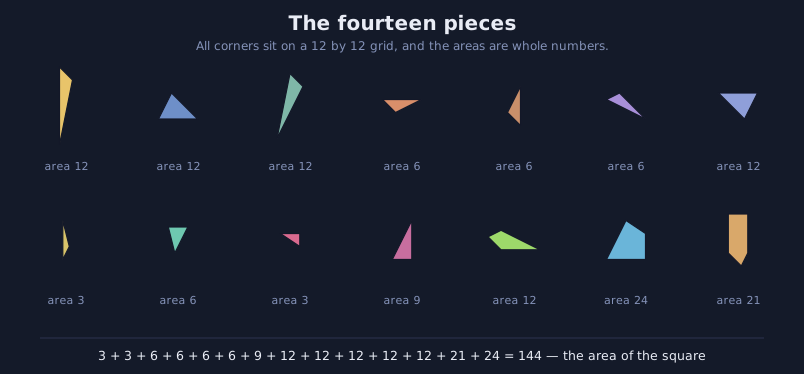
There is nothing decorative about the cut. Every corner of every piece sits on a 12 × 12 grid, which is why the areas come out as whole numbers: 3, 3, 6, 6, 6, 6, 9, 12, 12, 12, 12, 12, 21, 24 — adding to 144, the area of the square.
That grid is also what makes the game exact. Pieces turn in quarter turns and land on grid points, so there is no rounding anywhere and a finished square is either finished or not.
Two of the fourteen are duplicates of two others. It is a small detail with a large consequence: it is the reason the honest count is 536 rather than 2,144.
Is it harder than tangram?
Harder to finish, and much easier to finish by accident.
Fourteen pieces against tangram's seven is a far bigger search, and several of the Ostomachion pieces are thin slivers with only one or two places they can go. But there is only one target shape and 536 routes into it. In tangram most silhouettes have a handful of solutions, and some have none at all — a hopeful arrangement there usually fails, and here it quite often works.
Where the puzzle comes from
The name is Greek and roughly means bone-fight — the pieces were ivory or bone. The Latin name, Loculus Archimedius, just means Archimedes' little box.
What survives of the treatise is a few sentences in the Archimedes Palimpsest, a prayer book written over a scraped-clean copy of his work. Read under X-ray fluorescence at Stanford in the 2000s, the fragments read as though the question being asked was how many arrangements exist — not whether one does. If that reading is right, this is the oldest known problem in combinatorics, and the answer took twenty-three centuries.
If you like this one
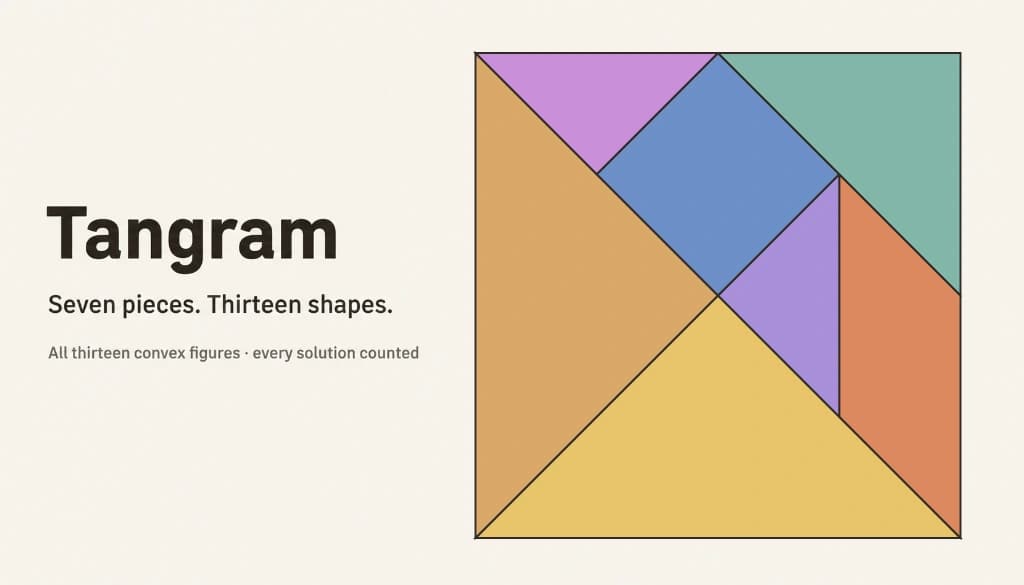
Tangram is the same idea with seven pieces and endless target shapes rather than one, and it has its own countable fact — exactly thirteen convex figures. Crates and the 15 puzzle are the other puzzles here, and the rest sit in puzzle games.
The 536, and how they were counted
Archimedes and the number 536 walks through the whole computation: the 4,288 tilings the search finds, how symmetry and the swap of two identical pieces fold them down to the 536 that Cutler published in 2003, and one thing that does not seem to be written down anywhere — how strongly each individual piece is pinned, which turns out to have nothing to do with its area.
The search runs on integer coordinates only, so every test is exact: 7,072 candidate placements, 1,640,374 nodes, 135 seconds. All 536 tilings are published as ostomachion-536.json if you would rather check the arithmetic than take our word for it.