
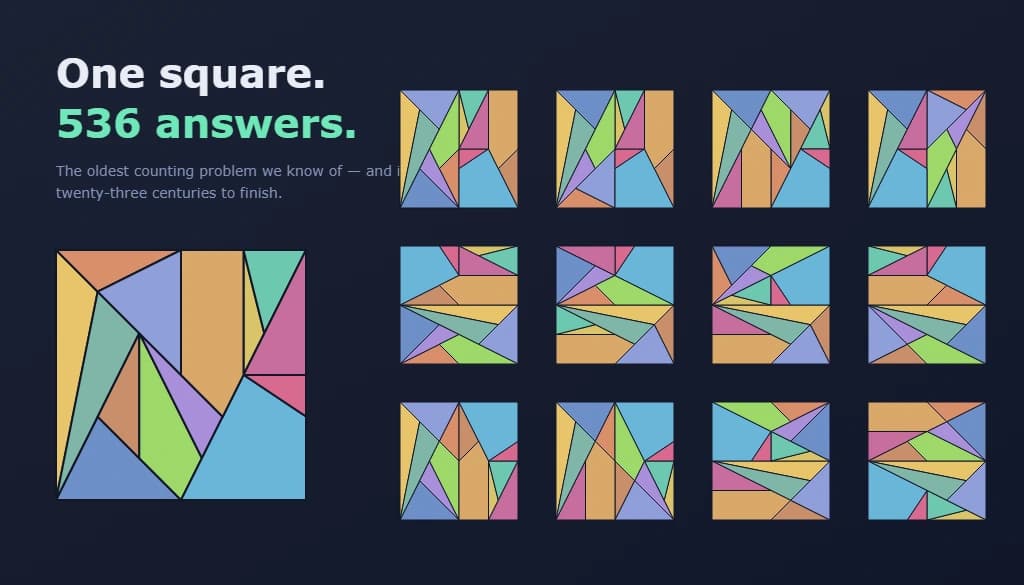
Around 250 BC, Archimedes wrote a treatise about a puzzle. Fourteen flat pieces cut from a square; put them back into a square. It is not a hard puzzle — he could obviously do it, and so can you.
The question he seems to have been asking was different, and much stranger for its time. Not can it be done. In how many ways.
The answer is 536, and it arrived in 2003.
What is the Ostomachion?
A square divided into fourteen pieces by straight cuts, all of whose corners sit on a 12 × 12 grid. It is also called the Stomachion, and in Latin the Loculus Archimedius — Archimedes' little box. The Greek name means something like bone-fight, which is either about the ivory the pieces were made from or about the argument that followed.
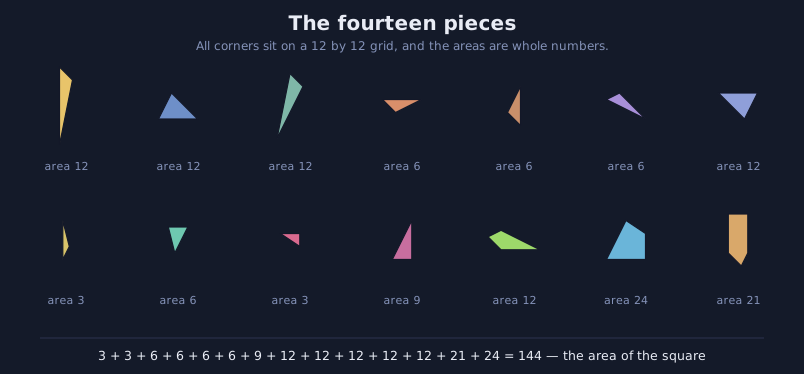
Two pairs among the fourteen are identical to each other. That detail matters more than it looks, and we will come back to it.
How do we know what Archimedes wrote?
Barely, and by luck.
His treatise survives in one place: a palimpsest. A tenth-century copy of several works of Archimedes was scraped clean in the thirteenth century and written over with a Christian prayer book — parchment was expensive and mathematics was not what the monastery needed. The original text is still faintly there, underneath.
The book resurfaced, was studied by Johan Ludvig Heiberg in 1906, disappeared again, and came up at auction on 29 October 1998. From 1999 the Walters Art Museum in Baltimore ran a twelve-year project on it, with more than eighty conservators, imagers and classicists working to read what was underneath.
Of the Stomachion treatise, what came back is a fragment. It is short enough that its meaning is arguable, and arguable it has been.
Was Archimedes really counting?
This is the interesting part, and the honest answer involves an "if".
For a long time the assumption was that the Stomachion was a shape-making diversion — the sort of thing tangram became, animals and ships out of a few pieces. The reading that changed that is Reviel Netz's: that the fragment is not about making pictures at all, but about how many ways the fourteen pieces can form the square. It is set out in Netz, Acerbi and Wilson, Towards a Reconstruction of Archimedes' Stomachion, in the journal SCIAMVS 5 (2004), and in The Archimedes Codex (Netz and Noel, 2007) for the general reader.
If that reading is right — and it is the prevailing one, not a certainty — then this is the oldest known problem in combinatorics, by something like two thousand years. Not "find an arrangement" but "count the arrangements", which is a different kind of question and a much more modern-sounding one.
What Archimedes concluded, if he concluded anything, went with the rest of the text.
Why did the answer take until 2003?
Because counting them by hand is miserable and nobody had a good reason to.
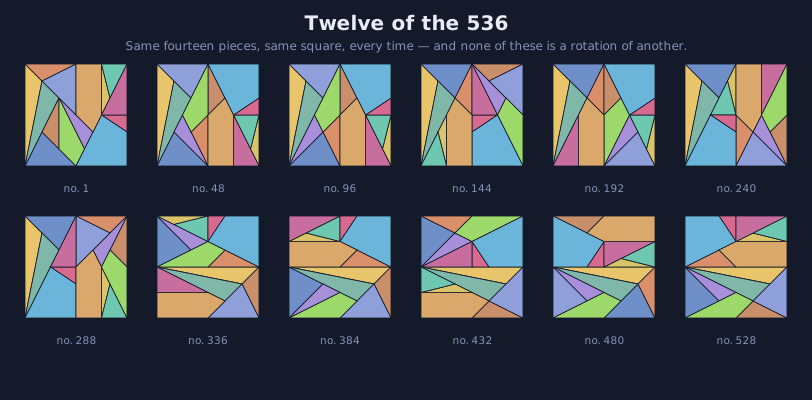
Bill Cutler settled it in November 2003 with an exhaustive computer search: 536 genuinely different solutions, counting arrangements that differ only by turning or mirroring the whole square as the same one. The result was reported by Netz and Noel in The Archimedes Codex and has stood since.
Twenty-three centuries between the question and the answer, and the answer took a computer a few hours.
Why do you also see the number 17,152?
Because both are right, and they count different things.
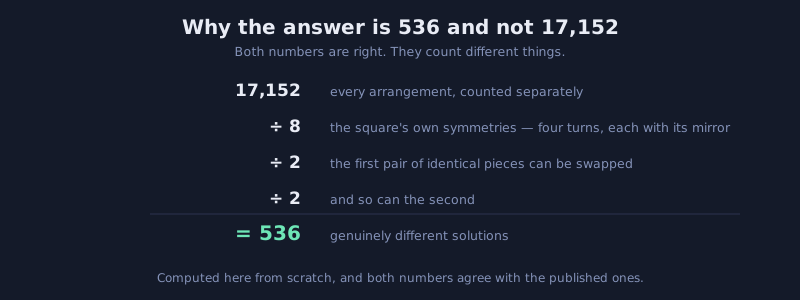
17,152 counts every arrangement separately: each of the eight ways a solution can sit in the square, and each of the four ways the two pairs of identical pieces can be exchanged. Fold all of that away and you have 536.
536 × 8 × 2 × 2 = 17,152. That is the whole disagreement, and it is not one.
We re-ran the search for this page rather than take the figure on faith, and getting both numbers out of one run is what told us we had the right pieces. Our search produced 4,288 arrangements with the identical pieces treated as interchangeable — which is 17,152 ÷ 4 — and 536 after folding by symmetry. The areas of a wrong piece set might match by luck. Both of those numbers would not.
How the search actually works
Every corner of every piece sits on the 12 × 12 grid, so all coordinates are integers and every test is exact. There is no floating point anywhere in the search, which means there is no tolerance to tune and no near-miss to argue about.
The search itself is plain backtracking with one useful restriction: take the first still-uncovered point of the square, and try only placements that cover that point. Across the fourteen pieces there are 7,072 candidate placements in total. The run visits 1,640,374 nodes and finishes in 135 seconds — where Cutler needed hours in 2003, which is mostly a statement about twenty years of hardware rather than about the algorithm.
Coverage is tracked on a lattice of points at one third of the small unit. That is bookkeeping for the search, not the criterion for a solution: because the fourteen areas sum to exactly 144, any complete non-overlapping placement inside the square is necessarily a tiling.
One detail is worth spelling out, because it is where this kind of program usually goes quietly wrong. If a lattice point falls exactly on the edge of a piece, it belongs to two pieces or to none, and the whole count is off by an amount nobody would notice. These edges have rational slopes and do hit lattice points. So the lattice offset is shifted until provably no point lies on any edge of any possible placement — at offset (1, 7), zero edge hits out of 1,296 points. On top of that, 400 of the finished solutions were re-checked with exact polygon intersection: no overlaps.
The numbers and all 536 tilings are published as ostomachion-536.json — the piece set with its areas, the run's figures, and every tiling as fourteen corner lists on the grid. It is written by the same solver this section describes, so it cannot drift away from the article.
Which pieces are actually free to move?
Here is something we have not seen anywhere else, because it only falls out once you have all the solutions in front of you.
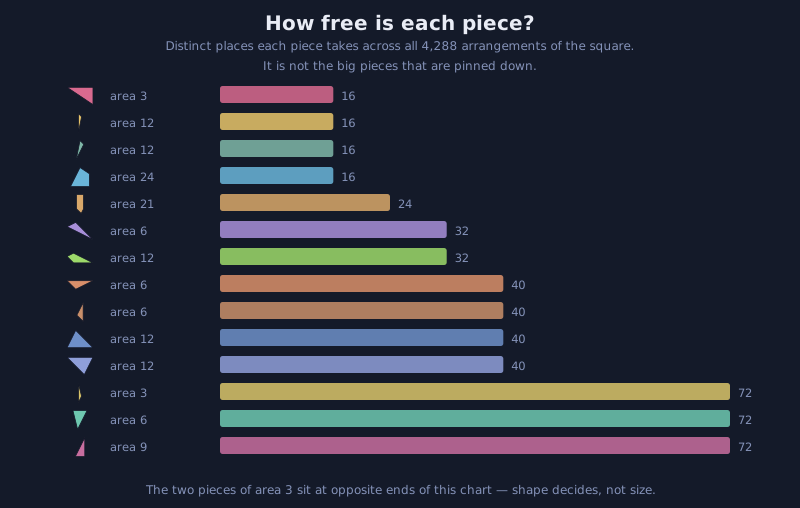
The freedom is wildly uneven. Four of the fourteen only ever appear in 16 distinct positions across every arrangement there is; three of them appear in 72. And the split has nothing to do with size — the largest piece of all, area 24, is among the most constrained, while a sliver of area 3 is among the freest. Its twin, the other piece of area 3, is among the most pinned down.
Shape decides, not size. Which is also the practical advice for playing it: place the awkward pieces while the square is still open, not the big ones.
One number we had to throw away
The first version of that chart said two pieces appear in only two positions, which would have been a far more dramatic finding. It was an artefact of our own bookkeeping.
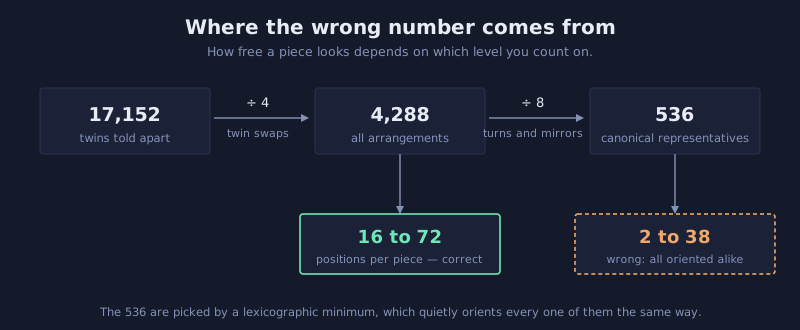
The 536 stored solutions are canonical representatives, and picking a representative means choosing one of the eight ways a tiling can sit in the square. We chose it by lexicographic minimum, which is a perfectly good rule and quietly orients every solution the same way. Ask that collection how many positions a piece takes and it answers honestly — about the collection. Counted over all 4,288 arrangements instead, the real range is 16 to 72.
It is the sort of mistake that produces a better headline than the truth, which is exactly why it is worth saying out loud. If you take the published data and count per piece yourself, note that the tilings in it are the canonical 536 — the same trap is waiting there, and the file says so.
Play it
The Ostomachion is here with all 536 built in. Complete the square and it tells you which of them you made and whether you had it already — folded through the eight symmetries and the twin swaps, so turning your finished square round does not earn you a second one.
If seven pieces sound more manageable, tangram has its own countable fact: out of every silhouette its pieces can make, exactly thirteen are convex, and we counted those too. Its history is worth the detour as well — the puzzle is two thousand years younger than this one and gets called ancient just as often.