
Most people teaching a child chess are not good at chess. They know how the pieces move, they have a vague memory of castling, and they would lose to anyone who owns a chess book. Then a seven-year-old asks what the horse does and suddenly they are the world authority in the room.
This guide is written for exactly that situation. You do not need to be good at chess to teach it well — you need an order to teach things in, permission to skip the parts that overwhelm, and something to police the rules while you concentrate on the child.
When is a child ready?
Somewhere around five is when most children can hold the basics, and many sit down happily at four if you start with a piece or two rather than the whole army. But age is the wrong measure. The real signals are simpler: can they take turns without it ending in tears, and can they sit with one activity for ten minutes?
If yes, they are ready for some chess. Not for a full game — we will come back to that.
And a note in the other direction, since it is rarely said out loud: the evidence that chess makes children better at maths or "smarter" in general is much thinner than the marketing around junior chess suggests. Teach it because it is a wonderful game that you can play together for the next forty years. That reason is sufficient.
Teach the pieces in this order: rook, bishop, queen, king, knight, pawn
This is the single most useful thing in this article, and it surprises most parents, because it is almost exactly the reverse of how the pieces are arranged in people's heads.
- Rook. Up, down, left, right. A child already understands this movement from every board game they have played. Start here.
- Bishop. The same idea rotated: diagonals only. Teach the pair together — one bishop lives on light squares forever, one on dark. Children find that fact delightful.
- Queen. Now she is easy: "the rook and the bishop combined." Introduced third, she takes ten seconds. Introduced first, she is a monster with six rules.
- King. Same directions as the queen, one square at a time. Also the moment to explain that the king is never actually captured — he just runs out of escapes.
- Knight. The famous one, and the one to be patient with. Skip "L-shape" if it does not land and use this instead: one square straight, then one diagonally outwards. Or let them see it on screen, which is the fastest teacher there is.
- Pawn. Last, and not by accident. The pawn is the most complicated piece on the board: it moves one way, captures a different way, moves two squares but only from home, promotes into another piece entirely, and has en passant, a rule that adults argue about on the internet. Leave en passant out of the first month completely.
One piece per sitting is a perfectly good pace. There is no prize for finishing the set in an afternoon.
Do not start with a whole game
A full game asks a beginner to juggle six movement patterns, turn order, captures, check, checkmate, piece values and a plan — simultaneously. That is why first games so often end with a bored child and a parent explaining that you cannot move the bishop like that.
The fix used by chess teachers everywhere is to play games that are not chess yet:
- Pawn Wars. Eight pawns each on their starting rows, nothing else. First player to get a pawn to the far side wins; you also win if your opponent has no legal move. It teaches forward movement, diagonal capture, blocking, promotion and simple planning, all with one piece type.
- Rooks only. Two rooks and a king each. Suddenly the board is readable, and captures become obvious.
- Knight tours. Put a knight on a corner and see how few hops it takes to reach the opposite corner. No opponent, no losing, just the movement drilled into the hand.
A practical note about doing these on a screen: our chess game — like most browser chess — always starts from the full position, so mini-games belong on a real board where you can simply put out the pieces you want. If you do not have one to hand, the printable boards in our tools section will get you through a rainy afternoon.
The first checkmate to teach
Teach the two-rook checkmate, sometimes called the ladder or staircase mate: two rooks walk the lonely king backwards, one rank at a time, until he falls off the edge of the board. It is visual, it repeats, and a child can execute it without understanding a single thing about strategy — which is exactly what you want their first taste of "winning on purpose" to feel like.
What not to teach first: the four-move checkmate. Every child discovers Scholar's Mate eventually and it feels like a magic trick, but as a taught opening it is a trap in both directions. It works twice, then it stops working forever, and the habit it leaves behind — queen out early, hunting one cheap threat — is precisely the habit their next opponent will punish.
Where a screen genuinely helps
The reason to teach with a browser game alongside a real board is not convenience. It is that the software takes over the job you are worst at — being a rules referee — and leaves you the job you are actually good at, which is being the encouraging adult.
Four things in our chess game do that work:
| Feature | What it does for the lesson |
|---|---|
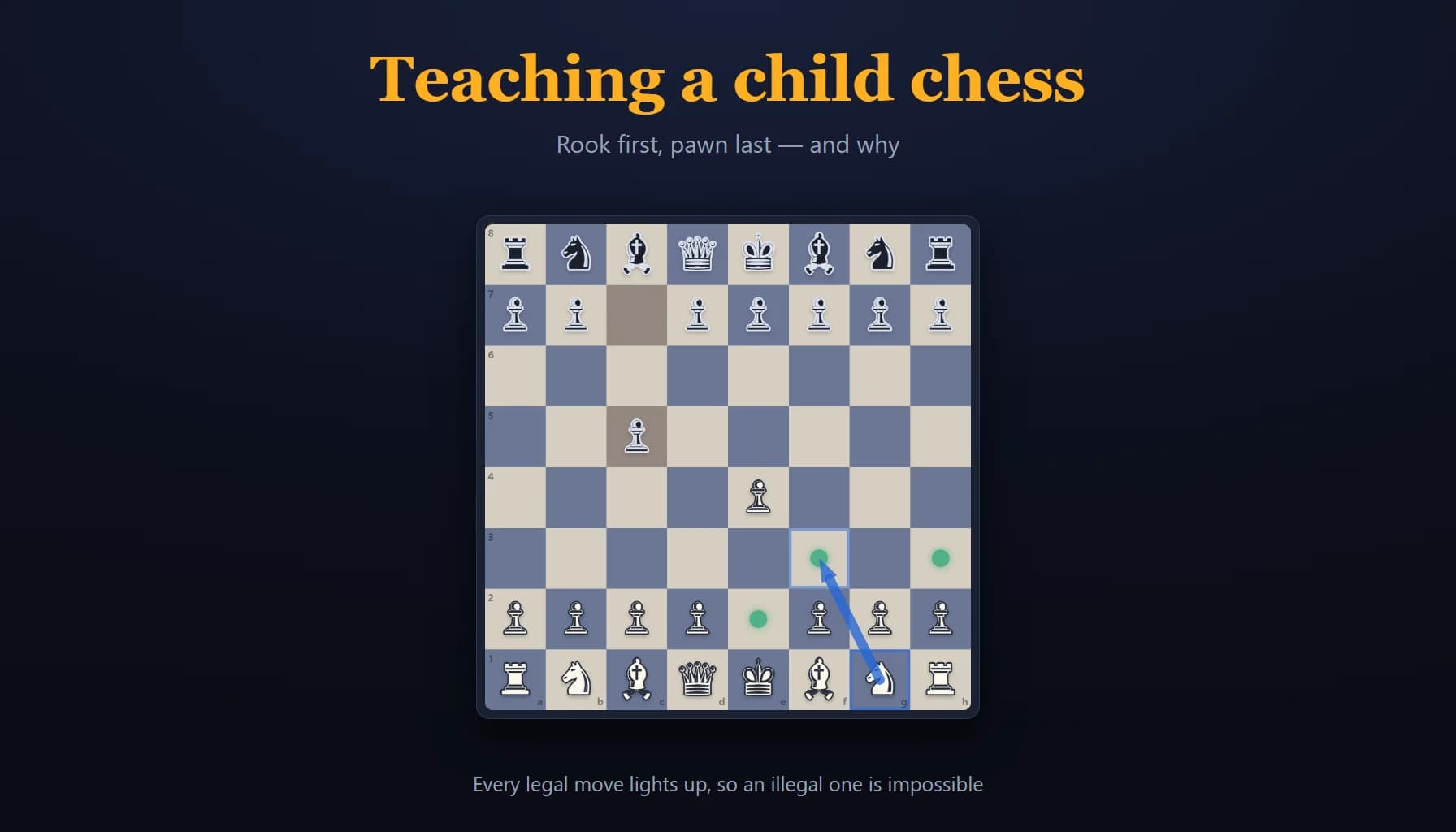
| Legal moves light up | Tap a piece, see green dots. An illegal move is impossible, so nobody has to be corrected. |
| Undo | "What if I go here instead?" becomes a question you can answer by trying it. |
| The coach | A blue arrow with a plain-English reason — "Try Nf3 — a well-tested developing move" — and it names the opening you have wandered into. |
| Two players on one screen | Sit next to each other and play. The screen keeps the rules; you keep the conversation. |
That third one is the one that matters for a parent who does not play. When the child asks "is this a good move?", you are not bluffing — you turn the hints on and you find out together.
And the honest limits: the coach suggests moves, it does not run lessons, and there are no puzzles or a curriculum. It is a game with a helpful voice, not a chess school. For a young child, that is usually the better shape anyway.
Sessions, and the losing problem
Keep it short. Ten to fifteen minutes with a five-year-old, and stop while they still want more. A session that ends early is one they will ask to repeat.
Should you let them win? Not by pretending — children spot it, and a hollow win teaches nothing. Handicap honestly instead, which is what adult chess has always done: play without your queen, or play with rooks against their full army. Now the win is real, and so is yours when you get it. Our game's three difficulty levels do the same job when they play the computer — start on Easy and move up when Easy stops being interesting.
Let them take moves back. Beginner chess is not a tournament. Undo is a teaching tool, and "what would have happened if…" is where most of the learning actually lives.
If chess is still too much
Sometimes the honest answer is that the child is not ready for thirty-two pieces, and that is fine — it is not a verdict on anything. A gentler strategy game first will build exactly the same muscles: taking turns, thinking a move ahead, accepting a loss without the world ending.
Checkers is the classic step, with one piece type and one rule about jumping — and it takes about five minutes to teach. Nine Men's Morris is another good one: simpler than chess, older than chess, and genuinely tactical. Children who enjoy either of those tend to come back to the chess board a year later and find it much less frightening.
The short version
- Wait for turn-taking and ten minutes of focus, not a birthday.
- Rook, bishop, queen, king, knight, pawn — in that order, one per sitting.
- Play Pawn Wars before you play chess.
- Teach the two-rook mate; do not teach the four-move mate.
- Let the screen police the rules so you can do the encouraging.
- Stop while they still want another game.
When you are ready to sit down together, the board is right here — free, no account, hints on or off — and it will patiently refuse every illegal move either of you tries to make.