Nine by nine squares, the same seven piece types as any chess variant — and one rule that makes Shogi unlike all the others. A piece you capture never leaves the game. It joins your hand, and it comes back.
How to play Shogi
How each piece moves
- King — one step in any direction.
- Gold general — one step orthogonally, plus one step diagonally forward: six directions, never the two backward diagonals.
- Silver general — one step in any of the four diagonal directions, plus one step straight forward. Never sideways, never straight back.
- Knight — two rows forward and one column over, forward only. Not the eight-direction knight of Western chess.
- Lance — any distance straight forward, blocked by the first piece in its way.
- Bishop and Rook move exactly as they do in Western chess.
- Pawn — one step straight forward. It also captures that way — there is no diagonal pawn capture here.
Every piece but the king and gold general can promote, and every one of them promotes to move exactly like a gold once it does.
The drop — Shogi's signature rule
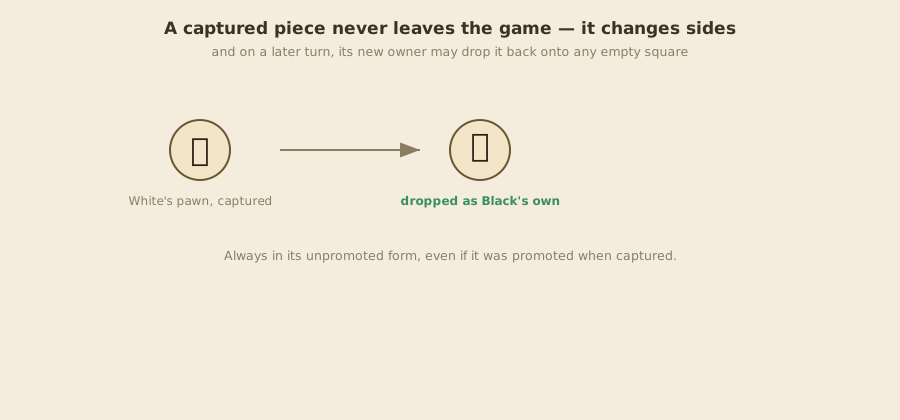
A captured piece is never removed from the game. It goes into the capturing player's hand — always reverting to its unpromoted form, even if it was promoted when taken — and on any later turn, instead of moving a piece already on the board, that player may drop it onto any empty square as a move in its own right.
Three restrictions keep drops from breaking the game. A piece can never drop somewhere it could never move from again — a pawn or lance on the last rank, a knight on the last two. A pawn can never drop onto a file that already holds one of your own unpromoted pawns (nifu). And a pawn can never drop to deliver an immediate checkmate (uchifuzume) — though dropping one to give check that falls short of mate is completely legal.
How do you win at Shogi?
Checkmate the enemy king. Because captured material keeps coming back into play rather than draining away, Shogi games essentially never stall out — professional Shogi draws happen in under 1% of games, against roughly half of grandmaster chess games ending drawn.
What this page simplifies, and why
Two real tournament rules, both genuinely intricate, get a simpler stand-in here. Sennichite — fourfold repetition — properly treats a repeat caused by perpetual check as an outright loss for the checking side; this page scores all fourfold repetition as a plain draw instead. And when both kings fight their way into the far side of the board, real tournament rules settle it with a detailed points count that this page does not implement at all. Both are disclosed simplifications, made because the full rules carry edge cases that even human arbiters argue over — not oversights.
Playing Shogi against the computer
How do the three computer levels differ?
In how many candidate moves get a second look at the reply and how often a merely good move gets played instead of insisting on the exact best one — the same design as the Xiangqi and Reversi opponents on this site. The evaluation counts material both on the board and sitting in hand, using the point values most Shogi engines converge on: pawn 1, lance 3, knight 4, silver 5, gold 6, bishop 8, rook 10, and roughly double for a promoted minor piece.
Where Shogi comes from
Japan, by way of a much older shared ancestor. Chess-like games arrived from China and Korea sometime between the 10th and 12th centuries, descended ultimately from chaturanga in 6th-century India — the same root Xiangqi and Western chess both trace back to. A direct ancestor of Shogi without the drop rule is recorded from 1210; the game in close to its modern form, drop rule included, is attested by the 16th century.
Where the drop rule itself came from is genuinely unsettled. A popular explanation ties it to samurai armies absorbing captured soldiers rather than executing them — an appealing story, but a story more than a confirmed history.
If you like this one
- Xiangqi — the sibling from the Chinese branch of the same family, no drops, a river and a palace instead
- Chess — the Western branch: castling and promotion, but nothing ever comes back once it's captured
- Checkers — forced diagonal captures, no relation beyond both being played on a checked board
- Reversi — the computer opponent here shares its candidate-scoring approach