
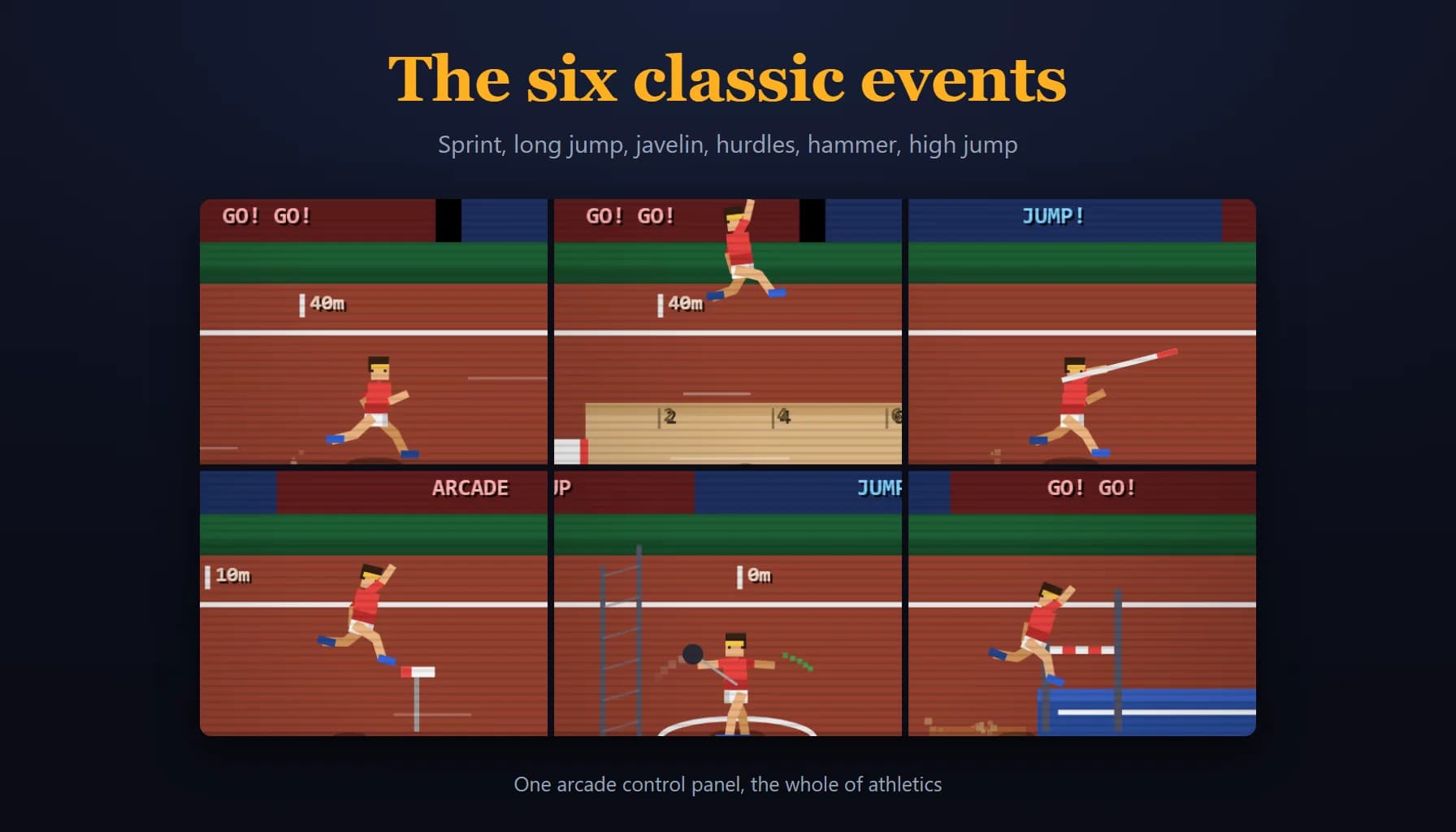
Athletics has close to fifty disciplines, but ask anyone to picture "track and field" and the same handful of images appear: a sprinter at the gun, a jumper hanging over sand, a spear in the air. There is a reason the picture is so consistent — in 1983, an arcade game chose six events, and those six became the canon that sports games have repeated ever since.
Here is what each of the six actually is, what it demands, and the rule in each that most people get wrong. If reading about them makes your fingers itch, every one is playable in the browser, one page per event.
100 m sprint — the purest number in sport
One straight line, no tactics, no equipment: the 100 m is the shortest outdoor distance and the sport's blue-riband event, and the winner is simply the fastest human in the world that day.
What people get wrong is where races are won. Nobody accelerates for a hundred metres — elite sprinters hit top speed around sixty metres in and then fight to lose it slowest. The event is a start, a build, and a controlled collapse. There is also no such thing as jumping the gun by skill: react faster than a tenth of a second and you are disqualified, on the grounds that no human can genuinely hear a gun that fast.
In the game: the start and the fade are both real — one twitch before the gun restarts you, and the race is won by whoever's rhythm survives the second fifty. Run it here.
Long jump — measured at the board, not the foot
Sprint at full speed, hit a wooden board, land in sand. The long jump looks like the simplest field event and hides the cruellest rule in athletics: distance is measured from the front edge of the board, no matter where your foot actually left the ground. Take off ten centimetres behind the board and you have donated ten centimetres. Touch a millimetre past it and the jump is a foul — traditionally betrayed by a strip of plasticine that keeps the fingerprint of your shoe.
So every jump is two contests at once: the jump itself, and a game of chicken with a twenty-centimetre target at ten metres per second.
In the game: the board, the foul and the greed are all faithfully there. Jump here.
Javelin throw — the only throw with a runway
Three throwing events use a circle; the javelin alone gets a run-up, which is why it throws three times further than anything else. The javelin is also the only implement in athletics that flies — it is a wing as much as a missile, and it must land tip-first to count.
The fact that explains the modern event: in the 1980s throwers became so good that javelins started landing dangerously close to the far end of stadiums, and the implement itself was redesigned to dive earlier. The sport literally had to nerf its own equipment — the full story is on the javelin page, along with the record that was retired rather than broken.
In the game: run-up speed times release angle, with a foul line waiting. Throw here.
110 m hurdles — a sprint that forbids sprinting freely
Ten barriers, each a little over a metre tall, spaced so precisely that elite hurdlers take exactly three strides between every pair — the spacing has not changed in about a century, and it turns the race into choreography at full sprint.
What people get wrong: knocking hurdles over is legal. It slows you down, which is punishment enough. And hurdlers do not jump — a good clearance is a fast, flat step that spends as little time in the air as possible. The event is rhythm wearing a sprint's clothing.
In the game: the ten hurdles stand at the genuine race spacing, and clipping one costs speed, not the race. Race here.
Hammer throw — no hammer, all physics
The "hammer" is a sixteen-pound steel ball on a wire — the same weight as the shot, thrown twice as far, because the thrower spins with it and lets centrifugal force do the arithmetic. Throwers turn three or four times in a circle barely two metres wide, ending dizzy and, ideally, still inside it. It is the only throwing event conducted from inside a cage, for the excellent reason that a released hammer negotiates with nobody.
The name is the fossil of a real tradition: Scottish and Irish contests threw actual sledgehammers, and the sport kept the word after swapping the tool.
In the game: spin speed against release timing, with the ground waiting for anyone who lets go low. Spin here.
High jump — the event that ends in failure
A bar, two uprights, and a rule with a beautiful shape: the bar keeps rising until you miss three times, which means every high jump competition ever held has ended with its winner failing. You do not beat the bar; you choose where it beats you.
It is also athletics' great story of technique beating tradition — a backwards flop that commentators laughed at in 1968 and every jumper on earth uses today. That story, and the record that has stood since 1993, are on the high jump page.
In the game: the bar starts low, rises ten centimetres per clearance, and grants exactly three misses. Clear it here.
Why these six?
They map the whole territory with no repeats: one pure sprint, one rhythm race, one horizontal jump, one vertical jump, one straight-line throw, one rotational throw. Six events, six different answers to "how fast, how far, how high" — which is athletics' entire question, and it fits on one arcade control panel: two run buttons and one action button.
That economy is why the 1983 template still gets homaged, and why, forty years later, the six of them still feel like a complete games-day in fifteen minutes. If you want the technique side — how to actually be fast on two keys — that is its own guide; the history of where the format came from is told here.