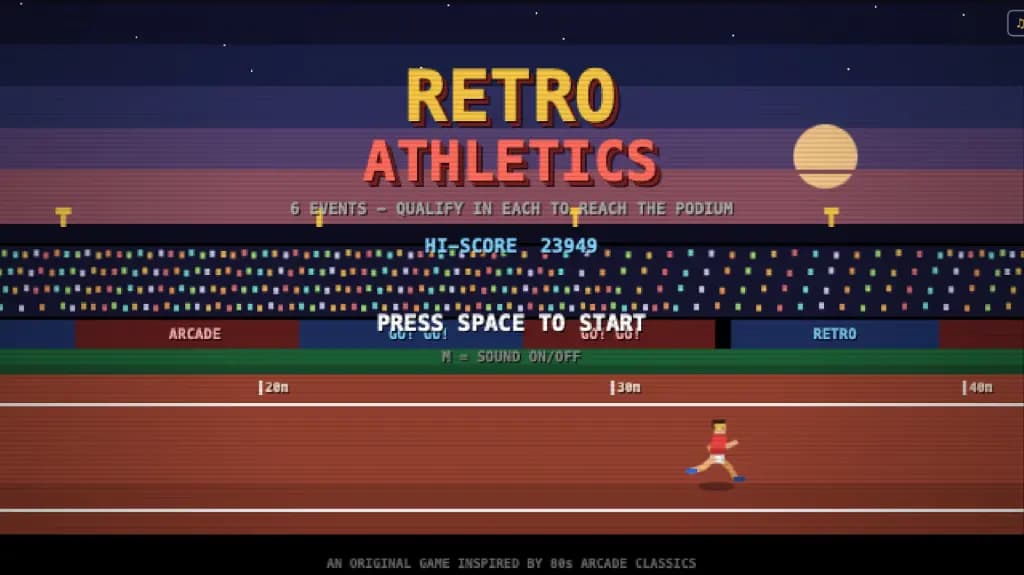
Sprint down the runway, raise the javelin, and let go a moment before the line. The throw is two numbers multiplied together — how fast you were running and the angle you released at — and getting one right while the other is wrong sends the spear straight into the turf.
How to throw
- Run. Alternate the two run keys (A and D, or the two RUN buttons on a phone). The speed bar fills. This is the raw material of the throw.
- Hold. Press and hold the action button — spacebar, or just hold the mouse button down on the playing field. On a phone it is the THROW button. The javelin comes up and the angle meter climbs. You keep running, slower.
- Release. Let go while the needle is inside the green band on the meter, roughly 38 to 52 degrees. The pointer at the athlete turns green at the same moment, so you can watch either.
If you are still holding when you reach the red line, the throw goes off by itself. You only foul if you run over the line with the javelin still down.
Why 45 degrees and not 33
Throw a stone and 45 degrees carries it furthest. That is what this game models, and the green band sits around it — wide enough to hit without a stopwatch.
Real javelin throwers release much lower — around 33 degrees. The reason is that a javelin is not a stone: it is a wing. It generates lift along its flight, so a flatter, faster release stays airborne longer than the ballistic maths suggests. The rules even had to be rewritten because of it. In 1984 Uwe Hohn threw 104.80 m and very nearly out of the stadium; the javelin's centre of gravity was moved forward in 1986 to make it dive earlier, and every record since starts from that redesigned implement.
Nobody will ever beat Hohn's mark. It is the only athletics world record that was retired rather than broken.
What counts as a good throw here
| Distance | What it means |
|---|---|
| 25 m | The qualifying mark in the six-event contest |
| 40 m | A clean run-up and a sensible angle |
| 55 m | Both right at the same time |
| 65 m+ | The crowd notices |
There is no ceiling except how fast you can run. The throw speed comes almost entirely out of the run-up, which is why the second half of the runway matters more than the angle meter.
Three habits that add metres
- Do not start the throw too early. Every frame you hold is a frame you are running slower. Build the speed first, then start the angle — the needle needs about two thirds of a second to reach the green band.
- Watch the bar, not the athlete. The speed bar turns green near the top. Starting your throw before it does is the most common way to lose ten metres.
- A foul is worse than a bad throw. You get three attempts. A cautious first throw that lands is worth more than two fouls and one perfect one you never reach.
The full contest
This is one event out of six. The complete Retro Athletics contest runs 100 m sprint, long jump, javelin, 110 m hurdles, hammer and high jump back to back — one score, one podium, and you are out the moment you miss a qualifying mark. The javelin is the third of them.