Space has no brakes. That one fact is the whole game.
You thrust, and your ship keeps going that way — through the rocks, past the rocks, out of the far side of the screen and back in the other. Turning does not change where you are heading. It only changes where you are pointing, and those two stop being the same thing about four seconds in.
How to play Shatterbelt
Rotate with ←/→ or A/D, thrust with ↑ or W, fire with Space, dash with Shift. On a phone all four are on screen. P or Esc pauses, M mutes.
Large rocks break into medium ones, medium into small, small into nothing. Clear every rock and the wave ends.
The two habits that keep you alive
Burn the other way early. The ship keeps 99.2% of its speed each second — in ten seconds of coasting you shed less than eight per cent. There is no slowing down except turning around and thrusting against yourself, and it takes about as long to stop as it took to get going. A full turn is 1.5 seconds; from rest to top speed is 1.4. Plan for both.
Do not chase. Everything wraps around the edges. The rock that just left the right-hand side is coming back from the left, and it will find you faster than you can find it.
Why a missed shot costs you so much
Three hits in a row doubles your score. Six in a row triples it. One miss and you are back to ×1.
That single rule turns a shooting game into an aiming game. A shot expires after crossing 80% of the screen, so the hopeful long-range pot at something drifting in the distance is not free — it is the most common way people lose a multiplier they have spent half a wave building.
Only four of your shots exist at once, which is the constraint the 1979 arcade cabinet ran on and the reason that game felt the way it did. You cannot hold the trigger and hose the screen clear. With the miss penalty on top, every shot is a decision.
Which rocks are worth the most?
Backwards from what everyone assumes:
| Rock | Points |
|---|---|
| Large | 20 |
| Medium | 50 |
| Small | 100 |
A large rock is worth almost nothing on its own. Follow it all the way down — one large, two medium, four small — and it pays 20 + 100 + 400 = 520. At a ×3 multiplier that is 1,560 points from one rock, and an extra life arrives every 10,000.
So the score is not in the shooting. It is in the follow-through: breaking a large rock and then staying with the pieces instead of turning to the next easy target.
What the dash is really for
130 pixels, instantly, invulnerable for a quarter of a second, once every five seconds. It is an escape hatch rather than a way to get around — the right moment is the rock you did not see, not the gap you fancy crossing. Nothing about it is random, which makes it the opposite of the hyperspace button on the old machines, where the safest thing you could do occasionally killed you.
The drone, and the wave it starts aiming at you
From wave 3 onwards something else crosses the screen: a drone, sliding horizontally with a slow vertical wobble, firing as it goes. It is worth 200 points, more than any rock, and if you ignore it it simply leaves at the far side.
It has one property worth knowing, because nothing on screen announces it. Up to wave 4 the drone fires at random angles — it is a hazard, not a threat, and standing still is survivable. From wave 5 it aims at your ship, with about a quarter of a radian of spread. The same object, the same appearance, and a completely different reason to respect it.
Its rate of fire tightens as well: every 1.55 seconds when it first appears, down to one shot every 0.9 seconds, which it reaches at wave 16 and never exceeds.
Where the high scores come from
Three things compound, and the third is the one people miss.
Follow the pieces down. A large rock left alone is 20 points; taken all the way to gravel it is 520. Turning away after the first hit throws away 96% of it.
Protect the multiplier. At ×3 that same rock is worth 1,560. One hopeful long shot at nothing costs you the multiplier and therefore roughly a thousand points of the rock you are about to break.
Take the drone. 200 points at ×3 is 600 — worth more than a large rock's whole chain at ×1, and it arrives every nine to sixteen seconds whether you want it or not. From wave 5 the choice is really made for you: leaving an aiming drone alive to save two shots is how good runs end.
Does it get harder forever?
Not quite, and the way it stops is the interesting part.
Each wave adds one rock — four in wave one, thirteen in wave ten — and each wave makes them 7% faster. But the speed stops rising at wave 13. From there on the rocks never get quicker; there are simply more and more of them.
That changes what the game is asking of you. Early on it is reaction time. Later it is screen management: knowing which half of the field is filling up, and being on the other side of it before it does. Same controls, different problem.
If you like this one
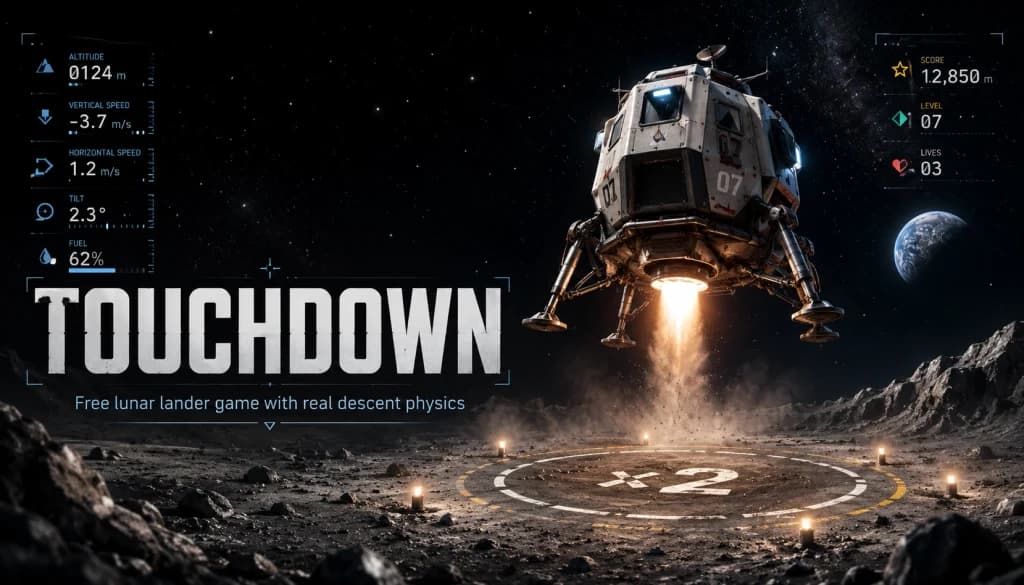
Touchdown is the other side of the same physics — thrust and inertia, but with the ground coming up at you and no shooting at all. Dark Spire and Glimmer are the other arcade games here, and the rest are in retro and arcade.
Where this kind of game comes from
A history of asteroid shooters traces the line from the 1979 original through the vector-graphics era to what survived into the browser.