
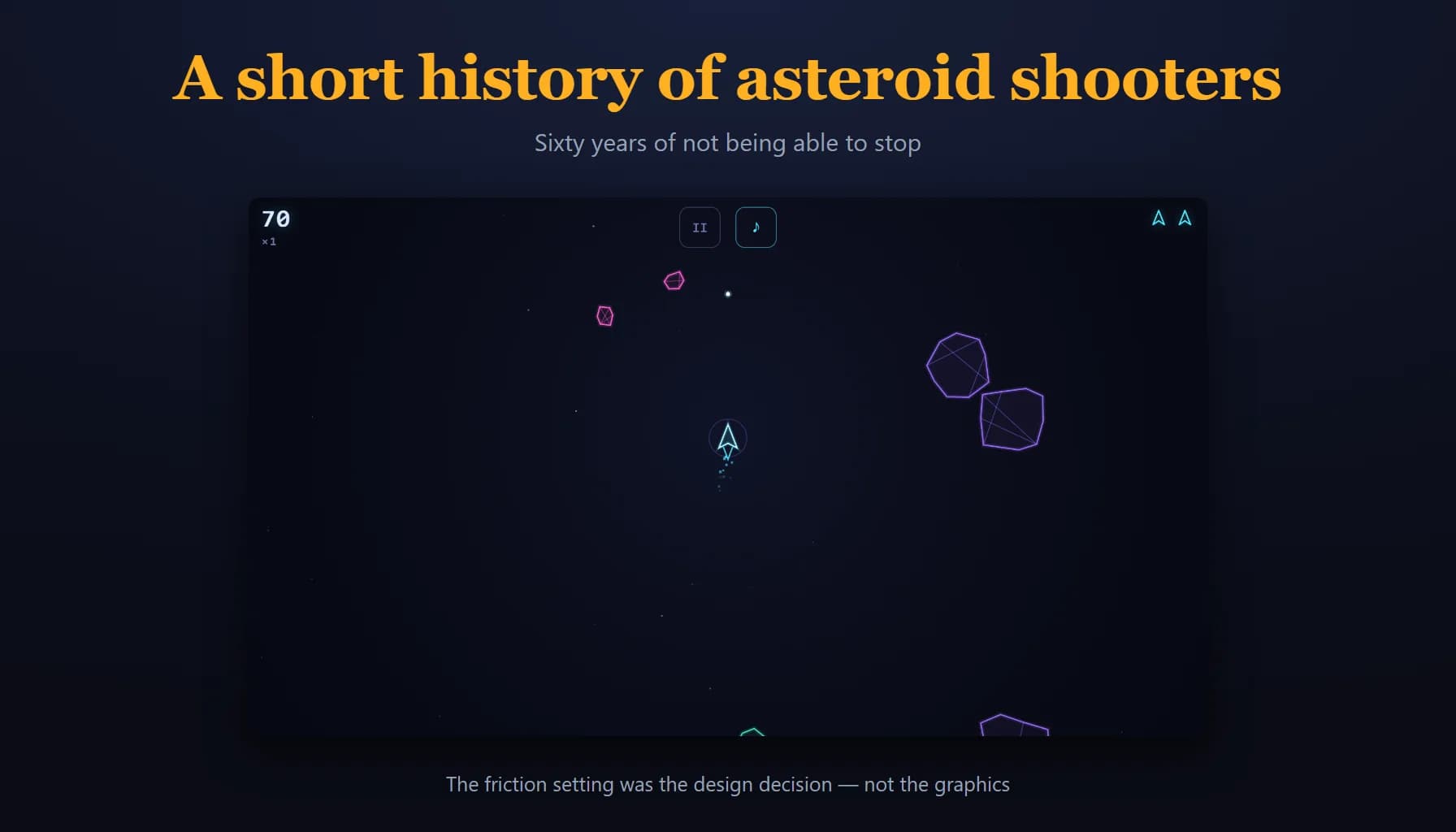
There is a specific frustration that only this genre produces. You let go of the thrust key expecting the ship to settle, and it does not. It keeps going, at exactly the speed you gave it, into exactly the rock you were trying to avoid.
That frustration is sixty years old this decade, and it was a design decision before it was a genre.
1962: two ships and a star
The ancestor is Spacewar!, written in 1962 by Steve Russell and others at MIT on a PDP-1 — a machine the size of a wardrobe with a circular vector display. Two ships circled a central star, fired torpedoes, and drifted. There was no floor, no friction and no forgiveness: you accelerated in the direction you were pointing, and then you kept moving until you did something about it.
Spacewar! was never sold. It spread the way software spread before software was a business — on tape, between institutions, to anyone with the right hardware — and a generation of programmers met it at university. That mattered later.
1971: the idea leaves the lab
Computer Space, built by Nolan Bushnell and Ted Dabney, took Spacewar!'s physics into a coin-operated cabinet and became the first commercially sold arcade video game. It did not sell especially well. The usual explanation is that it asked too much of a bar customer with one quarter: nobody had explained inertia to them, and the game had no interest in doing so either.
The lesson the industry drew was not "drop the physics". It was "give people something to shoot at that makes the physics matter".
1979: rocks
Asteroids arrived from Atari in November 1979. The concept came from Lyle Rains and the code from Ed Logg, who had played Spacewar! at Stanford and took the ship's movement scheme more or less from memory. The display was vector — a MOS 6502 driving Atari's QuadraScan hardware — which is why the lines look drawn rather than pixelated, and why the game aged so oddly well.
It was enormous. Around 70,000 cabinets sold in the United States and roughly 30,000 abroad; Atari took some $150 million in direct sales, and operators collected around $500 million in coins by 1980. Some of them had to install larger coin boxes, which remains the most convincing measure of a hit game ever recorded.
The bit that is actually interesting
Buried in the development story is the detail that explains the whole genre. Logg had to tune the ship's friction, and both extremes failed:
- With no friction at all, the game became too easy — the ship was a billiard ball, and expert players could simply keep it moving forever.
- With heavy friction, players died constantly and reported that the ship felt like it was flying itself.
The playable version sits in a narrow band between those, where momentum is clearly real but not quite in charge. Every asteroid shooter since has had to find that same number, and the value you pick is your game's personality. It is the reason a modern take can feel completely different while doing, on paper, exactly the same thing.
Our own Shatterbelt keeps about 99 % of the ship's speed every second — enough that drift dominates the way you play, little enough that a casual player is not permanently sliding into the walls.
And the exploit
Players worked out that they could park at a screen edge and shoot across the wrap-around boundary at the saucers, more or less indefinitely. Games began lasting for hours, then for days. Operators, who had just bought bigger coin boxes, now had machines occupied for an entire afternoon by one quarter — and complained loudly enough that Atari shipped patched chips and changed how it tested games before release.
The scoreboard had its own limit: the machine rolls over at 99,990 points, so the very best players eventually ran out of number rather than lives.
What the genre kept
Strip away four decades of hardware and the same four rules keep turning up, including in Shatterbelt:
- Momentum is conserved. Aiming and moving are one control, so every shot you line up commits you to a direction.
- The screen wraps. There is no safe corner, and anything that leaves is coming back.
- Targets divide. Destroying something makes the screen more dangerous before it makes it safer — the only genre where progress and panic rise together.
- A single hit ends you. No health bar, no regeneration. It keeps the whole thing honest.
Nothing in that list needs a vector monitor, a coin box or a 6502. It is why the format survives in browsers, on phones, and in whatever comes next: the rules are cheap, and the feeling they produce has never been improved on.
Playing one now
If you want the 1979 original, Atari has kept it in print — it appears in the company's own compilations, and the same is true of most of its arcade contemporaries. If you want something in the tradition right now, in a browser, for nothing, that is what we built Shatterbelt for: crystalline rocks that split twice, a combo multiplier that punishes spraying, a dash for when the drift wins, and no coins required — however large the box.