An arcade crossing game in the tradition the eighties invented: you are small, the world is moving, and the only way forward is one careful hop at a time.
The goal
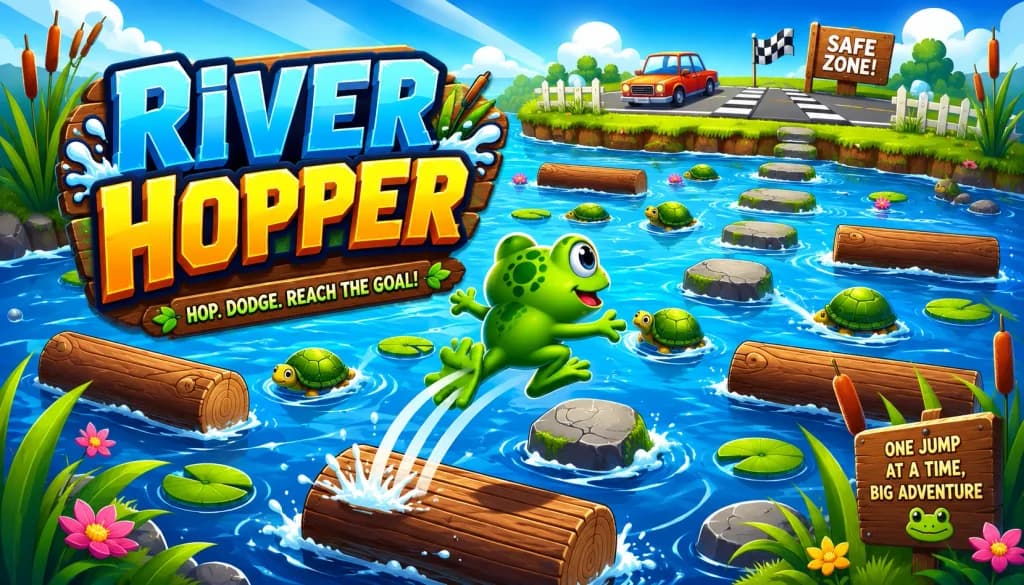
Bring five hoppers home. Each one starts at the bottom of the screen and has to reach one of the five empty spots on the far bank, and the level is finished only when all five are filled.
Between the start and those spots lie two very different problems. First a road, where the traffic is fast and the gaps are simply timing. Then the water, where there is no ground at all — you cross on floating logs, stepping stones, lily pads and the backs of turtles, and standing still is only safe as long as whatever you are standing on stays put.
You get three lives for the whole game and thirty seconds for each hopper. That second number is the one people misread: the clock is per crossing, not per level. It restarts every time a new hopper sets off, so a careful, deliberate crossing fits comfortably inside it. What does not fit is dithering at the roadside waiting for a gap that is never quite perfect.
Running at it never works. The board is a moving puzzle, and your job is to read it.
Controls
One press, one hop. There are no diagonals and nothing to hold down, so every move is a decision rather than a drift.
On a computer
| Action | Keys |
|---|---|
| Hop forward | W or ↑ |
| Hop back | S or ↓ |
| Hop left | A or ← |
| Hop right | D or → |
| Pause and resume | ESC |
Both sets of keys are live at once, so you do not have to choose. Press ESC once to pause; press it again, or click the Resume button, to carry on.
On a phone or tablet
Swipe on the playfield. Your thumb is already there, and the direction is the movement itself — up, down, left or right, one swipe one hop. It is the quickest way to play, and it matters here: the gaps between the cars are short.
Under the game there are also six buttons — the four directions, a pause, and a ↵ button that starts a new game when the screen says GAME OVER. Nothing to set up and no separate mobile version to find.
What kills you
Four things, and it is worth knowing all of them before the first attempt:
- The cars. Touching one on the road is instant, with no grace period.
- The water. Landing in the river rather than on something floating in it.
- The sides. The left and right edges of the river are as fatal as the water. A log that carries you off the screen has killed you just as surely as a car would have.
- The clock. Thirty seconds per hopper, and a hopper that does not make it home in time is lost like any other.
Everything else is safe. An empty lane on the road really is empty, and you can stand in it for as long as you like.
How to play
Advance one hop at a time. Watch the lane ahead before you commit, because the gap you are aiming for will have moved by the time you land in it.
On the road, an empty lane is genuinely empty and you are safe standing in it. On the water it is the reverse: the log under you is moving, and the edge of the screen is as fatal as the traffic was. Hopping backwards to buy a moment is a real move, and one most players forget they have.
The instinct most players have to unlearn is hurrying. Standing still is a move. The player who waits half a second for a clean gap gets across; the player who keeps hopping runs out of room in the middle of a lane, which is the worst place to be.
As the spots fill up, the crossing gets psychologically harder rather than mechanically harder. The fifth hopper travels exactly the same route as the first, but by then you have something to lose, and that is when people rush a jump they had been timing perfectly for four attempts.
Tips
- Time the jump onto a moving platform, not the platform itself. Too early and you land in front of it, too late and it has gone. Aim at where the log will be, not where it is.
- Read the traffic before you step off the kerb. The cars run on fixed cycles. Two or three seconds of watching from safety tells you the whole pattern, and those seconds are cheap.
- Look one lane further than you are. The decision that matters is not the hop you are making, it is the one after it.
- Waiting is free — up to a point. A safe square costs you nothing but the clock, and thirty seconds is generous if you are moving and stingy if you are not.
- Watch the sides on the water. When a log is drifting towards the edge, your next hop is a sideways one, not a forward one.
- Keep half an eye on lives and remaining spots. Down to your last life with four spots filled is the moment to slow down, not to finish quickly.
- Do not chase a gap you have already missed. Reset, wait, take the next one.
Why this kind of game is harder than it looks
The genre was defined by Frogger, which Konami released into arcades in 1981 and which became one of the biggest hits of its era. It was built around an idea that was unusual at the time: an arcade game with nothing to shoot at. The story of how it was made, and how Konami nearly could not sell it outside Japan, is worth reading on its own.
What made it work is that the difficulty comes entirely from timing and patience, not from reflexes or accuracy. Every hazard moves on a fixed cycle. Nothing is random, nothing is unfair, and every death is a mistake you can identify. That is a rare and rather honest kind of difficulty, and it is why the format has outlived almost everything else from that period.
The other half of the design is that the game asks you to plan two moves ahead while the board rearranges itself underneath you. Chess players recognise the feeling immediately, which is not something you expect to say about an arcade game where you play a frog.
About this version
River Hopper is an original game built with Unity, not a port. It runs directly in the browser — nothing to install, no account, and no plugin — on a computer with the keyboard and on a phone with the on-screen buttons.
Because it is a real 3D engine build rather than a page of JavaScript, the first load is a larger download than the rest of the games here. Give it a few seconds on the first visit; your browser keeps it afterwards, so every later visit starts immediately.
If you are working through the genre rather than this one game, the companion piece on games like Frogger you can play in a browser covers what else is out there, what is officially available and what each one changed.