
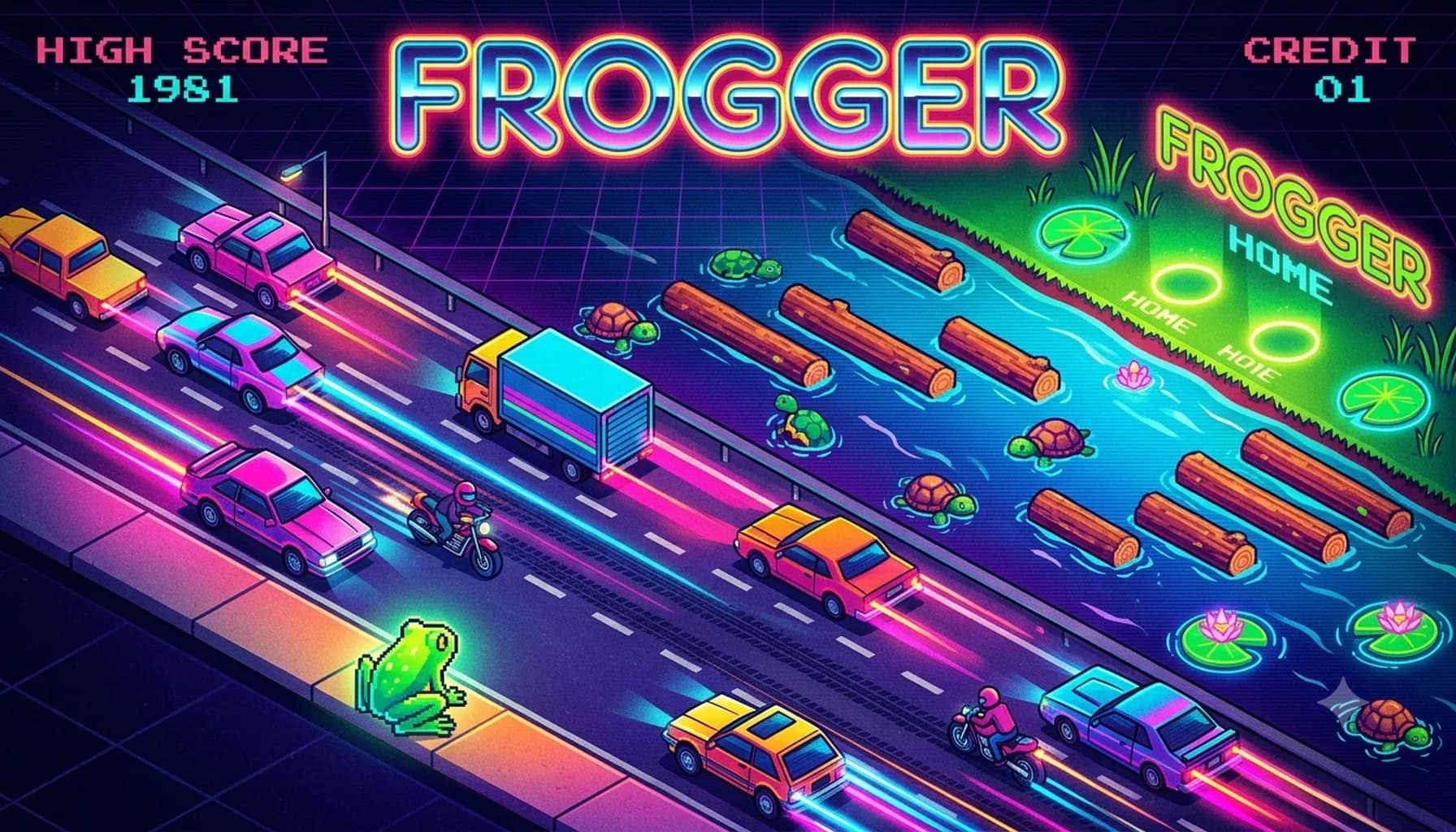
In an arcade full of guns, Konami released a game about crossing a road.
That is the fact worth starting with, because everything else about Frogger — the hundred and thirty-five million dollars, the Atari cartridge, the Seinfeld episode — follows from a decision that looked wrong at the time. In 1981 the money was in shooting things. Space Invaders was three years old, Galaga was months away, and the accepted wisdom of the cabinet business was that a player needed something to aim at.
Frogger gave them a frog, a road, and thirty seconds.
The frog at the traffic light
The origin story that follows the game around is a small one, and it is the kind of story that is either true or should be. A Konami developer, stuck at a red light, watched a frog trying to get across the road in front of him — hopping, stopping, hopping again, judging gaps between cars. He got out and moved it. Then he went and made a game about it.
The attribution wobbles depending on where you read it. Wikipedia credits Takeshi Hara as director and Takahide Harima as designer, with Harima and Hara also among the programmers alongside Keiichi Miyoshi; other accounts attach the traffic-light anecdote to Akira Hashimoto. Treat the anecdote as folklore with a plausible shape rather than as a documented moment.
What is not in doubt is that the resulting design is unusually literal. Most arcade games of the period abstract their subject into a metaphor — you are a ship, or a gun, or a mouth. Frogger is about a frog crossing a road, and it is about that all the way down.
Konami had a hit and no way to sell it
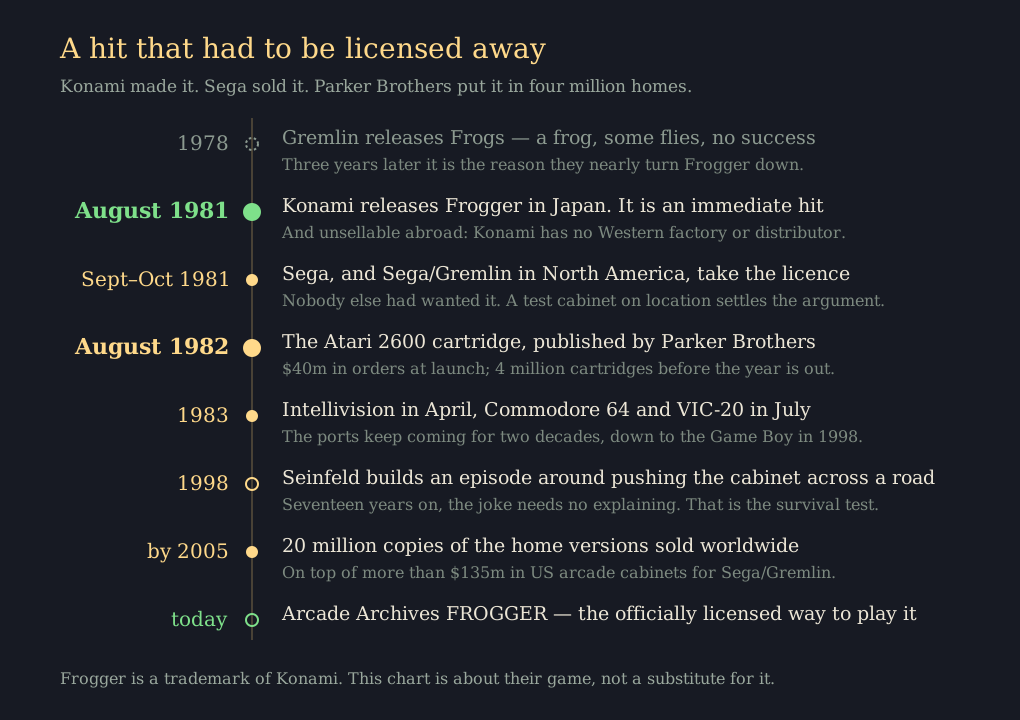
Here is the part of the story that gets skipped. Frogger was a success in Japan almost immediately, and Konami could do nothing with it, because in 1981 Konami had no manufacturing or distribution operation in the United States or Europe. A hit arcade game is a hit only where there are cabinets, and cabinets are a logistics problem before they are a creative one.
So Konami licensed it out. Sega took it worldwide; in North America it went through Sega/Gremlin, the partnership Sega had formed with the San Diego company Gremlin Industries.
Sega/Gremlin were not enthusiastic. Two reasons, both rational:
No one else had wanted it. By the time it reached them, no other American company had taken the licence. In that business, a game nobody has bought is usually a game nobody should buy.
They had already made this mistake. Gremlin had released Frogs in 1978 — a game about a frog, eating flies, going nowhere commercially. Somebody in that building had every reason to say: we tried the frog.
The story of what changed their mind is one of the better ones in arcade history. They put a cabinet on location — a bar, in the usual telling — and watched the earnings. It was the most played machine there. Scepticism does not survive a coin count.
The release dates that follow are documented: Japan in August 1981, North America in September, Europe in October. (You will also see 23 October 1981 cited for the North American launch; the discrepancy is the kind that clings to arcade releases, where "released" can mean approved, shipped or on location.)
The game with nothing to shoot at
Look at the design as a set of decisions and it becomes clear that none of them were accidents.
Two hazards, opposite rules. The road and the river are not one obstacle repeated. On the road, empty space is safe and you can stand in a lane indefinitely. On the water there is no safe space at all — the log under you is already moving, and the screen edge will kill you as surely as a lorry would. Half of the game teaches you to wait; the other half punishes you for it. That is one screen doing the work of two games.
Five frogs, not one goal. The level ends when five home slots are filled, so the game is played five times over with rising stakes and identical geometry. Nothing gets mechanically harder. What changes is what you have to lose. Anyone who has botched the fifth crossing after four clean ones knows this is a psychological design, not a difficulty curve.
Thirty seconds per frog. Not per level. The clock resets with every new frog, which sounds generous and is: thirty seconds is plenty for a careful crossing and nowhere near enough for a hesitant one. It is a timer that punishes indecision specifically, rather than slowness.
Everything moves on a cycle. Nothing in Frogger is random. Every death is reconstructable, which means every death is your fault, which means you play again. Games that kill you unfairly get switched off; games that kill you fairly eat quarters.
And the thing it does not have: a fire button. The genre it belongs to barely existed before it and is still, forty-five years later, thinly populated. It turns out to be genuinely hard to make patience exciting.
What the numbers say
The commercial record is the part that surprises people who remember Frogger as a quaint little game.
| US arcade cabinet sales, Sega/Gremlin | over $135 million |
| Atari 2600 version, orders at launch | $40 million |
| Atari 2600 cartridges sold by end of 1982 | 4 million |
| Wholesale revenue from those cartridges | $80 million |
| Home versions sold worldwide by 2005 | 20 million copies |
The Atari 2600 cartridge, published by Parker Brothers in August 1982, is the outlier in that table. Forty million dollars in orders before a single unit reached a shelf is not a licensing deal, it is a phenomenon — and it happened because the arcade original had already done the marketing.
Intellivision followed in April 1983, Commodore 64 and VIC-20 in July 1983, and the ports kept coming for the next two decades, down to a Game Boy version in August 1998. Konami's first genuine international hit turned into Konami's most portable asset.
Why it stayed
Most 1981 arcade games are now a screenshot in a listicle. Frogger is a reference people still make without explaining, which is the actual test of cultural survival.
It got a 1998 Seinfeld episode — George buys the machine that holds his high score and has to push it across a street without unplugging it, which is either the best or the most obvious joke available. It turns up in Wreck-It Ralph and Pixels. Traffic reporters use its name as a verb. Somewhere along the way a transposon in fruit flies got named after it, which is the sort of thing that only happens to games a generation of graduate students grew up on.
The reason it lasted is not nostalgia. It is that the design does not date. Sprites date, resolution dates, cabinet art dates. Read the pattern, commit to a gap, accept that the ground is moving does not, because it is not a technology — it is a problem.
What is hard to copy
Anyone can build a game where you cross a road. What is difficult is the specific tension Frogger found, and it comes from a single rule most imitators drop: the safe square is a real place you can stay.
Endless runners cannot do this. If the screen scrolls, standing still is death, and a game where standing still is death cannot make waiting into a skill — it can only make it into a delay. Frogger lets you stop, and then makes stopping cost you something else: the clock. That is what turns a reflex test into a judgement test, and it is the thing that separates the genre from the runners it is usually shelved next to.
The second hard part is the two-halves structure. Give the player two hazards that obey opposite rules and the second crossing feels new even though nothing new has been introduced. Give them two hazards that obey the same rules and the second crossing is filler.
Where this comes from
- Frogger — Wikipedia for development credits, regional release dates, the Sega/Gremlin licensing arrangement, sales figures and the port history
- Frogs — Wikipedia on the 1978 Gremlin game that made Sega/Gremlin wary of the licence
- Gremlin Industries — Wikipedia on the Sega/Gremlin partnership and its role in North American distribution
- Frogger — Konami Wiki on Konami's lack of Western distribution in 1981 and the on-location test
- Arcade Archives FROGGER — HAMSTER, the officially licensed modern re-release
The traffic-light anecdote is widely repeated and inconsistently attributed; it is included here as folklore, not as a documented event.
A note on the name. Frogger is a trademark of Konami, and this article is about their game, not a substitute for it. If you want to play the original, the licensed route is Arcade Archives FROGGER.
If what you actually want is the feeling — a road, a river, a timer and one hop at a time — that is what River Hopper is for. It is an original game in the same tradition, it runs in the browser with nothing to install, and it keeps the rule that matters: the safe square is safe, and knowing when to use it is the whole game.
For the wider field, see games like Frogger you can play in a browser — what is officially available, what is not, and what each one changed.