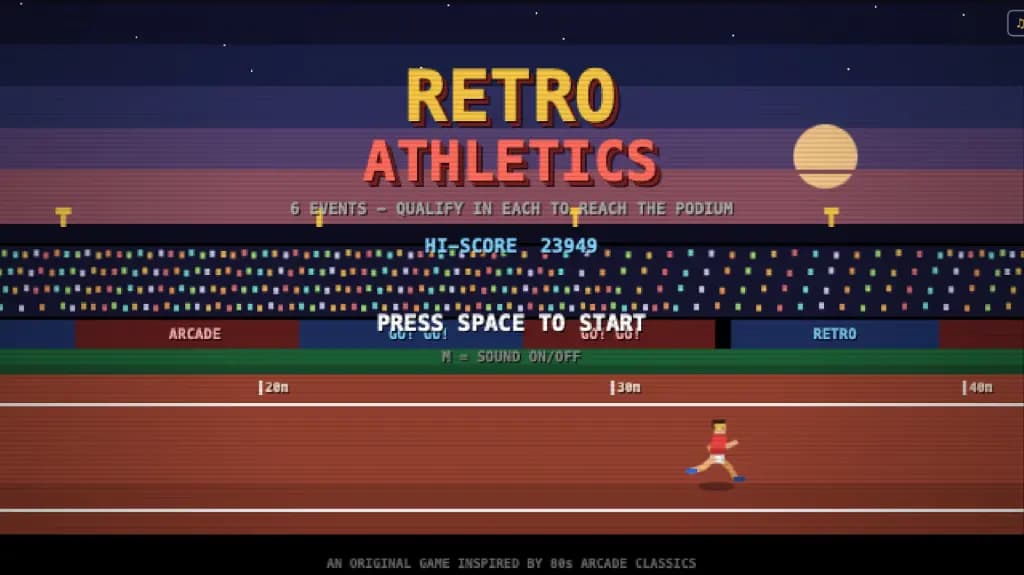
Spin the hammer up until the world blurs, then let go at exactly the right point of the circle. The hammer throw is the six-event contest's odd one out: there is no runway, no line to cross, and the running keys do not move you an inch — they spin you.
How to throw
- Spin. Alternate the two run keys (A and D, or the RUN buttons on a phone). Each clean alternation whips the hammer a little faster, and the ticking gets quicker as you do.
- Watch the circle. A green zone is marked on the swing. Releasing there launches the hammer at a good angle — about 42 degrees at the centre of the zone, flatter the further off you are.
- Release. Press the action button — spacebar, or click on the playing field — as the hammer passes through the green. On a phone it is the THROW button.
Release far too low and the throw is a foul: the hammer would have met the ground before the crowd. There is no foul line here — timing is the only way to fail.
The trade-off: speed shrinks the window
Distance is spin speed times release angle, and the two fight each other. The faster the hammer whirls, the less time it spends in the green zone each revolution, so the release gets harder exactly as it gets more valuable. A patient throw at four-fifths speed with a centred release routinely beats a furious spin with a panicked one.
That is not an accident of the game — it is the real event in miniature. A hammer thrower's release speed is everything, but only if they can still control where on the circle the hammer leaves.
The hammer is not a hammer
The implement is a 7.26-kilogram steel ball on a wire, nothing like a tool — but it used to be. The event descends from weight-throwing contests in Scotland and Ireland where actual blacksmiths' sledgehammers were thrown, and the name outlived the object by about a century.
The men's world record is one of the oldest in athletics: Yuriy Sedykh threw 86.74 m in 1986, spinning four times where most rivals turned three, and nobody has beaten it since. Like the javelin's retired record from the same era, it is a mark from the sport's wildest decade that modern athletes chase but do not catch. This game's ceiling lands a few metres short of it, which seems only respectful.
What counts as a good throw here
| Distance | What it means |
|---|---|
| 25 m | The qualifying mark in the six-event contest |
| 50 m | A steady spin and a release inside the green |
| 65 m | Both at once |
| 80 m+ | The Sedykh zone |
Three habits that add metres
- Do not release on the first pass. The first revolutions are slow; the hammer gains far more from three extra turns than from an early perfect release.
- Pick a landmark. The zone sits at the same place every throw. Release when the hammer enters the green, not when your eye says it is centred — at full spin your reaction lag does the centring for you.
- A foul is worse than a soft throw. Three attempts, best counts. Bank a clean fifty before you go hunting eighty.
The full contest
This is one event out of six. The complete Retro Athletics contest runs 100 m sprint, long jump, javelin, 110 m hurdles, hammer and high jump back to back — one score, one podium, and you are out the moment you miss a qualifying mark. The hammer is the fifth of them, and by then your forearms know it.