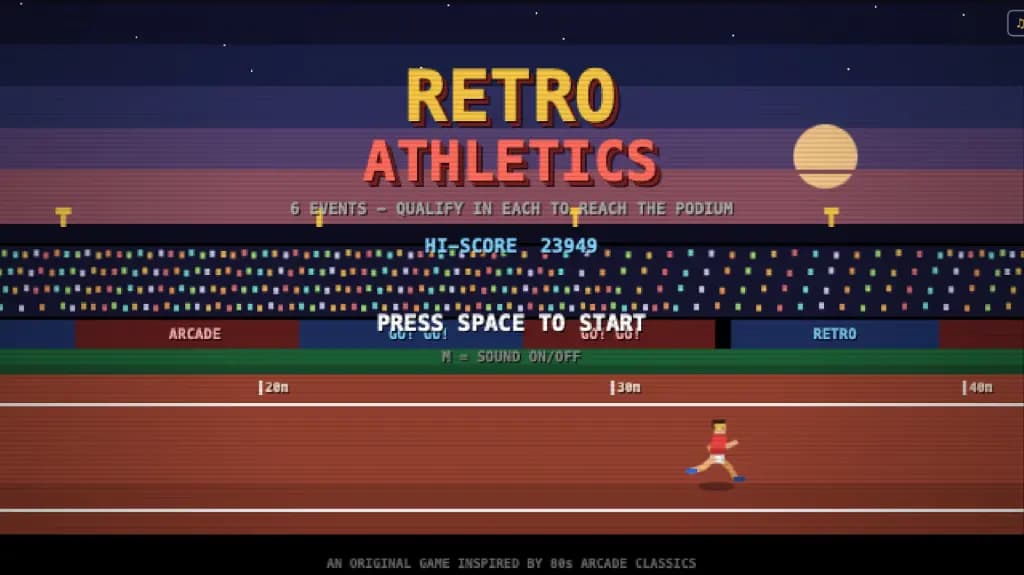
The sprint again — except ten times per race, something stands in the lane. The 110 m hurdles is the contest's coordination exam: the same flat-out alternating rhythm as the 100 m, with a jump button that has to fire ten times without ever interrupting it.
How to run
- Wait for the gun. Same start as the sprint: ON YOUR MARKS, GET SET, bang. Early movement resets the start.
- Sprint. Alternate the two run keys (A and D, or the RUN buttons on a phone) and build to full rhythm before the first hurdle — you have 13.72 metres, and you will want all of them.
- Leap. Press the action button — spacebar, a click on the field, or JUMP on a phone — a beat before each hurdle. Then get straight back on the rhythm.
Hit a hurdle and it falls, you stumble, and a quarter of your speed is gone. The race continues — no disqualification — but speed lost mid-race must be mashed back at full price.
The spacing is real
The ten hurdles stand where they stand in an actual 110 m hurdles race: 13.72 metres to the first, 9.14 metres between the rest. Those numbers are a hundred years old and they shape everything about the real event — elite hurdlers take exactly three strides between barriers, every barrier, because the spacing allows nothing else. It is less a sprint with obstacles than a dance at ten metres per second.
The game inherits that regularity, and it is a gift: once you are at full speed, the hurdles arrive on a fixed count. You are not reacting to ten surprises — you are playing a rhythm with an accent every other bar. Find the count, and the jump button becomes part of the run instead of an interruption of it.
Hurdlers do not jump
The real event's open secret: a good hurdle clearance is not a jump but a fast, flat step — the lead leg snaps down the far side, and the whole barrier costs around a third of a second. Height is wasted time in the air. The world record has stood at 12.80 seconds since Aries Merritt ran it in 2012 — barely a second slower than the flat 100 m, over ten barriers more than a metre tall.
The game agrees with the physics: its leap is fixed and low, and your time is decided by when you press, not how long. Jump late and you clip the barrier; jump absurdly early and you land in front of it with your rhythm in pieces. A beat early, every time, on the count — that is the whole event.
What counts as a good time here
| Time | What it means |
|---|---|
| 19.00 s | The qualifying mark in the six-event contest |
| 17.00 s | Clean clearances, cautious pace |
| 15.50 s | Full sprint rhythm with the jumps on the count |
| Under 14 s | The rhythm and the barriers have merged |
Three habits that cut seconds
- Jump with a spare finger. If the jump press breaks your left-right alternation, every hurdle costs you twice. Keep the running pair running and give the spacebar to a thumb.
- Take the first hurdle carefully. It arrives while you are still accelerating, off-count. Clear it safe, then lock into the rhythm the even spacing hands you.
- After a hit, rebuild before you leap. A collision kills your speed and your count. Two or three flat strides to restore both beats panic-jumping the next barrier at half pace.
The full contest
This is one event out of six — the fourth. The complete Retro Athletics contest runs 100 m sprint, long jump, javelin, hurdles, hammer and high jump back to back — one score, one podium, and a missed mark ends the run. The hurdles are where qualifying runs go to die: fast enough is easy, clean enough is not.