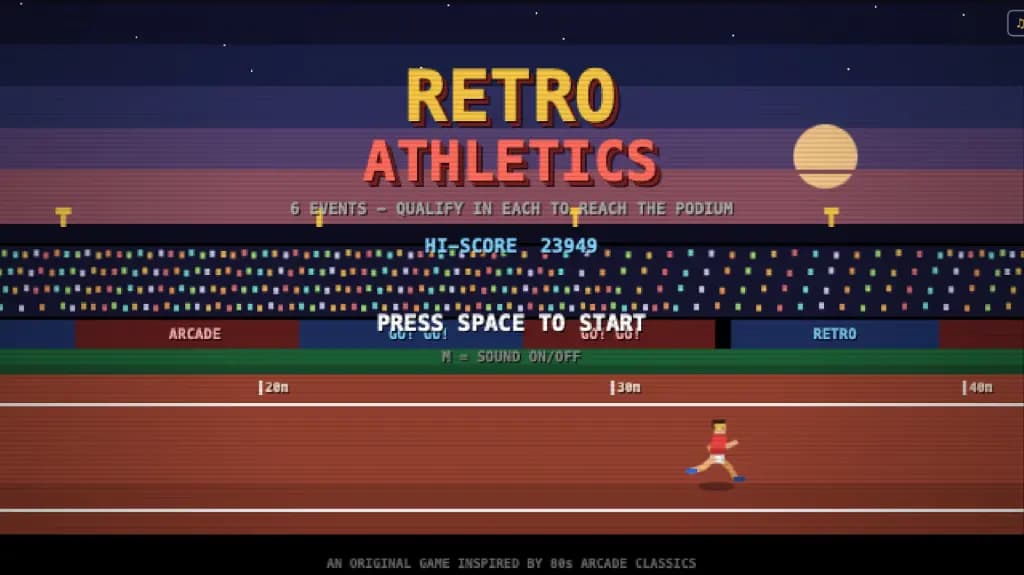
Sprint down the runway, choose the moment you leave the ground, and try not to cross the board doing it. The long jump is the simplest of the athletics events to describe and the hardest to be greedy in: the last stride before take-off is where most attempts are lost.
How to jump
- Run. Alternate the two run keys (A and D, or the RUN buttons on a phone) and watch the speed bar fill.
- Hold. Press and hold the action button — spacebar, or just hold the mouse button down on the playing field. On a phone it is the JUMP button. The angle meter climbs while you keep running, more slowly.
- Release. Let go while the needle is inside the green band, roughly 38 to 52 degrees, and before the white board. The pointer at the athlete turns green at the same moment.
Still holding when you reach the board? The jump goes off automatically. You only foul by running over the board without having started at all.
Why the game lets you pick 45 degrees and reality does not
Throw a ball and 45 degrees carries it furthest. That is the physics this game uses, and the green band sits around it — wide enough to hit without a stopwatch.
A real long jumper takes off at about 20 degrees, and not because they have not read the textbook. They arrive at the board at close to ten metres a second, and the take-off foot is on the ground for roughly a tenth of a second. There is simply no time to convert that much horizontal speed into height — pushing harder upwards mostly costs speed, and speed is what the jump is made of.
So the honest way to read this game is: the angle meter is a mechanic, not a simulation. What it does model correctly is the trade-off. Every frame you spend raising the angle is a frame you are running slower, and that tension is the real event in miniature.
Bob Beamon's 8.90 m in Mexico City in 1968 stood for 23 years and is still the Olympic record. Thin air at 2,240 metres and a following wind exactly on the legal limit helped; so did a take-off that measured, by later analysis, close to perfect.
What counts as a good jump here
| Distance | What it means |
|---|---|
| 3 m | The qualifying mark in the six-event contest |
| 5 m | A clean run-up and a sane angle |
| 7 m | Both right together |
| 8 m+ | You have the rhythm |
Three habits that add distance
- Build speed before you touch the angle. The most common mistake is starting the hold at half speed. The needle reaches the green band in about two thirds of a second.
- Learn where the board is. The runway is marked. Watch the board, not the athlete — the auto-release saves you from the worst fouls, but only if you were already holding.
- Do not chase the perfect first attempt. Three tries, best counts. Land one, then get greedy.
The full contest
This is one event out of six. The complete Retro Athletics contest runs 100 m sprint, long jump, javelin, 110 m hurdles, hammer and high jump in sequence — one score, one podium, and a missed qualifying mark ends the run. The long jump comes second.