Run at the bar, pick your moment, and jump exactly once. The high jump is the quietest event in the contest — no metres ticking past, no foul line, just a bar that keeps rising until it finds the height you cannot clear. Which it will. It always does.
How to jump
- Run. Alternate the two run keys (A and D, or the RUN buttons on a phone). Speed matters more than it looks: your take-off power comes straight out of your running speed.
- Watch the zone. A highlighted take-off zone sits on the runway just before the uprights. That is where the jump has to happen.
- Jump. One press of the action button — spacebar, a click on the field, or JUMP on a phone. No holding, no angle meter. One press, one chance.
Reach the bar without jumping and it is a balk — a miss, just as if you had rattled the bar off its pegs. Three misses at one height and the event ends with your last cleared bar as the result.
One press, no meter
The other jumping events in Retro Athletics give you an angle to manage. The high jump strips even that away, and what is left is the purest timing test in the contest: speed, one mark on the ground, one press.
That makes it deceptively easy to start — the 1.50 m opening bar forgives almost anything — and merciless later. At 2.10 m the same casual run-up that cleared the opener comes down straight onto the bar, because height is made of speed, and speed is made of the run-up you were too relaxed to build. The event does not get harder. Your habits just stop being good enough.
The bar always wins
The high jump is the only event in athletics that ends, by rule, in failure: every competition, even a world-record one, finishes with the winner missing three times at whatever came next. The game keeps that structure — the bar rises ten centimetres per clearance until 2.30 m, and somewhere on the way up it takes your measure.
The real event's story is about technique beating tradition. Until the 1960s jumpers went over face-down, in scissors and straddle styles, because they had to land in sand. When foam mats arrived, an Oregon student named Dick Fosbury realised you could go over backwards, head first — and won the 1968 Olympic gold with a technique the commentators openly laughed at. Within a decade the "Fosbury Flop" was simply how the event is done. The world record has belonged to Javier Sotomayor at 2.45 m since 1993 — the longest-standing record in men's athletics after the ones from the eighties that will never fall.
What counts as a good height here
| Height | What it means |
|---|---|
| 1.50 m | The opening bar — and the qualifying mark |
| 1.80 m | Comfortable, if the run-up stays honest |
| 2.10 m | Full speed and a late, brave take-off |
| 2.30 m | The top of the game's ladder |
Three habits that add centimetres
- Never coast the run-up. Every bar from 1.90 up punishes a lazy approach. Build full speed on every attempt, including the easy ones — the habit is the technique.
- Jump later than feels safe. The deepest part of the take-off zone gives the most forward carry over the bar. Early jumps look brave and land on the bar coming down.
- Use your three misses. A miss is information: too early, too late, or too slow. Change exactly one thing on the next attempt, not all three.
The full contest
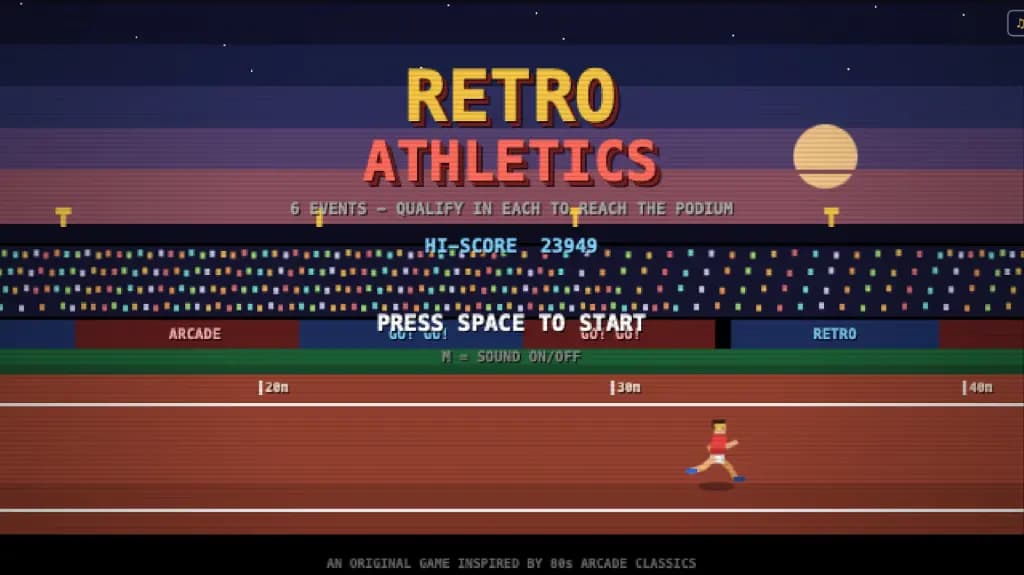
This is one event out of six — the last one. The complete Retro Athletics contest runs 100 m sprint, long jump, javelin, 110 m hurdles, hammer and high jump back to back — one score, one podium. By the time the bar starts rising, everything else is already on the scoreboard, and the only thing left to beat is your own nerve.