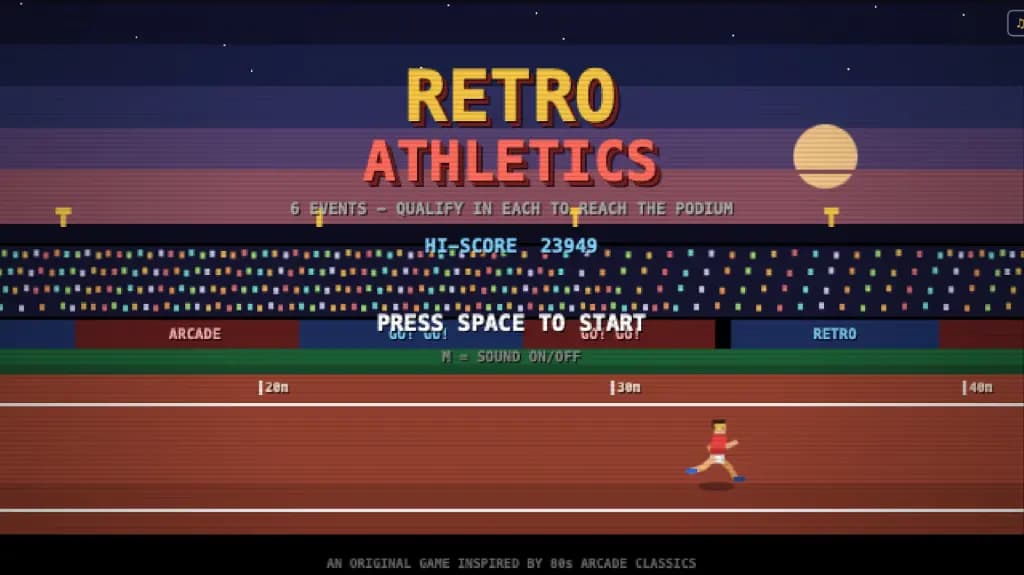
No angle meter, no foul line, no implement to drop on your foot. The 100 metres is the six-event contest reduced to its engine: a starting gun, two keys, and the question of how clean a rhythm you can hold for fifteen seconds. Every other event in the contest is built on top of what happens here.
How to run
- Wait. The starter goes through ON YOUR MARKS and GET SET. Hands off the keys — any input before the gun is a false start and resets the start.
- Go. At the gun, alternate the two run keys (A and D, or the RUN buttons on a phone) as fast as you can cleanly. The speed bar shows your pace; green means you are near the top.
- Hold it. A hundred metres takes longer than your opening enthusiasm. The race is won in the second half, where rhythms fall apart.
Alternation, not aggression
The game counts alternations — left, right, left, right. One key hammered five times is one input. That single rule is what makes the event a skill rather than a tantrum: your speed is exactly the frequency of your clean left-right signal, and nothing else. The technique guide covers the grips — two hands, or the faster one-handed trill — and the metronome mindset that survives a whole race.
The speed cap is worth knowing: the game will not let you run faster than a whisker under Usain Bolt's measured top speed — about twelve metres per second, the fastest any human has been timed on foot, mid-race in Berlin in 2009 on the way to his 9.58. That record has now stood for seventeen years. A perfect game here lands in the low tens, which is exactly where it should.
The start is free time
Everyone obsesses over hand speed; the cheapest seconds live at the gun. A sluggish reaction and a slow spin-up cost more than any mid-race wobble, because the metres at the start are run at your slowest. Real sprinters are disqualified for reacting faster than a tenth of a second — the sport decided that no human can hear a gun that fast, only guess it. The game is gentler: guess wrong and you only restart. So sit on the edge of the gun, and when it fires, spend your first half second reaching full rhythm, not finding it.
What counts as a good time here
| Time | What it means |
|---|---|
| 15.00 s | The qualifying mark in the six-event contest |
| 13.00 s | A steady rhythm, held to the line |
| 11.50 s | A clean start and a fast, disciplined trill |
| Low 10s | The ceiling — Bolt territory |
Three habits that cut seconds
- React, don't anticipate. A false start costs a full reset. Wait for the bang with fingers resting on the keys, not hovering over them.
- Spin up hard, then settle. The first second decides your average speed more than any other. Reach top rhythm fast, then drop into a tempo you can hold.
- Finish through the line, not at it. Rhythms sag when the tape appears. Run to a point a few metres past the finish and let the clock catch you quick.
The full contest
This is one event out of six — the first. The complete Retro Athletics contest runs the sprint, then long jump, javelin, 110 m hurdles, hammer and high jump back to back — one score, one podium, and a missed mark ends the run. The sprint is the gatekeeper: fifteen seconds here, or none of the rest exists.