
Every button-mashing sports game comes down to one question, asked with increasing desperation somewhere around the third event: how do people press keys that fast?
Mostly, they don't. The players who post fast times in Track & Field-style games are rarely the ones with the fastest hands. They are the ones who understood three things about how these games actually measure speed — and then picked a technique their hands can sustain for a full race instead of one glorious second.
Alternation is the measurement, not the obstacle
The first thing to understand is what the game is counting. In almost every game of this family — from the 1983 arcade original to modern browser versions — hammering one button does nothing. The engine counts alternations: left, right, left, right. One key pressed twice in a row is a single input, no matter how hard you hit it.
That changes the problem completely. You are not being asked to press keys quickly. You are being asked to produce a clean left-right signal at a high, steady frequency. Those are different skills. A frantic burst that doubles up on one key — left-left-right-left — throws inputs away exactly when you feel fastest. A calm player producing a perfectly clean alternation at a moderate tempo will beat a flailing player producing a dirty one at a high tempo, every time.
So the goal is not fury. The goal is a clean signal.
The three grips, ranked
There are three standard ways to alternate two keys, and they are not equal.
Two hands, one finger each. An index finger on each key. This is what everyone does first, and it is the slowest of the three, because each hand has to complete its whole down-up cycle alone. It is, however, almost impossible to get wrong, and it is the most comfortable over a long session. A reliable starter grip.
Two fingers, one hand. Index and middle finger of one hand on the two keys, drumming like a two-note piano trill. This is the technique to learn. The fingers share one hand's tension, the alternation comes almost for free — a drumroll is an alternation — and with a loose wrist a trill runs noticeably faster than two separate hands. Pianists and drummers are disgustingly good at these games, and this is why.
The claw. Both hands stacked over the keys, fingers from each. Faster in theory, chaos in practice: the coordination cost eats the gain, and doubled inputs creep in. Arcade legends used variations of this on big cabinet buttons; on a keyboard it is mostly a way to press A twice in a row.
Start with two hands. Switch to the one-handed trill when you want the next gear. It feels slower for the first ten minutes and then it is simply faster.
Rhythm survives the race — bursts do not
A 100 m sprint in these games lasts around fifteen seconds, and fifteen seconds is a long time for hands. The most common way to lose a race is to open at a tempo you can hold for five.
Think of it like the real event it imitates: sprinters do not accelerate for a hundred metres, they reach top speed and then try not to lose it. In the game, your top speed is the fastest clean alternation you can sustain, and your race is won by holding it. Set a metronome in your head — steady eighth-notes, not a drumroll you hope survives — and speed the metronome up across sessions, not across a single race.
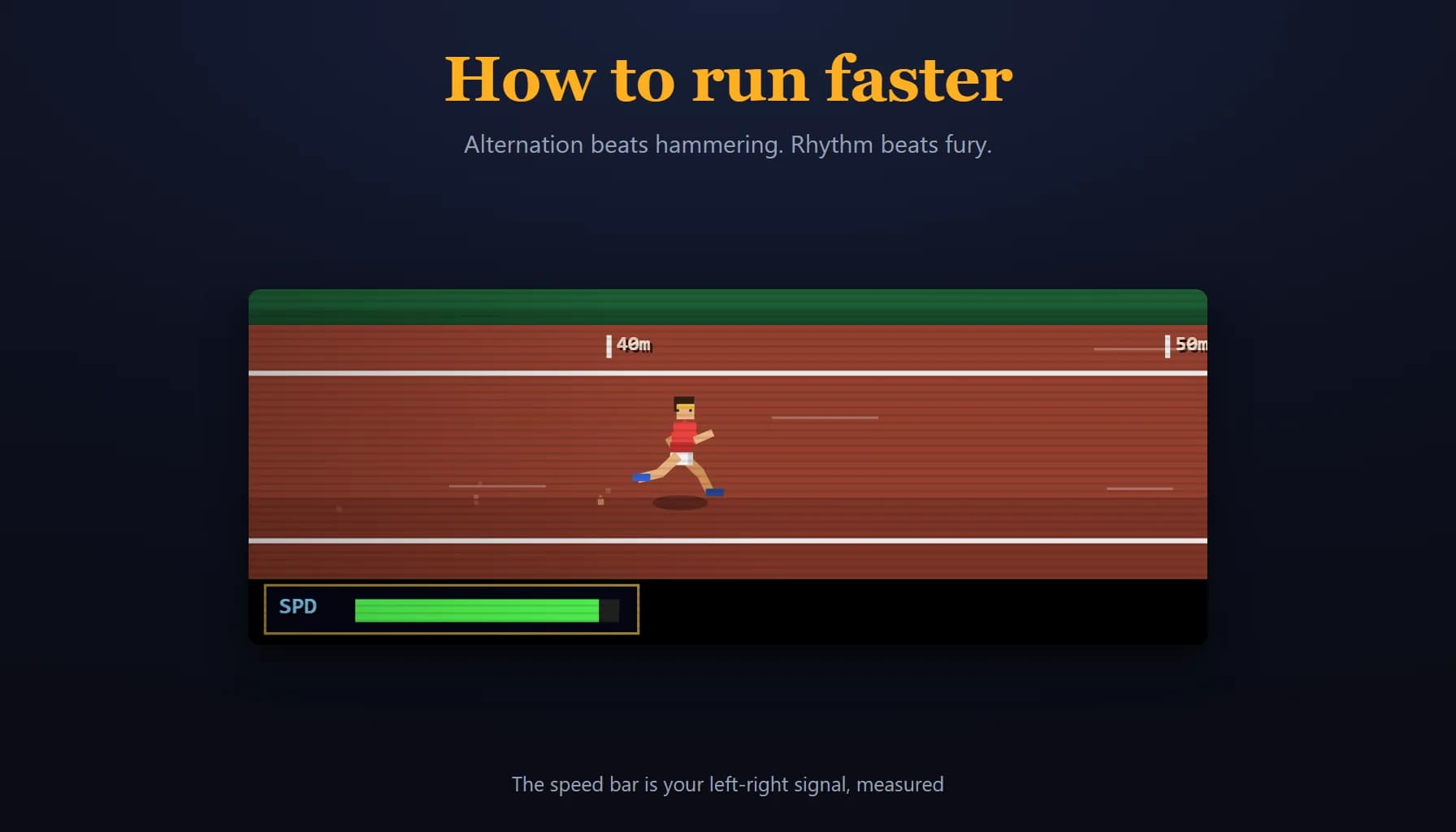
The sprint page makes a good practice bench for exactly this, because it is the one event with nothing else to think about: no angle, no line, no bar. Your time is your rhythm, measured.
The arcade tricks, and why they died
The 1983 cabinets spawned a whole folklore of go-faster techniques: rulers laid across the two buttons and strummed, spoons, superballs, the famous "scrubbing" of a gloved palm dragged back and forth across both buttons. Konami reportedly redesigned later cabinets partly to defeat the ruler trick. Players will optimise anything, including the interface itself.
None of it translates to a keyboard. Keys sit in sockets, not proud of a metal panel, and there is nothing to strum. What does translate is the idea underneath those tricks: every one of them converted a hard task (press fast) into an easy one (produce an alternating signal cheaply). The one-handed trill is the same idea, minus the cutlery.
One modern note: on some keyboards, holding several keys at once can block further presses. If your inputs feel swallowed, that may be the hardware — alternate cleanly and release fully rather than mashing keys down together.
When mashing is only half the event
Pure speed wins the sprint, but most events in a six-event contest attach a second skill to the rhythm, and the interplay is where times and distances are really made.
- In the long jump and javelin, the run-up is the throw: distance is roughly speed times angle. Every moment spent holding the angle button is a moment you are slowing down, so build full speed first and start the angle late.
- In the 110 m hurdles, the skill is keeping the rhythm through interruptions — press jump with a finger that is not part of your running pair, or the leap will cost you the alternation.
- The hammer throw is mashing in disguise: the alternation spins you faster, and only the release timing is new.
- The high jump barely cares about your top speed — it cares whether you can keep running cleanly while watching for a mark.
Be kind to your hands
Real talk, because these games are older than ergonomics: keep the wrist loose, let the fingers do the work, and stop when anything aches. Fifteen minutes of relaxed, rhythmic play beats an hour of white-knuckled hammering — for your tendons and for your times. The best mashers in forty years of this genre have all, in the end, been drummers rather than blacksmiths.
Now go beat your sprint time. Steady eighth-notes. You know the technique.