
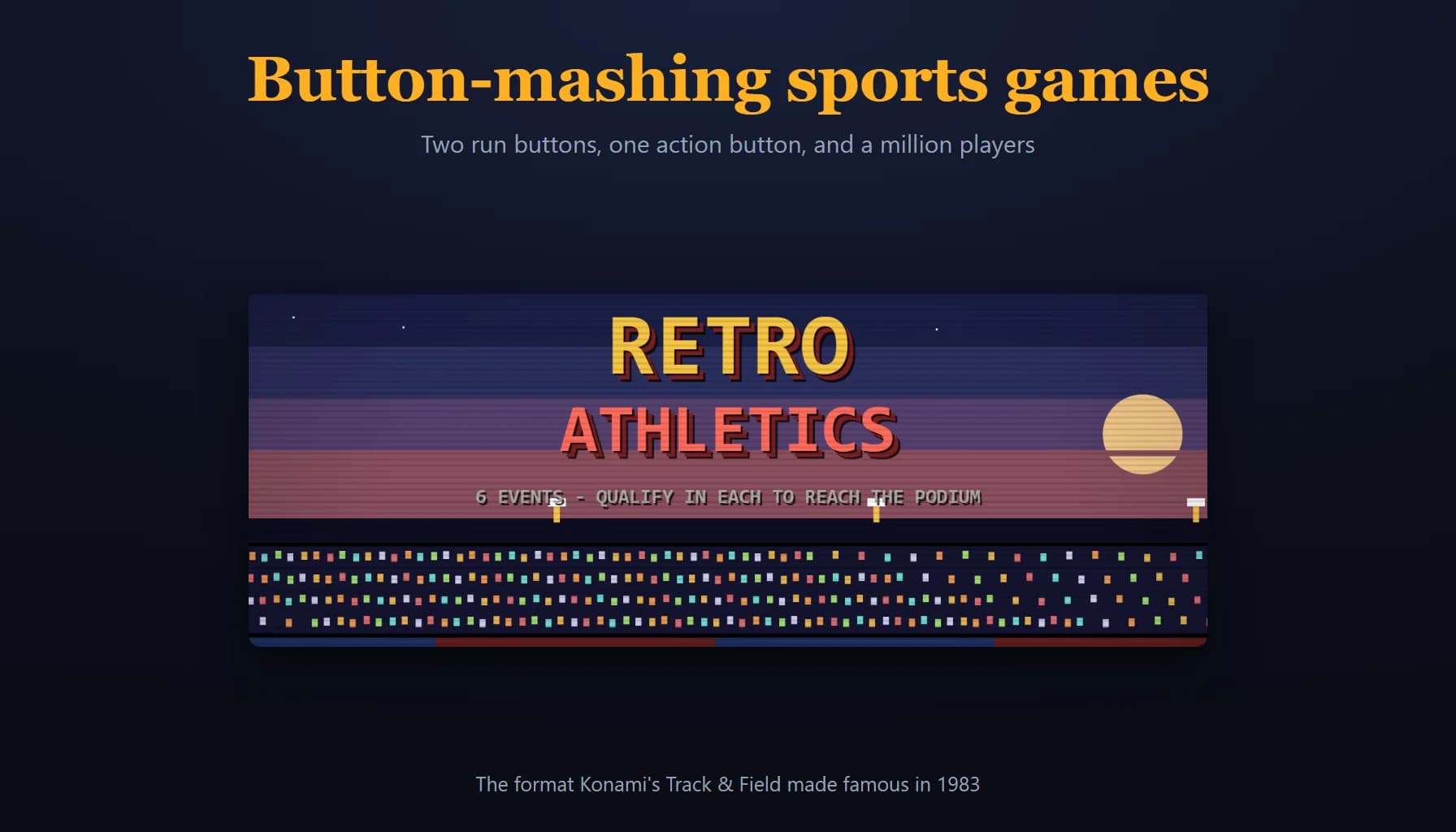
In September 1983, Konami released an arcade game with no enemies, no spaceship and no maze. It had a running track, six athletics events, and a control scheme you could explain to anyone in one sentence: press these two buttons very fast, and press that one at the right moment.
In Japan and Europe it was called Hyper Olympic. In North America it became Track & Field, and within a year it had done something no shooter ever managed — it put over a million people into a single organised competition.
Six events and one idea
The 1983 original ran six events: the 100-metre dash, long jump, javelin throw, 110-metre hurdles, hammer throw and high jump. Two run buttons built your speed when tapped alternately; one action button jumped, threw or released at an angle. Miss the qualifying mark in any event and the game was over, no matter how many coins were left in your pocket.
If that structure sounds familiar, it should — it is the exact template that athletics games have copied for four decades, and it is the one Retro Athletics plays as an open homage: the same six events in the same order, from the sprint through long jump, javelin, hurdles, hammer and high jump.
The design insight, in hindsight, was that an athletics meet is already a video game. Sport had spent a century compressing human effort into single numbers — one time, one distance, one height. Konami just needed an input that could measure effort. Which raises the obvious question.
Why two run buttons?
Because one button cannot measure a stride.
A single button rewards whoever can vibrate a finger fastest — or wedge something against the button. Two buttons that only count alternating presses turn mashing into cadence: left, right, left, right. It is a tiny model of running, and it produces the same physical drama at the cabinet that a race produces on a track — tension, rhythm, collapse. That one decision created the genre. (Some later cabinets swapped the buttons for a trackball, which players span with a flat palm — same idea, rounder.)
Players, of course, immediately began optimising the interface itself. The folklore of the era is full of go-faster tools: rulers and pens strummed across the two buttons, bouncy-ball tricks, the gloved-palm "scrub" dragged back and forth so each pass hit both buttons. Arcade operators grumbled, buttons wore out, and the tricks became part of the game's legend. Forty years on, the honest version of that arms race is learning to trill two keys like a drummer — the cutlery, sadly, stays in the kitchen.
The million-player tournament
Here is the fact that best measures what Track & Field was in 1984: between 30 April and 26 May of that year, Konami and its US distributor Centuri ran the 1984 March of Dimes International Track & Field Challenge, a charity tournament held across American arcades and in Japan. It drew more than a million contestants — around 800,000 in the United States and 200,000 in Japan — and Guinness World Records later recognised it as the largest organised video game competition ever held, a record that stood for decades.
Gary West of Oklahoma City won the US final; Phil Britt of Riverside, California took the world championship in Tokyo that June. Remember that this was 1984 — decades before esports had a name, arena crowds or streaming. A game about pressing two buttons in alternation got there first, with a charity fundraiser.
The rivals: waggle, wreckage and timing
Success that loud gets copied fast, and 1983–84 produced a whole field of rivals, each solving the "measure effort" problem differently.
The Activision Decathlon (1983), designed by David Crane for the Atari 2600, replaced buttons with the joystick itself: you waggled the stick left and right to run. Daley Thompson's Decathlon (Ocean, 1984) brought the same idea to British home computers and became famous less for its gameplay than for its casualty rate — a generation of joysticks died on its 1,500 metres, and "the game that broke your joystick" is still its epitaph.
The smartest divergence came from Epyx, whose Summer Games series (1984 onwards) quietly de-emphasised mashing in favour of timing and rhythm — pole-vault releases, diving rotations, gymnastics steps. It traded the physical comedy of the arcade for precision, and its descendants are everywhere in modern sports minigames.
Konami itself followed up with Hyper Sports in 1984 — new events, same two-buttons-and-timing grammar — and returned to the format as late as 1996 with International Track & Field on the PlayStation, teaching a new generation the same forearm burn.
The long tail: from Beijing to QWOP
The format never really died; it just changed venues. Konami's athletics series resurfaced around Olympic years, and from 2007 the Mario & Sonic at the Olympic Games series carried the two-inputs-and-timing formula to tens of millions of living rooms, with waggled controllers standing in for the old buttons.
And in 2008 the genre received its strangest tribute: Bennett Foddy's QWOP, in which four keys control a sprinter's individual thighs and calves, and simply finishing 100 metres is a triumph. QWOP is a parody, but it is a loving one — it takes the genre's founding idea, running is harder than it looks, and turns the dial to the maximum.
Playing the format today
The 1983 original still exists in official form — Konami has reissued it over the years in its arcade collections and modern re-releases — and its descendants fill every platform that has ever had two buttons.
If you just want the format itself, in a browser, with no download: that is what Retro Athletics is for. Six events, two run keys, one action button, and a qualifying mark that does not care how nostalgic you are. The buttons are yours; we cannot help with the forearms.