
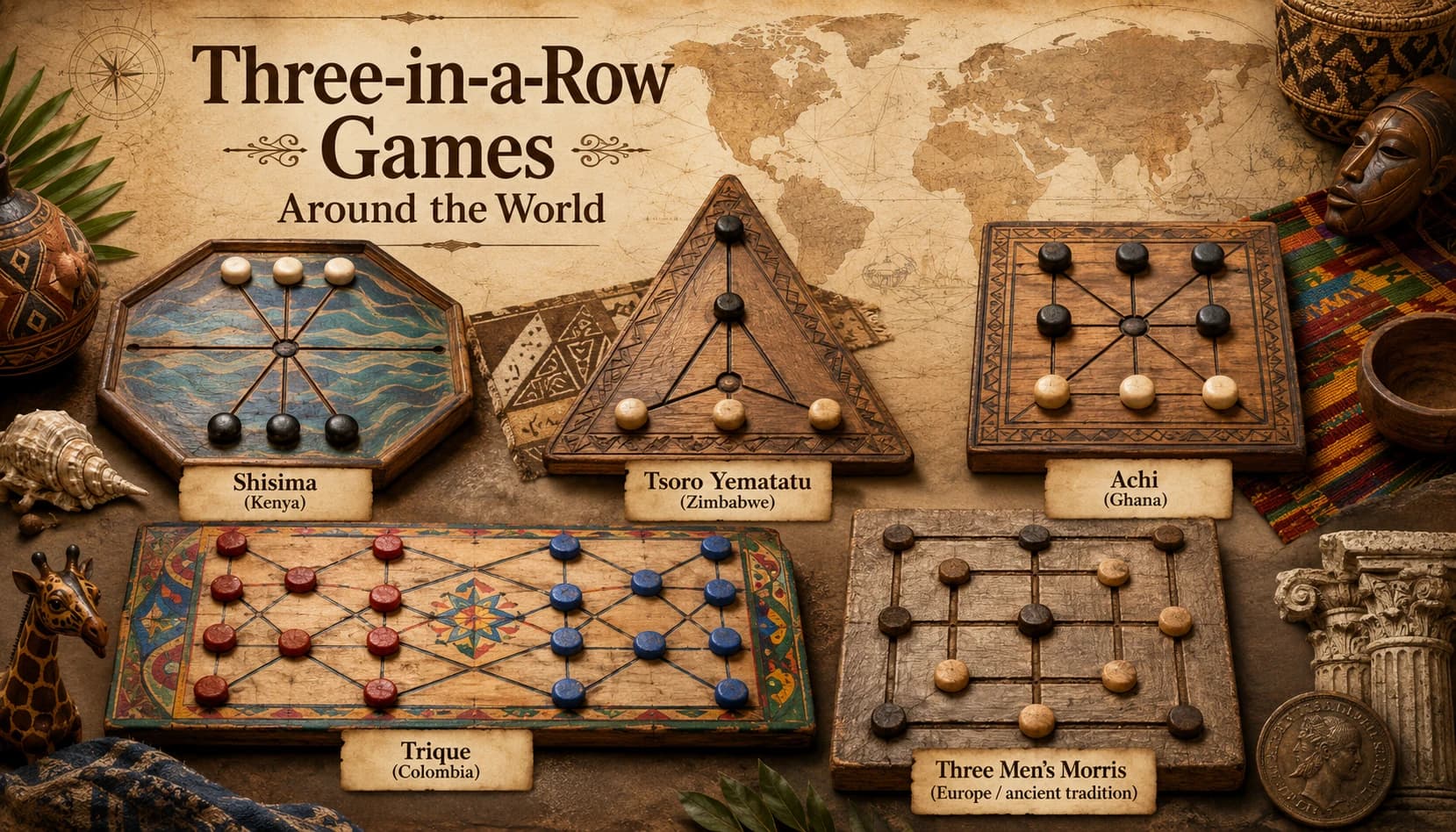
Almost every culture that has ever had a flat surface has invented a game where you put down three counters and try to get them in a line. And almost every one of them ran into the same wall: one point on the board is worth more than all the others, and whoever takes it first tends to win.
What is interesting is not that they all hit the problem. It is that they solved it in four genuinely different ways — and you can see all four just by looking at where the winning lines cross.
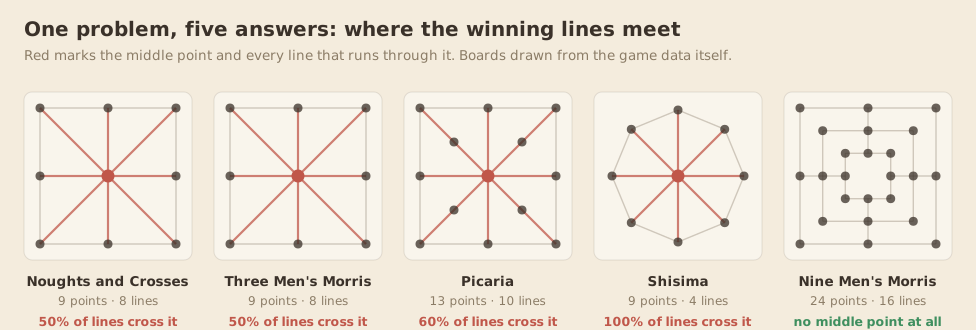
Why does the middle square decide noughts and crosses?
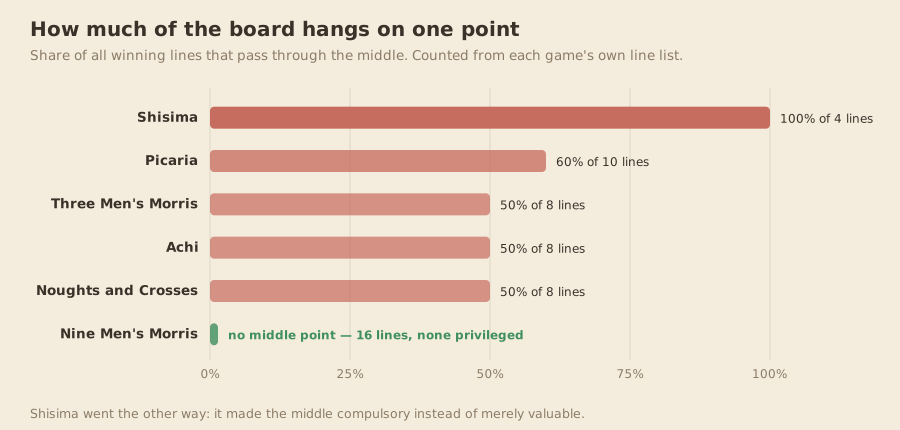
Nine squares, and eight ways to make a line: three rows, three columns, two diagonals. Count how many of those eight pass through the centre and you get four — a corner sits on three, an edge on only two.
So the opening move is not really a choice. Take the middle and you are on half the winning lines in the game; take an edge and you are on a quarter.
The problem is not that it is unfair — it is that it is finished
Noughts and crosses does not actually favour the first player. Two people paying attention will draw every single time, and all 255,168 possible games come down to a handful of ideas you have exhausted by about age seven. That is the failure mode: not an unfair game, a dead one. Every other game on this page is an attempt to keep the same three-in-a-row idea alive for adults.
The other fix, which every one of them uses: stop filling, start moving
There is a second thing wrong with noughts and crosses, and it is easy to miss because it looks like the whole game. You place a mark and it stays there forever. Nine squares, nine moves, and the board fills up — so the game cannot last longer than the board is big, and the last few moves are usually forced.
Every other game here places its men and then keeps going. The pieces slide, the position changes without anything being added, and a game can run as long as both players keep finding ideas. That single change is what turns a two-minute diversion into something two adults will play three times in a row — and it is why the boards below can be so small and still worth sitting down to.
Three Men's Morris: the same nine points, one extra rule
Take the noughts and crosses grid, give each player three men instead of five, and let them keep moving after they are all placed. That is Three Men's Morris — Roman, and still played across half the world under a dozen names.
Suddenly the middle is worse than an advantage. It is a win.
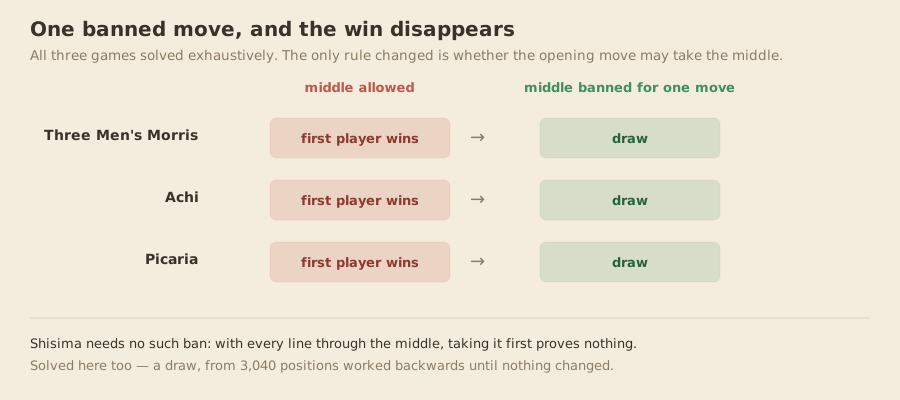
So the game comes with a rule that looks arbitrary until you test it: the first player may not open in the centre.
We solved the board, and the ban is worth exactly one result
That rule is not decoration. We ran the game out completely — every position of the sliding phase, with the placing phase on top:
- Centre open on move one → the first player wins by force
- Centre closed on move one → a draw with correct play
One forbidden square is the difference between a game and a demonstration.
Achi: four men each, and only one empty point
Achi is from Ghana, and it makes one change: four men a side instead of three, on the same nine points. Do the arithmetic and something odd falls out — 4 + 4 = 8 pieces on 9 points, so when the placing is done there is exactly one empty point left.
The whole second half of the game is therefore a sliding-block puzzle. You cannot manoeuvre; you can only push one piece into the single hole, which immediately opens a different hole somewhere else. Every move you make hands your opponent a new option, and there is never a quiet move to pass with.
Achi keeps the same centre rule as its Roman cousin, and for the same reason — we solved it too, and the result flips the same way.
Picaria: thirteen points instead of nine
Picaria, played by the Zuni and other Pueblo peoples of the American Southwest, is the one that redraws the board. It keeps the nine points and adds four more, each sitting halfway between a corner and the middle.
That sounds cosmetic. It is not. Those four points cut each long diagonal into two short three-point lines, so a corner and the centre are no longer neighbours — and the middle now sits on six of the ten winning lines instead of four. Picaria did not weaken the centre. It made it stronger, and then banned it on move one like everybody else.
One caution on Picaria that we would rather state than hide: the thirteen-point geometry is a reconstruction. The two things every source agrees on are "four extra points forming an inner square" and "four extra diagonals", and there is precisely one arrangement that satisfies both. It is reasoned, not copied from a surviving board.
Shisima: the board that makes the middle compulsory
Shisima comes from Kenya, and it is the cleverest solution here by some distance. The board is an octagon with a hub — the shisima, the body of water at the centre. Eight points around the rim, one in the middle, three men each, and no placing phase at all: everything starts on the board.
Now count the winning lines. There are four, and every single one is two opposite rim points plus the hub.
If every line needs the middle, holding it proves nothing
That is the trick. On every other board here, the centre is worth more than the other points, so you race for it. On Shisima the centre is worth everything — which means both players need it, neither can be denied it forever, and sitting on it achieves nothing on its own. The board defuses the middle by making it a prerequisite instead of a prize.
Solved: a draw, over 3,040 positions
Shisima has no placing phase, so pieces can shuffle indefinitely and an ordinary search runs in circles. We worked it backwards instead — every legal arrangement, marked from the decided positions outwards until nothing changed:
- 1,680 possible arrangements of three white and three black men
- 1,520 of them with no line already finished, giving 3,040 positions
- nine passes to reach a fixpoint
- from the standard opening: a draw
No banned squares, no extra rules. The geometry does the work.
Nine Men's Morris: delete the middle entirely
The last answer is the most radical, and it is the one that won. The Morris family blew the board up to twenty-four points arranged as three nested squares — and if you look for the middle point, there isn't one. The centre of the board is empty space.
With no privileged square, there is nothing to ban and nothing to race for. Sixteen winning lines, none of them more valuable than the rest, nine men each, and enough room that the game stayed interesting for two thousand years. The family kept growing from there: Six Men's Morris on sixteen points, Twelve Men's Morris and Morabaraba on twenty-four with the diagonals restored and twenty lines.
The short version
| Game | Points | Lines | Through the middle | The fix |
|---|---|---|---|---|
| Noughts and Crosses | 9 | 8 | 4 of 8 | none — and the game dies |
| Three Men's Morris | 9 | 8 | 4 of 8 | ban it on move one |
| Achi | 9 | 8 | 4 of 8 | ban it, and fill the board |
| Picaria | 13 | 10 | 6 of 10 | ban it on a bigger board |
| Shisima | 9 | 4 | 4 of 4 | make it compulsory |
| Nine Men's Morris | 24 | 16 | none | remove it |
Questions people actually ask
What is the oldest three-in-a-row game?
The Morris boards are the ones with hard evidence behind them — cut into Roman paving from Britain to Syria. Three Men's Morris shares that ancestry. Beware the older dates you will see quoted for scratched grids in ancient stone: the stone is dated, the scratches are not.
Is noughts and crosses a solved game?
Yes, and it has been for as long as anyone has bothered. Both sides playing correctly always draw. That is precisely why every culture that liked the idea went on to build something harder on top of it.
Which of these is the best game for two adults?
Shisima if you want something you can teach in thirty seconds and still lose at, and Nine Men's Morris if you want an evening. Achi is the strangest of them — a game with one empty square is unlike anything else on this list.
Are there more of these?
Many more. The picture at the top of this page shows two we do not have here yet: Tsoro Yematatu from Zimbabwe, played on a triangle, and Trique from Colombia. The same idea has been invented independently on every inhabited continent, which is about as strong a hint as games history ever gives you that the idea is a good one.
Play them here
All of these run in the browser, free, no account:
- Shisima — the wheel, three men a side, no placing phase
- Three Men's Morris — the Roman original
- Achi — four men each and a single empty point
- Picaria — the thirteen-point Pueblo board
- Nine Men's Morris — the one that removed the problem
- Morabaraba — twelve cows and the diagonals back
And if you would rather have them on paper, the printable boards are all there too.