Thirteen points, not the usual nine. Four extra points sit halfway between each corner and the centre, splitting every long diagonal into two short lines instead of one — the one real structural difference that separates Picaria from every other three-in-a-row game built on the plain nine-point grid.
How to play Picaria
Two players, three men each, ten winning lines on a board most games in this family don't use. Get three of your colour in a row and you win — there's no capturing here at all.
How do you set up a Picaria board?
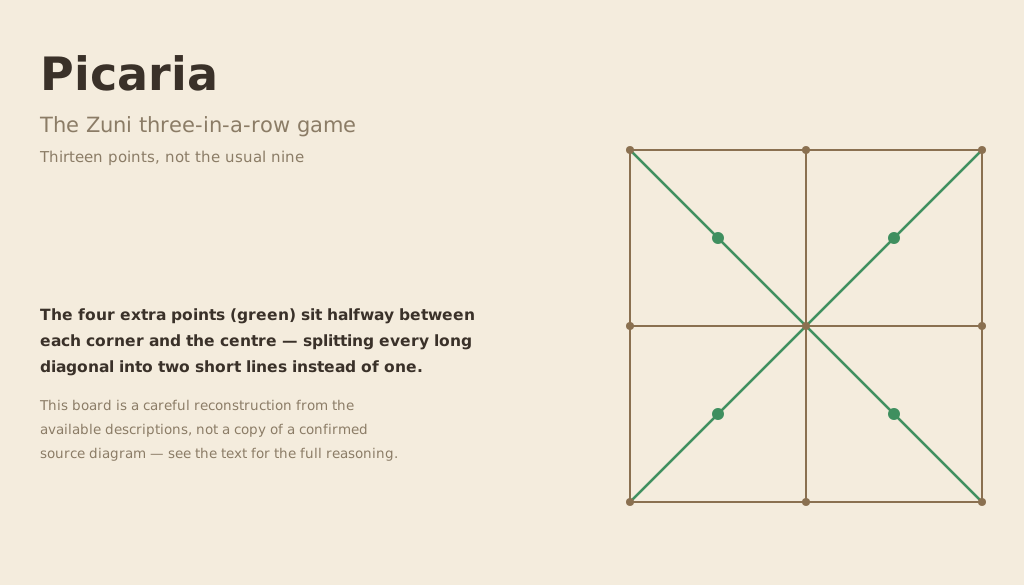
There's nothing to arrange before play starts — thirteen empty points, and whoever's turn it is places first. Light places first, and may not take the centre on that opening move; after that it's open to either side for the rest of the game.
Moving: place, then slide
- Place — one man a turn, onto any empty point, until all six are down.
- Slide — once placing is done, move one of your own men along a drawn line to an empty neighbouring point.
- No legal move loses, the standard rule this whole family shares.
A genuine extra winning line, not a cosmetic addition
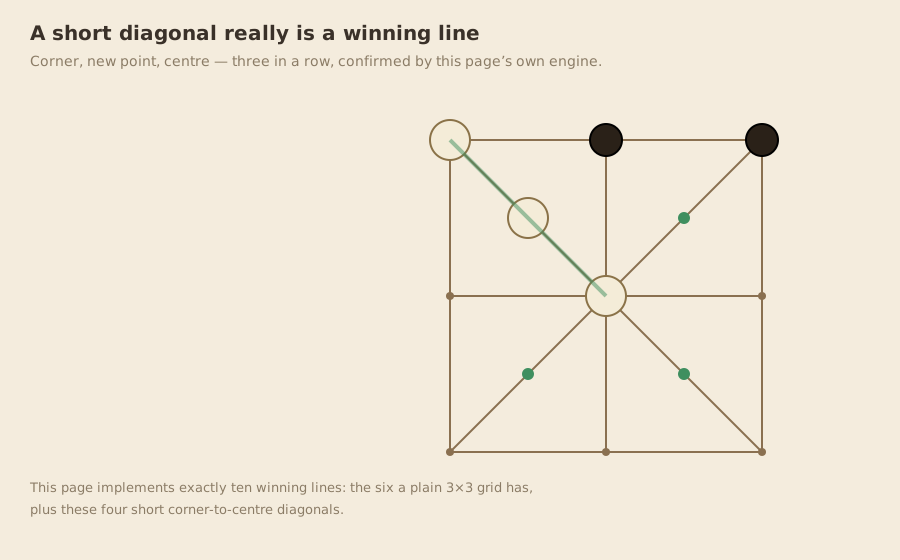
Each of the four new points sits exactly on a straight line between a corner and the centre — meaning the two long diagonals a plain nine-point board would have are each split into two separate three-point lines here instead. This page implements exactly ten winning lines in total: the three rows, three columns and two diagonals a 3×3 grid already has, plus these four short corner-to- centre diagonals. The centre point sits on six of the ten — every row, column, and all four short diagonals — making it the single most valuable point on the board by a wide margin.
Picaria strategy
The centre is worth even more here than on a plain board
On a standard nine-point three-in-a-row board, the centre sits on four lines. Here it sits on six — the middle row, the middle column, and all four short corner-to-centre diagonals. Losing the race for it on the second placement of the game (since it's locked on the very first) costs you more on this board than the equivalent moment costs on a plain nine-point one, precisely because so many more of the ten possible winning lines run straight through it.
The new points reward patience, not haste
Each of the four new points only connects to two neighbours — its corner and the centre — compared to three or more for almost every other point on the board. That makes them poor places to rush a piece toward early, since a piece sitting there has very little room to manoeuvre later in the sliding phase if the position doesn't go your way. They're much stronger as the third piece completing a short diagonal you've already set up, not as an opening placement in their own right.
Watch both diagonal halves, not just one
Because each long diagonal is now two separate three-point lines instead of one, a piece near the centre can be one slide away from completing either half — a threat a plain nine-point board simply doesn't have, since there the whole diagonal is a single line an opponent only has to break once. Here, blocking one half does nothing to protect the other.
Where does Picaria come from?
Picaria comes from the Zuni people and other Pueblo communities of the American Southwest. Like a great many traditional games played directly on the ground or on a board scratched by hand, its exact original form is harder to pin down with certainty than a game sold in a box with a printed rulebook — which is exactly the situation this page ran into while researching the board itself, addressed honestly below rather than glossed over.
Why this page's board is a reconstruction, not a copy
Every source we could find — an encyclopedia entry, an academic paper analysing the game mathematically, instructions for building a physical board by hand — agrees that the real, traditional Picaria board has thirteen points, not the plain nine a lot of digital versions default to. They also agree on the general shape: four extra points, forming a smaller square around the centre, connected by four additional diagonal lines. What none of them provided was an exact diagram or coordinates precise enough to build from directly — one academic source even substitutes the simpler nine-point board for its own proofs specifically because the real one is more complicated to formalise.
So the board on this page is a reconstruction: the specific geometry that satisfies every description at once — nine standard points plus four more, each at the midpoint between a corner and the centre, each also splitting that diagonal into two separate winning lines. Before treating it as finished, we checked it the same way every solved board on this site gets checked: brute force, confirming that with the centre closed on the opening placement, correct play from both sides is a genuine draw rather than a hidden forced win for one side. It passed. That doesn't make this page's board an archaeological certainty — it makes it a specific, considered, disclosed choice, built to be worth actually sitting down to play rather than either quietly guessed at or avoided entirely for being too uncertain to touch.
Playing against the computer
How do the three computer levels differ?
In how many moves ahead the search looks, and how reliably it commits to the best one it finds — the same design every Morris-family opponent on this site shares, Achi and Three Men's Morris included. Easy checks only a couple of moves deep and sometimes plays a weaker move anyway; hard searches much further and almost never does.
If you like this one
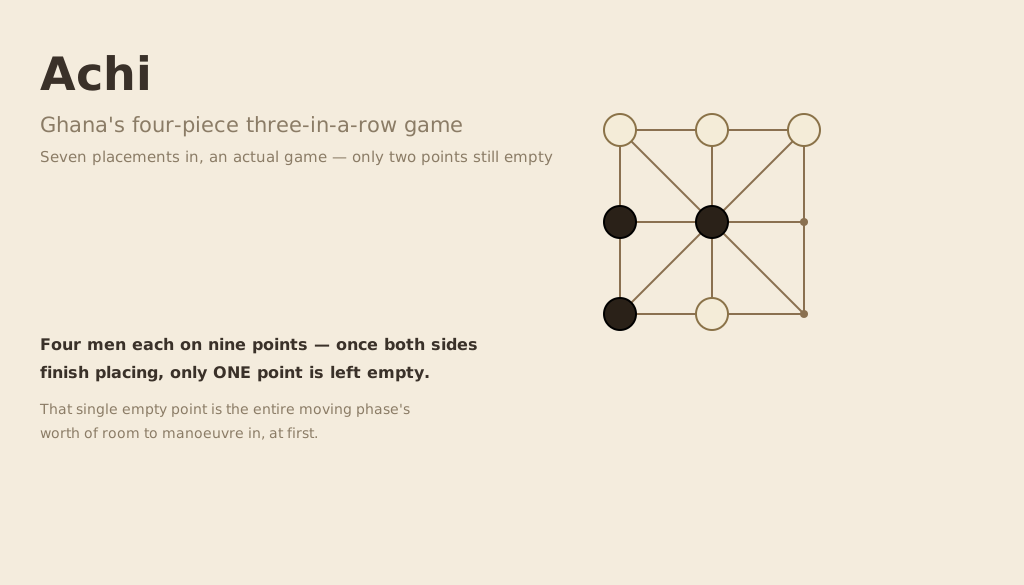
- Achi — a different three-in-a-row tradition entirely, from Ghana, on the plain nine-point board with four men a side instead of three
- Three Men's Morris — the simplest version of this whole family, and the one Picaria is most often confused with when only its nine-point variant gets shown
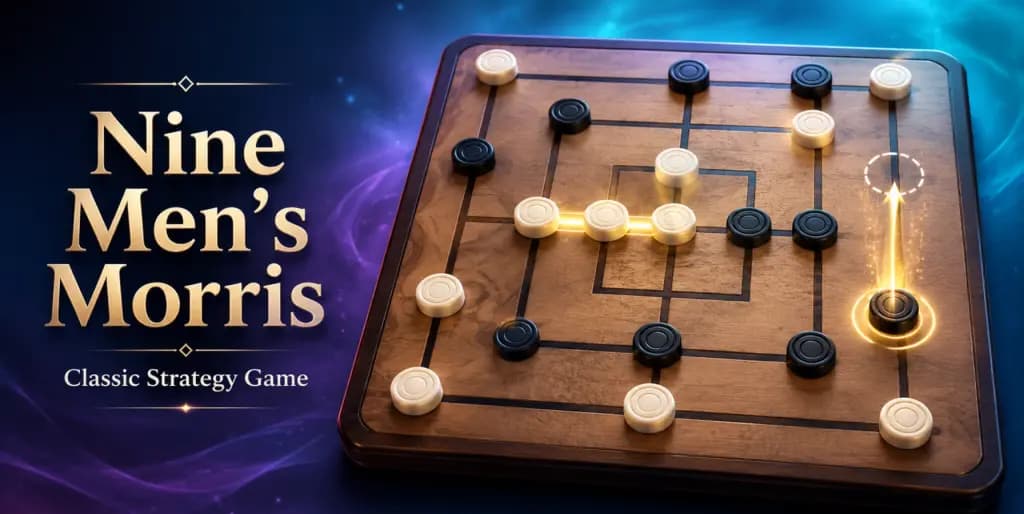
- Nine Men's Morris — the same idea of aligning pieces, grown into a full capturing game on a much bigger board
- Senet — another ancient board game whose exact original rules nobody fully agrees on either