Four men each on nine points — one more than Three Men's Morris, and just enough that only a single point stays empty once everyone's down. Getting that extra piece onto the board is exactly what makes Achi a different game, not just a bigger one.
How to play Achi
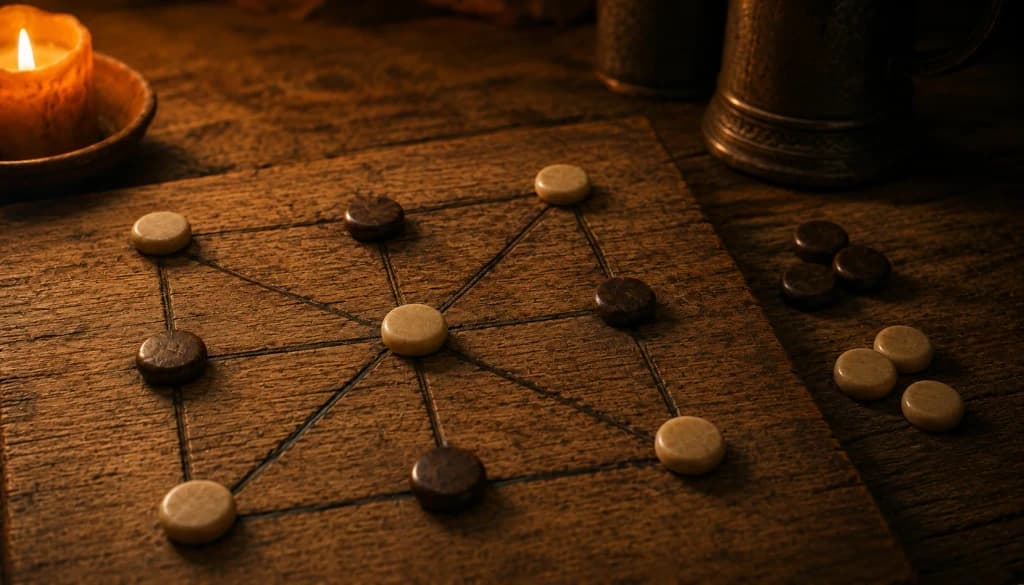
Two players, four men each, the familiar three-by-three grid with every line drawn: three rows, three columns, both diagonals. Get three of your colour in a row and you win — there's no capturing here at all.
How do you set up an Achi board?
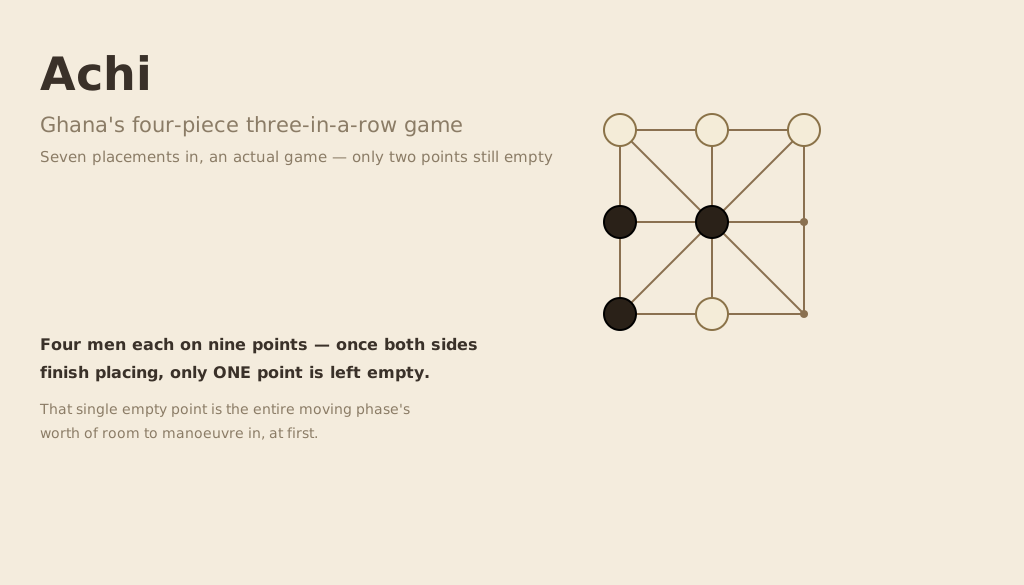
There's nothing to arrange before play starts: nine points, eight men total once both sides finish placing, and whoever's turn it is places first. Light places first, and may not take the centre — after that opening move the centre is open to either side for the rest of the game.
Moving: place, then slide
- Place — one man a turn, onto any empty point, until all eight are down.
- Slide — once placing is done, move one of your own men along a drawn line to an empty neighbouring point. With only one point open at the start of the sliding phase, your very first slide is often the only legal one available.
- No legal move loses. Unlike some relatives of this game, there's no draw for being stuck — getting boxed in costs you the game outright.
Why a completed row doesn't win during placement
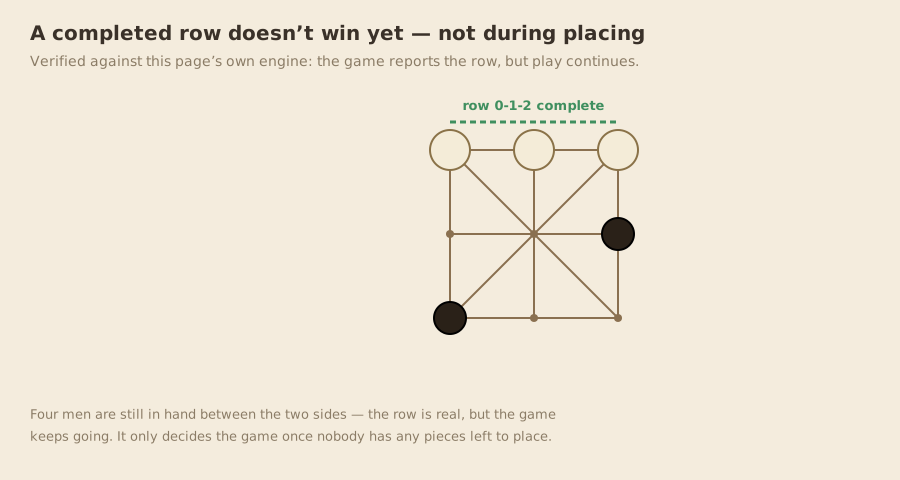
This is the one rule about Achi that isn't obvious from the pieces and board alone, and it's not a house rule invented for this page — it's a finding. Four men a side on nine points leaves only one empty point once placing finishes, and we tested what happens if a completed row wins the instant it appears, the way it does in Three Men's Morris: every single combination of a locked opening point and how long it stays locked hands the whole game to one side, checked by brute force, no exceptions. There simply isn't enough room on the board for placement to matter as real strategy under that rule.
Delay the win check instead — a completed row only decides the game once nobody has any pieces left to place, whether that's the exact moment placing ends or later in the sliding phase — and the picture changes completely: with the centre closed on the opening move, the game becomes a genuine draw with correct play from both sides. That's the rule this page actually implements. It's a real simplification of the traditional game, not a rediscovery of some documented exception, and it's disclosed here rather than left silent, in keeping with how every other computed ruling on this site gets treated.
Achi strategy
Why four pieces changes everything
With Three Men's Morris, the board still has real breathing room once placing ends. With Achi, it doesn't — eight of nine points are full, and your very first slide might be forced. That single difference means placement itself is where an Achi game is actually won or lost far more than the sliding phase that follows it: think about which point stays empty and who benefits from being stuck less, not just which points you personally occupy.
Should you form a row early even though it doesn't win yet?
Usually, yes — a row that's already sitting on the board the moment placing ends is extremely strong, because it means your very first slide in the moving phase might not even be necessary to win: if the row survived intact (nothing forced you to break it while filling the rest of the board), the game is decided the instant both hands are empty, no move required. The real skill isn't rushing to form one — with four pieces and eight lines it's not hard to stumble into a row by accident — it's noticing you have one early enough that your remaining placements protect it rather than accidentally forcing it to break before placing actually finishes.
The centre matters even though it can't be taken first
Being unable to open on the centre doesn't make it unimportant — it's still the single most connected point on the board, touching all eight lines. Whoever claims it on the second placement of the game usually gets more out of the exchange than whoever spent their opening move elsewhere.
Playing against the computer
How do the three computer levels differ?
In how many moves ahead the search looks, and how reliably it commits to the best one it finds — the same design every Morris-family opponent on this site shares. Easy checks only a couple of moves deep and sometimes plays a weaker move anyway; hard searches much further and almost never does. None of the three levels play this board perfectly solved, the way this page's own analysis does — that would make for a much less interesting opponent, not a better one.
Where does Achi come from?
Achi comes from Ghana, part of a wider West African tradition of small, portable three-in-a-row and alignment games played on boards scratched into the ground, carved into wood, or drawn by hand — games that need no equipment beyond a flat surface and a handful of stones or seeds to tell the two sides apart. That portability is a large part of why games in this family spread and persist the way they do: nothing about Achi requires a manufactured board at all.
A family of games, not one fixed rulebook
Games in this broader tradition — small alignment games played with a handful of pieces on a hand-drawn grid — turn up under different names across West Africa and beyond, with local variation in piece count and exact win conditions being the norm rather than the exception. That's worth knowing going in: unlike a game standardised by a modern federation with a single printed rulebook, "how Achi is played" has always had some regional give to it. The version on this page — four men, the nine-point diagonal board, no capturing, deferred wins during placement — is one specific, fully playable ruleset built to be internally consistent and fair, not a claim that every household played it with these exact edges.
Why this matters for how the page was built
That regional variation is also why this page leans on computed proof rather than a single cited source for the one rule that isn't obvious — the placement-phase win timing. A brute-force check of every possible opening restriction is something no single regional variant needed to work out, because nobody was comparing a locked-versus-open centre against a stopwatch. It's a genuinely new piece of analysis this page did for its own sake, to make sure the digital version is worth actually sitting down to play.
If you like this one
- Three Men's Morris — the closest relative here, same board, one fewer piece a side, and roomier for it
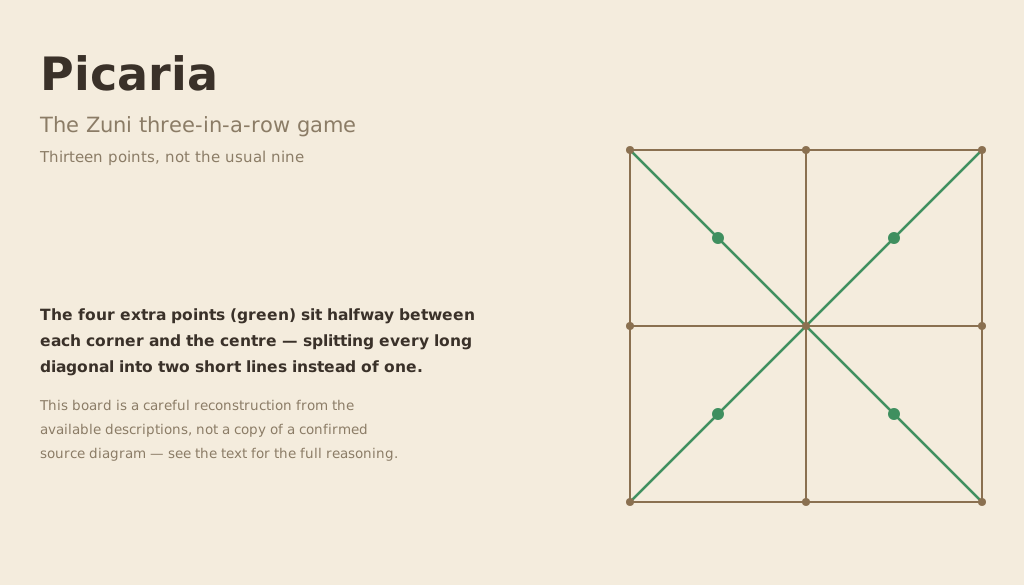
- Picaria — a different three-in-a-row tradition entirely, on its own thirteen-point board
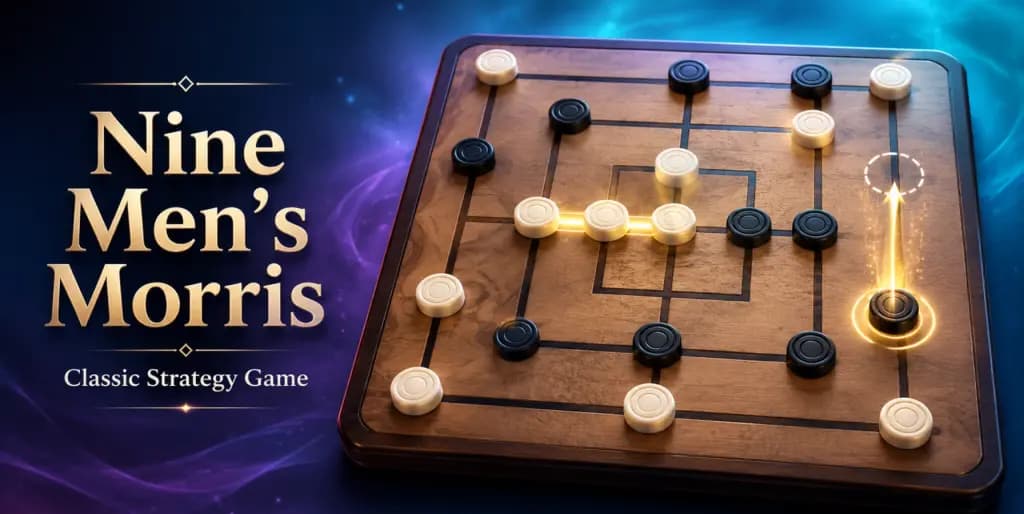
- Nine Men's Morris — the same family grown up: capturing, a bigger board, centuries of tournament play
- Six Men's Morris — another shorter relative, two squares instead of three, no diagonals at all