Five points, four pieces, and never more than two moves to choose from. Slide one of yours into the empty point; if you cannot move, you lose.
It is about as small as a board game can be while still being a game — small enough that the whole of it fits on this page.
- 60 positions in the entire game
- 4 of them lose — and all four are the same shape
- 97.8 % — how often knowing that shape wins
- 0 % — how often you lose once you know it
How do you play Pong Hau K'i?
- The board is five points — four corners and a centre, joined by seven lines.
- The centre joins all four corners. The corners join round the outside, except the top two, which are not joined to each other.
- Red starts on the top-left and bottom-right, blue on the top-right and bottom-left. The centre is empty.
- Slide one of your pieces along a line into the empty point. There is only ever one gap, so you have at most two choices.
- Nothing is captured and nothing is placed. The four pieces stay put all game.
- If you cannot move, you lose.
The whole game, on one page
Sixty positions exist. Not sixty thousand — sixty. So instead of describing the game, here it is.
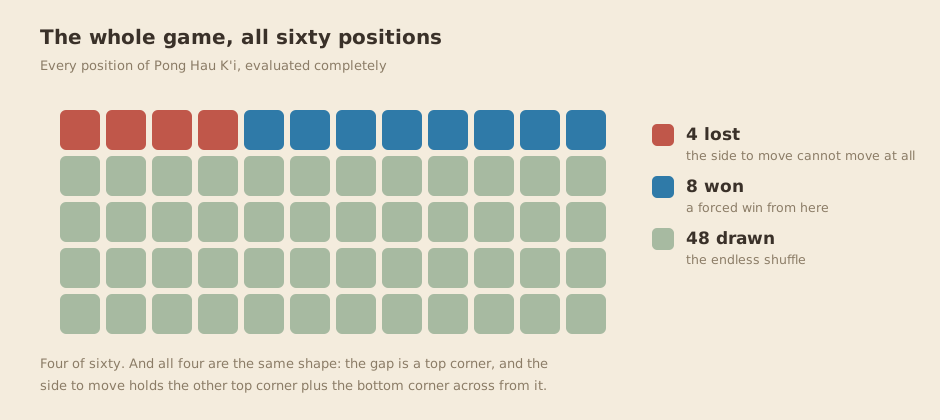
Forty-eight of the sixty are drawn. That is the endless shuffle: two players pushing pieces back and forth with nothing to decide.
What is the one losing shape?
All four lost positions are the same picture, and it is worth learning by eye:
That is the whole of the game's danger. There is no second trap, no variation on it, no deeper level.
Is it worth playing if it is a draw?
That depends entirely on whether the other person knows the shape.
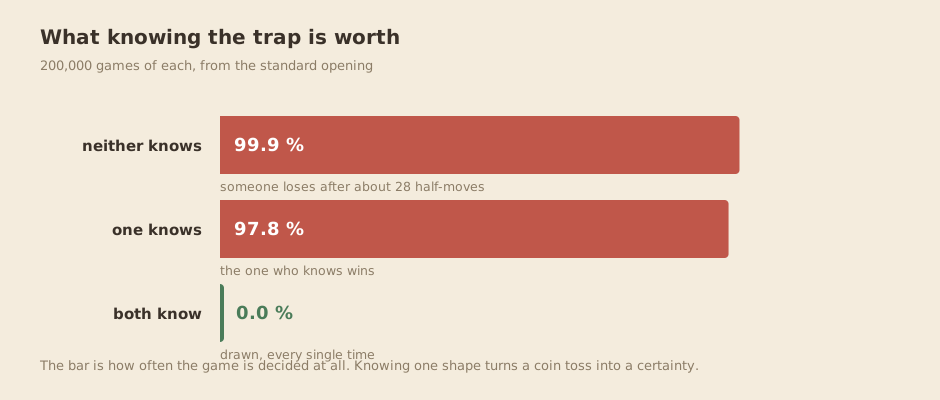
Between two players who do not know it, somebody loses after about 28 half-moves — it feels like a real contest, and the loser never quite sees what happened. Once one side knows it, that side wins 97.8 % of games. Once both know it, every game is drawn.
So the game has an unusually short life: it is genuinely fun exactly once, and then it is solved for you personally. That is not a criticism — it is what a five-point game is for, and it is why it turns up as a children's game across half of Asia.
How do you actually win?
You cannot force a win against someone who knows the shape. What you can do — and what wins 97.8 % of games against someone who does not — is two things.
Never move into the shape. Before each move, look at where the gap will be after it. If the gap ends up on a top corner and your two pieces are the other top corner and the far bottom corner, do not make that move. There is always another one available, because a lost position can only be entered voluntarily.
Then wait. You are not building anything; there is nothing to build. You are simply staying safe while the other person has two choices every turn and no idea which is which. Sooner or later they take the wrong one — and the measurement says a game decided this way runs about 38 half-moves, so roughly nineteen turns each before the mistake arrives.
The strong computer level here does exactly this, and nothing more. It holds the solved values, it never enters a losing position, and it waits.
What the game is actually teaching
There is a reason this board turns up in classrooms as often as in playgrounds. With sixty positions it is one of the few real games a person can hold entirely in their head — you can genuinely know it, not merely play it well.
That makes it a demonstration of something bigger: what "solved" means. Chess and Go are not solved because they are too large; Pong Hau K'i is solved because it is not. The difference is only size, and the board shows you exactly what sits on the other side of that line.
Why are the top corners not joined?
Because that missing line is the game.
Join them and every corner would have three ways out. No arrangement of four pieces could ever block anybody, every position would be drawn, and there would be nothing to play. One absent edge is the difference between a game and a fidget.
Where does it come from?
Pong Hau K'i is Chinese. In Korea the same game is umul gonu — the well game, named for the shape of the board — or gang gonu. It is played in Thailand as sua tok tong and in India under other names again.
Games this small travel easily and get reinvented constantly, because the whole apparatus is five dots and four pebbles. The interesting thing is not that it spread, but that the same asymmetric board spread with it: somebody, somewhere, worked out that the missing edge was the point, and that detail survived every retelling.
Playing a friend online
Pick With a friend online under the board and press Open a table. You get a four-character code; send it to whoever you are playing. No account, no download.
If neither of you blunders, the game is drawn after the same position comes up three times — the same rule chess uses, and here it is not a formality but a necessity: without it, two careful players would never stop.
Other small games here
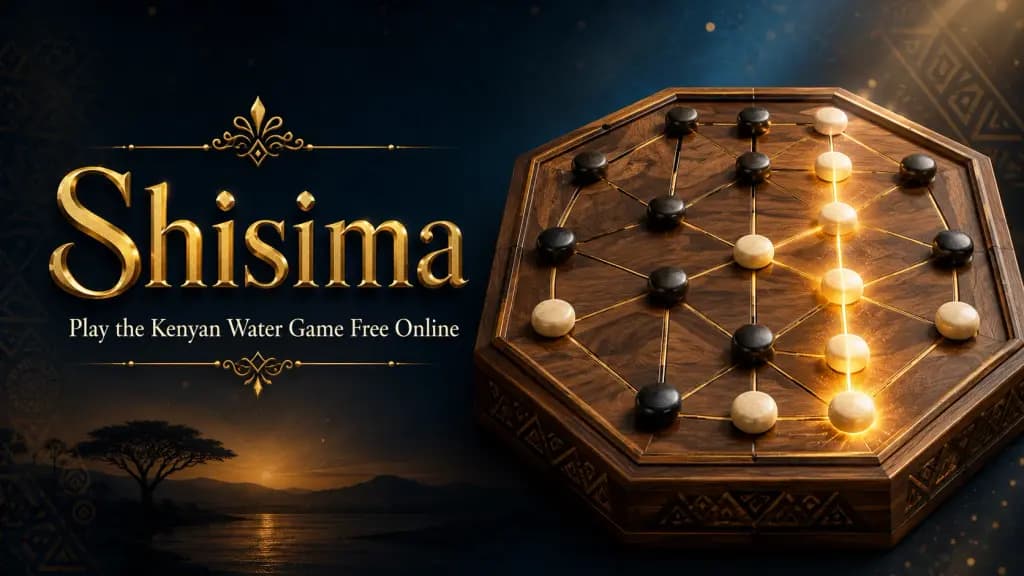
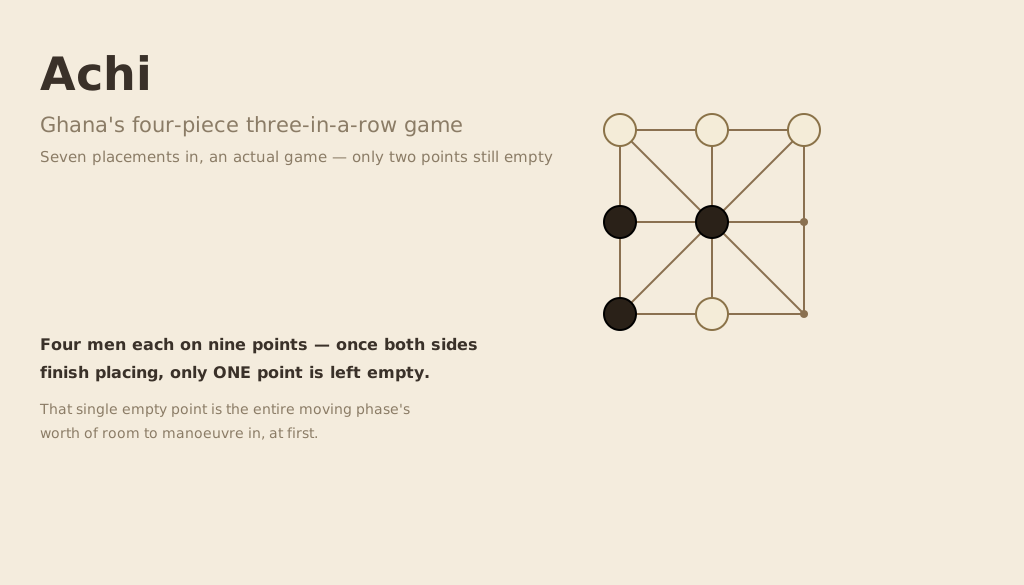
Shisima from Kenya and Achi from Ghana are the same order of size and rather more forgiving. Three Men's Morris is what happens when you allow nine points instead of five — and it turns out to be won for whoever starts, unless you ban the centre.