
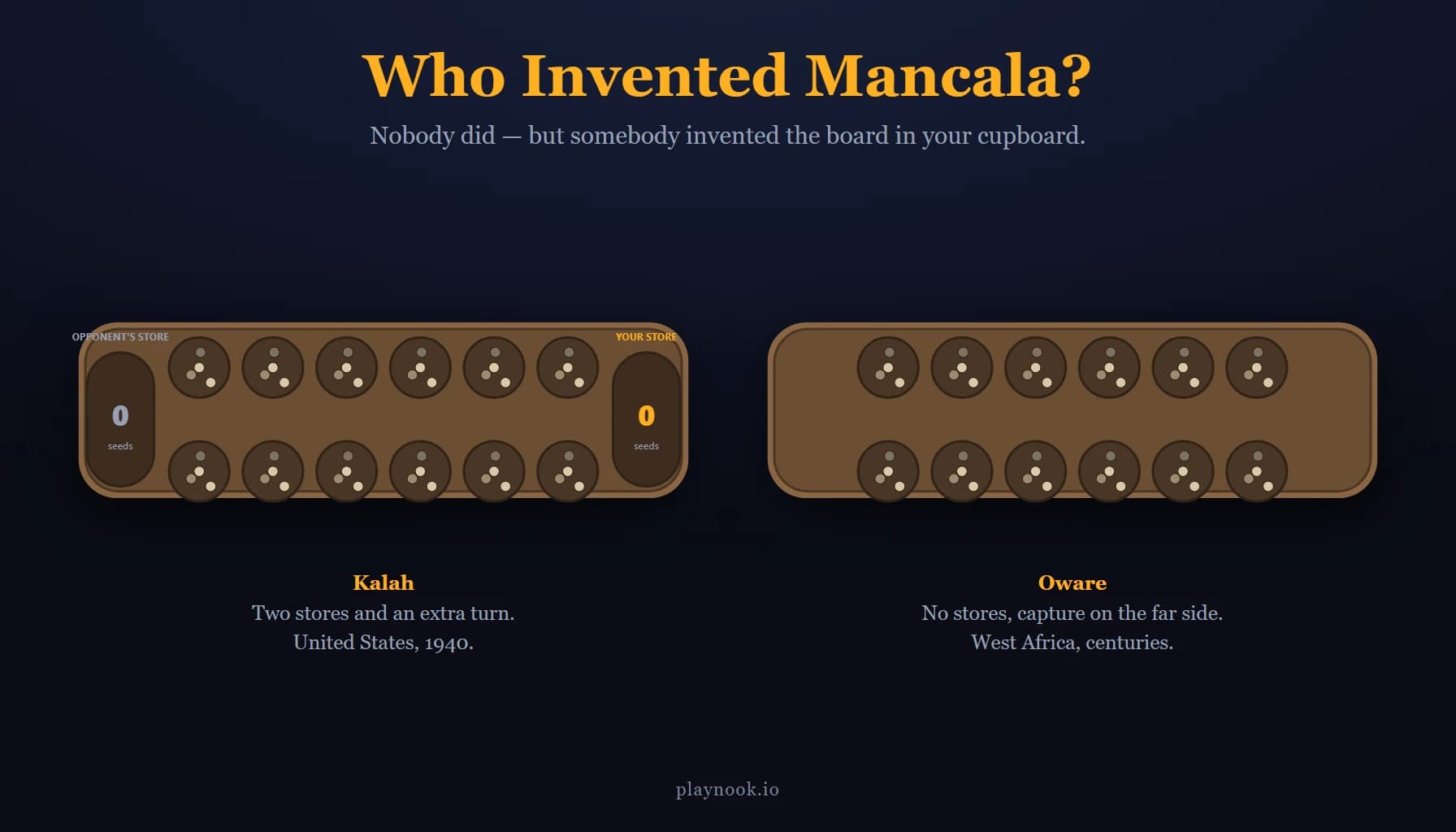
Ask who invented mancala and the question contains a mistake.
Nobody invented mancala, because mancala is not a game. It is a family of several hundred sowing games that grew up across Africa, the Middle East and Asia over more than a thousand years, with no author and no first edition.
But the board on your shelf is a different matter. That one has an inventor, a company and a trademark, and it is younger than the television.
The board you own is called Kalah
If your set has two rows of six pits and a large store at each end, and the rules say you take another turn when your last seed lands in your store, you are not holding an ancient African game. You are holding Kalah.
Kalah is the version sold across Europe and North America under the plain word Mancala, which is roughly like selling a chess set labelled "Boardgame". It is one member of the family and by a wide margin the most recent.
William Julius Champion Jr.
The record, as far as it can be pieced together, runs like this.
Champion was an American, a Yale graduate. The story usually given is that he encountered a written account of an African sowing game as a young man — around 1905 — and read ethnological literature on African and Asian mancala games in the years afterwards.
He devised Kalah in 1940 and began selling it in 1944. Patents followed in the 1950s — a design patent and then one covering the rules. In 1958 he founded the Kalah Game Company in Holbrook, Massachusetts, which produced the game well into the 1970s. The name Kalah was a registered trademark from 1970 to 2002.
Champion promoted it as an educational game, which it genuinely is: it teaches counting, planning and a little arithmetic, and it does so faster than the traditional games it descends from.
A note on sources. The detail above comes from board-game reference works and encyclopaedia entries rather than from archival research, and accounts differ on some dates. The broad shape — an American, the 1940s, patents in the 1950s, a company in Massachusetts — is consistent across them. Where you see a specific patent number quoted online, including on illustrations of this article's subject, treat it with the same caution you should apply to "5000 BC".
What he actually changed
This is the part that matters, because it is the part you can see on the board.
Champion took the sowing mechanic — which is genuinely old and genuinely African and Asian — and added two rules that are not typical of the traditional games:
1. The extra turn. Land your last seed in your own store and you go again. Traditional two-row games generally have no store to land in.
2. Capture opposite an empty pit. Land your last seed in an empty pit on your own side and you take that seed plus everything in the pit directly facing it.
Both additions do the same work: they make the game faster, sharper and much easier to teach. They also produce chains — a well-chosen opening can give you three or four turns in a row — which is exactly the kind of thing that delights a beginner and sells a box.
And they make Kalah a different game from Oware, where there are no stores, captures happen on the opponent's side, and you are obliged to feed an opponent who has run out of seeds. Strategy advice for one is frequently wrong for the other, which is the single most common source of confusion about "how to play mancala".
The marketing problem
Here is the uncomfortable bit.
Kalah was sold as an ancient game. Box art and advertising presented it as something handed down from Africa or "the Orient" — which is how a 1940s American board game came to be, for millions of people, the mancala, while the games it was adapted from went unnamed.
It is worth being precise about what is and is not wrong with that.
What is true: the sowing mechanic is genuinely ancient, genuinely African and Asian, and Champion did not pretend to have invented sowing.
What is not: the specific game in the box — the stores, the extra turn, the opposite-capture — is a twentieth-century design. Presenting that as an artefact of antiquity took the prestige of a tradition and attached it to a product, while the tradition itself got no credit and no name.
That is not an unusual story in the history of board games. It is worth telling anyway, because the people who play Oware in Ghana or Toguz kumalak in Kazakhstan are playing something older, deeper and less well known than the box that borrowed their family's reputation.
So what should you call it?
If precision matters: call your board Kalah, and call the family mancala.
In practice everyone will keep saying mancala, and that is fine — words drift, and "mancala" as shorthand for the boxed set is now too widespread to fight. But it is worth knowing that when somebody says they are good at mancala, the correct follow-up is which one.
Is Kalah a bad game?
No, and this article is not an argument that it is.
Kalah is a genuinely good design. The extra-turn rule creates real decisions, the opposite-capture creates real traps, and the whole thing can be taught to a seven-year-old in ninety seconds. Being modern is not a flaw; plenty of excellent games are modern.
It has one notable weakness, and it is a consequence of how sharp Champion made it: with perfect play the first player wins many standard configurations. We looked at what that actually means at a real table — the short version is that it matters far less than it sounds.
Common questions
Who invented mancala? Nobody. Mancala is a family of games that developed over centuries across Africa, the Middle East and Asia. The specific board most Western players own — Kalah — was devised by William Julius Champion Jr. in 1940.
Is mancala an ancient game? The sowing mechanic is ancient; the oldest defensible evidence is from around the fourth century AD. The Kalah rules are from the twentieth century.
Is Kalah African? The mechanic it borrows is. The game itself is American, designed in 1940 and sold from 1944.
Why is Kalah sold as "Mancala"? Because it was marketed under the family name rather than its own, and the label stuck. It is now the default meaning of the word in English-speaking countries.
Which mancala is the traditional one? There are many. The best known is Oware in West Africa; others include Congkak, Toguz kumalak, Bao and Omweso. Our family guide covers what separates them.
Does knowing this change how I should play? Only in one way: stop looking for "the real rules of mancala". There are none. Find out which game is on the table and learn that one.
You can play Kalah, Oware, Congkak and Toguz kumalak here and feel the difference in about five minutes, which is faster than any article can explain it.