
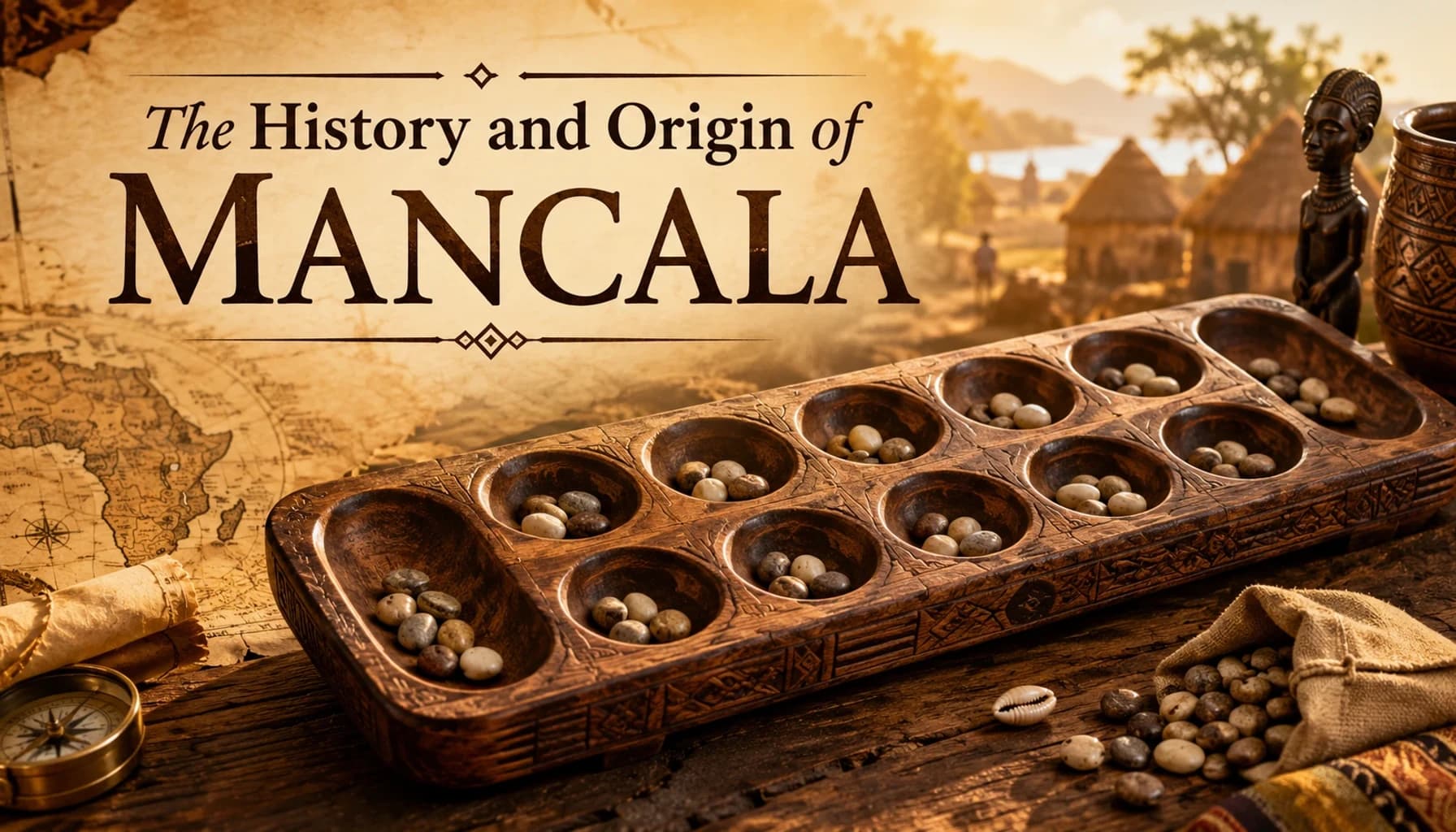
Search for the origin of mancala and you will be given a number within about four seconds. Five thousand years. Seven thousand. Ancient Egypt, usually, with a photograph of holes cut into a temple floor.
The number is always confident and it is never sourced, and there is a reason for that: the evidence to support it does not exist and probably never did. Not because the game is young — it is very likely older than most things people call old — but because of what a mancala board is made of.
That is a more interesting problem than a date, and it is where any honest history of this game has to start.
Why this game leaves almost no trace
A chess set leaves carved pieces. A Roman board game leaves a marked stone slab. A mancala game leaves two rows of holes.
For most of its history, the equipment was one of three things:
- Holes scooped in the ground. Dig twelve depressions in the dirt, gather forty-eight pebbles, and you have a board. It disappears with the next rain.
- A wooden board. Wood rots. In the climates where these games are oldest, it rots quickly.
- Pits worn into rock. These survive — and they are the problem, because a row of holes in stone does not say what it was for.
That last point is the one most articles skip. Rows of depressions cut into rock turn up across Africa and the Middle East, and some of them are almost certainly game boards. Others were used for counting, for grinding, for storage, or for purposes nobody can now reconstruct. A hole is not a document.
And you cannot date one. Carbon dating needs organic material. Stratigraphy needs the object to sit in a datable layer. A depression cut into an exposed rock surface is neither, which means the honest answer to "how old is this board" is usually "no older than the rock, and that is all we know".
What we can actually point to
Strip out what cannot be checked and a real picture remains — later than the folklore, but solid.
Abu Shaar, Egypt. Rows of carved depressions consistent with a mancala board, associated with a Roman-period fort, roughly the fourth century AD.
Matara, Eritrea and Yeha, Ethiopia. Similar rows from around the sixth to seventh century.
The written record. A sowing game appears in the medieval Arabic Kitab al-Aghani — the Book of Songs — which puts the game in literature rather than only in the ground.
Look at where those sites are and the pattern is obvious: they sit on the routes linking the Nile, the Red Sea and the Arabian Peninsula. That is not a coincidence. Sowing games spread the way everything else spread — with traders, along water, between ports.
The defensible summary: sowing games were well established across Africa and the Middle East more than a thousand years ago and moved along trade routes. Any claim more precise than that is decoration.
The name says what the game is
Mancala comes from the Arabic naqala, meaning to move.
It is a description of a gesture, not the name of a game — and that single fact explains why the word ended up covering hundreds of different games. Nobody in Ghana, Uganda or Kazakhstan called their game mancala. They called it Oware, Omweso, Toguz kumalak. "Mancala" is the label that outsiders put on the whole shelf.
Which is worth remembering when someone says they know how to play mancala. There is no such game. There is a family of them, and the rules differ enough that advice for one is often actively wrong for another.
The crossing
The part of this history that gets least attention is the part that is best documented.
Sowing games travelled to the Caribbean and the Americas with the transatlantic slave trade. They survived there, played by people who had been carried across an ocean, under names that are recognisably the old ones: Warri in Barbados and Antigua, Awari in Suriname, Adji-boto among the Maroons.
This is not a footnote. It means the game is a piece of cultural continuity that survived the deliberate destruction of almost everything else — language, names, family. When somebody in the Caribbean plays Warri, the line back to West Africa is unbroken, and it is unbroken because a game needs nothing but hands, seeds and a memory of the rules.
That is a genuinely remarkable thing about mancala, and it is more interesting than any date.
Then somebody patented it
The strangest chapter is the most recent one, and it happened in the United States.
The board in most Western homes — two rows of six pits with a large store at each end — is Kalah, and Kalah is not ancient. It was devised by an American in 1940, sold from 1944, patented in the 1950s and marketed as an ancient African game.
That is a whole story of its own, and we have told it separately: who invented mancala.
What the archaeology cannot tell you, the distribution can
Here is the argument that convinces me the game is genuinely old, even without a date.
Sowing games are found across an enormous area — West Africa, East Africa, the Horn, the Arabian Peninsula, Central Asia, South India, Sri Lanka, Indonesia, the Philippines — with local rules that differ substantially but share a core mechanic that nobody would arrive at twice by accident: pick up the contents of a pit, drop them one by one around the board, and something happens depending on where the last one lands.
Games do not spread that far quickly. They spread that far over centuries, along trade routes, mutating as they go — which is exactly what the variant map looks like. The breadth of the family is better evidence of age than any hole in any rock.
Common questions
How old is mancala? Firmly attested from around the fourth century AD in Egypt and the sixth to seventh in the Horn of Africa. It is probably older, but boards made of wood or scooped in earth leave nothing to find.
Is mancala the oldest board game in the world? It is often called that and the claim cannot be supported. Senet in Egypt and the Royal Game of Ur have datable physical boards and grave goods; mancala does not. What can be said is that the mancala family is unusually widespread and unusually persistent.
Was mancala played in ancient Egypt? Rows of pits exist at Egyptian sites, including Abu Shaar, but the ones with a defensible date are Roman-period, not pharaonic. Photographs of holes in temple floors captioned "3000 BC" are a caption, not a finding.
Where does the word mancala come from? From the Arabic naqala, to move. It describes the sowing action and was applied by outsiders to a whole family of games with their own local names.
Why are there so many versions? Because the mechanic is simple enough to carry in your head and be rebuilt anywhere with pebbles and holes. Every place it reached adapted it, and the adaptations stuck.
Is the mancala set I own an ancient game? Almost certainly not. It is Kalah, a twentieth-century American design built on the traditional mechanic. The mechanic is old; that particular set of rules is not.
You can play four of the traditional boards here — Kalah, Oware, Congkak and Toguz kumalak, with the right seed counts for each — or print one and use whatever is in the kitchen for seeds, which is what everyone did for the first thousand years.