
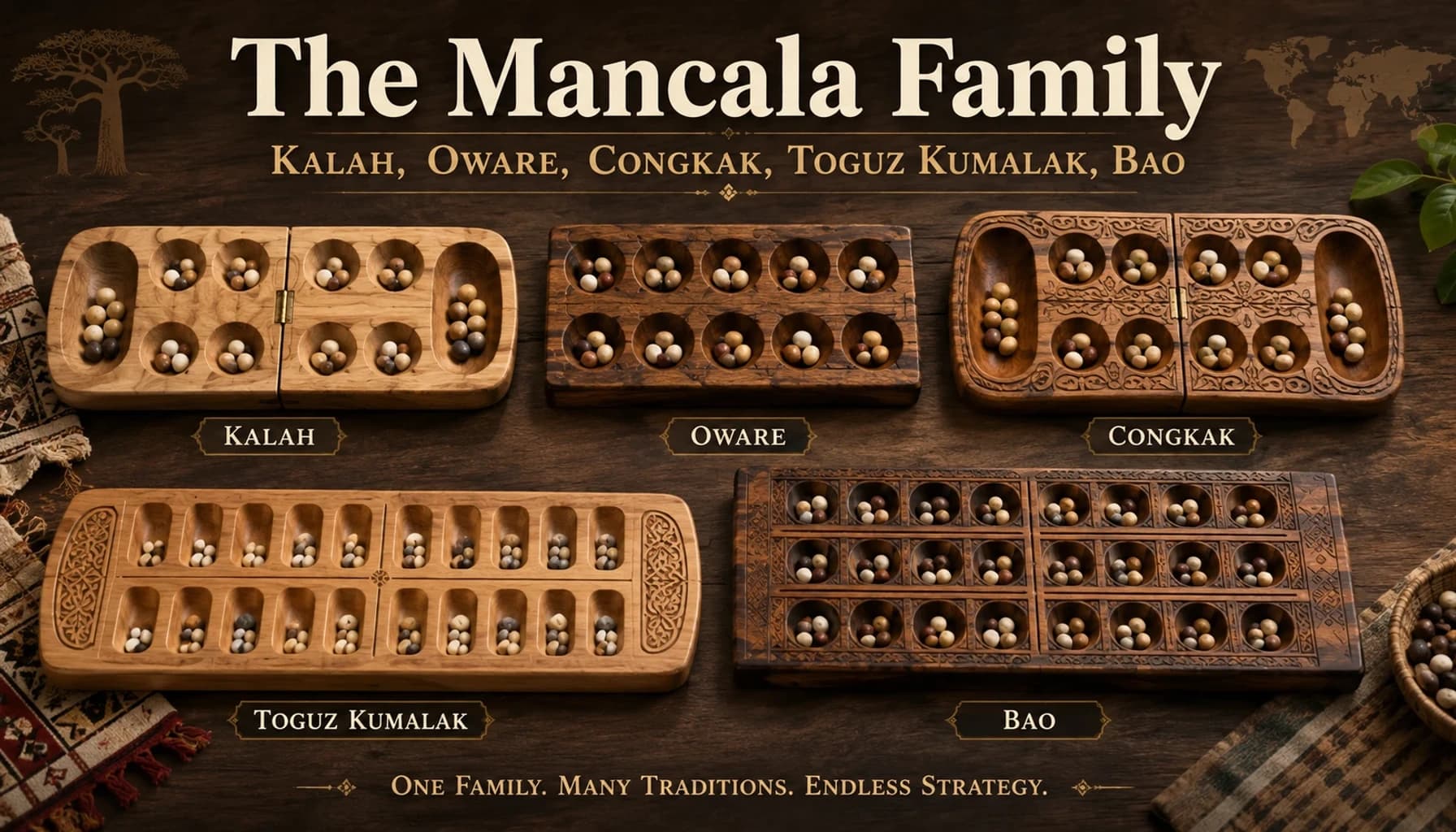
There is no game called mancala.
That sounds like pedantry until you have watched two people sit down to play, each confident they know the rules, and discover four moves in that they are playing different games. It happens constantly, because mancala is a family name — from the Arabic naqala, to move — applied by outsiders to several hundred games that share one gesture: pick up the seeds in a pit, drop them one at a time around the board, and see where the last one lands.
Everything after that gesture is negotiable. And the negotiations produce games that feel nothing alike.
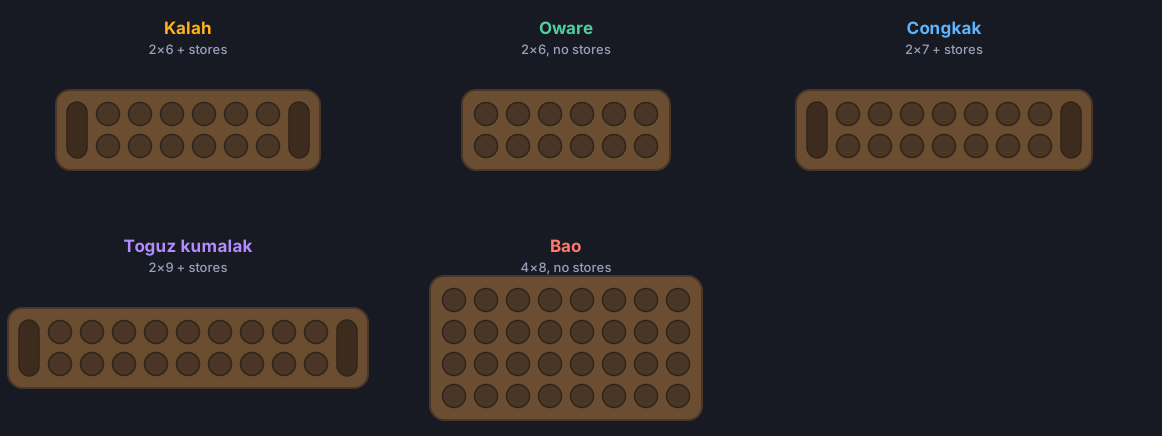
The three questions that define a mancala game
Before the local rules, ask these. They tell you most of what you need to know.
- How many rows? Two is the common case. Four rows — as in Bao and Omweso — produces a completely different, much longer game.
- Are there stores? A store is a big pit at the end where captured seeds go and out of which nothing is ever sown. Kalah has them. Oware does not, and its absence is why Oware's captures work the way they do.
- Where does capturing happen? On your side, on the opponent's side, on a count, on an empty pit? This single rule is the personality of the game.
Kalah — the one in the cupboard
Two rows of six pits, a store at each end. The board sold across Europe and North America under the plain word Mancala.
Two rules define it: land your last seed in your own store and you take another turn; land it in an empty pit on your own side and you capture that seed plus everything in the pit directly opposite.
Those rules make it fast, sharp and very easy to teach, which is exactly what they were designed for — because unlike everything else on this page, Kalah was designed, in twentieth-century America. That story is here.
The extra-turn rule also gives it a distinctive feel: a good opening move can chain several turns together, and the first player has a real advantage — a measurable one.
Play it if: you want a game in ten minutes, or you are teaching someone.
Oware — the one the experts play
Two rows of six pits, no stores. West Africa, especially Ghana, where it is a serious game with serious players. Also called Awale, Ayo, Warri and a dozen other names.
The differences from Kalah are not cosmetic:
- Captures happen on the opponent's side. If your last seed lands in an opponent's pit that then holds two or three seeds, you take them — and you keep taking backwards along the row while the condition holds.
- You must feed a starving opponent. If the other side has no seeds, you are obliged to play a move that gives them some. If you cannot, the game ends.
That second rule is what makes Oware a strategist's game. You cannot simply starve someone out; you have to construct a position where feeding them costs them anyway. It is a beautiful constraint and it has no equivalent in Kalah.
Play it if: Kalah has started to feel mechanical. The full Oware guide is here, and you can play it as its own game.
Congkak and Sungka — the long boards
Two rows of seven pits with stores. Congkak in Malaysia, Sungka in the Philippines; close relatives with regional differences.
The signature rule is that sowing continues when your last seed drops into an occupied pit — you pick up that pit's contents, including your seed, and carry on around the board. A turn can go round several times before it ends.
The result is a game with long, snaking turns where the board is transformed before your opponent gets a move. It rewards a kind of forward reading that Kalah never asks for.
Play it if: you like a turn that goes somewhere.
Toguz kumalak — the Central Asian one
Two rows of nine pits with stores. Kazakhstan and Kyrgyzstan, where it is played competitively with clocks, rankings and championships. The name means "nine pebbles".
Nine pits and nine starting seeds a pit means 162 seeds on the board — a huge number by mancala standards, and it makes for a long, calculating game. It also has a rule found nowhere else on this list: a pit can become a tuzdyq, a "holy pit", which belongs to the player who created it and collects seeds for the rest of the game.
Play it if: you want the mancala equivalent of a long chess game.
Bao and Omweso — the four-row games
Four rows of eight pits. Bao on the Swahili coast of East Africa, Omweso in Uganda. These are the deep end of the family.
Four rows mean seeds circulate rather than march, and captures feed back into the board instead of leaving it. Bao proper has a whole opening phase with its own rules before the main game even begins, and specially designated pits. It is widely considered the most complex traditional mancala, and among its strongest players it has the status chess has elsewhere.
Play it if: you have already worn out the two-row games and want a project.
What actually changes: a summary
| Game | Where | Board | The rule that defines it |
|---|---|---|---|
| Kalah | USA, 20th c. | 2×6 + stores | Extra turn from your store; capture opposite an empty pit |
| Oware | Ghana, West Africa | 2×6, no stores | Capture on the opponent's side; you must feed them |
| Congkak | Malaysia | 2×7 + stores | Sowing continues from an occupied pit |
| Sungka | Philippines | 2×7 + stores | Close relative of Congkak |
| Toguz kumalak | Kazakhstan | 2×9 + stores | The tuzdyq, a captured pit that keeps collecting |
| Bao | Swahili coast | 4×8 | Multi-phase, seeds re-enter play |
| Omweso | Uganda | 4×8 | Fast, tactical, no stores |
The important line is the last column. Two boards can look identical and play nothing alike. The first question before any game of mancala should be which mancala — and the honest answer to "do you know how to play?" is usually "I know how to play one of them".
Where to start
If you have only ever played the boxed set, the fastest way to feel the size of this family is to play two of them back to back. Kalah and Oware use the same board and the same twelve pits, and they are not the same experience at all.
Our mancala board plays four of them — Kalah, Oware, Congkak and Toguz kumalak, each with the correct pit count and starting seeds — and Oware has its own table where you can play a friend online.
For the kitchen table, the printable mancala board prints all four layouts with the right number of pits and a seed count for each. Use dried beans; that is what most of the world uses.
Common questions
Is Kalah the same as mancala? No. Kalah is one modern member of the mancala family — the one usually sold under the family's name in the West.
Which mancala variant is the best? For a quick game, Kalah. For depth on a two-row board, Oware. For the deepest game in the family, Bao. "Best" mostly means "how long do you have".
What is the difference between Oware and Kalah? Kalah has stores and an extra-turn rule and you capture on your own side; Oware has no stores, you capture on the opponent's side, and you are obliged to feed an opponent who has run out of seeds.
How many mancala games are there? Several hundred documented variants, and the real number is unknowable because the game was passed on by playing rather than by writing.
Is Toguz kumalak a mancala game? Yes — two rows, sowing, capture on a count. Its scale and its tuzdyq rule make it feel very different, but the mechanic is the family's.