
Seollal is Korean Lunar New Year, and it is not primarily a games holiday. It is about ancestors, bowing to elders, and tteokguk — the rice-cake soup that, by tradition, is what actually makes you a year older.
But it is also three days of extended family sitting on a heated floor with nothing scheduled, and that is how the games got in. They are not a museum programme. They are what people do between meals.
Yut Nori (윷놀이) — the one everybody plays
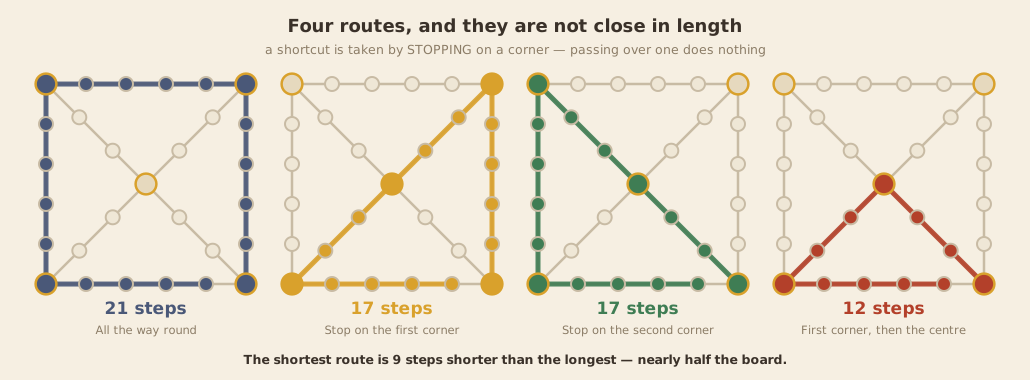
Four sticks, four horses each, and a square board with two diagonals across it. You throw the sticks, count the flat sides landing up, and move that far. The whole game turns on one condition: stop exactly on a corner and you cut across the middle. Pass over it and nothing happens.
That is worth a great deal. Going all the way round is 21 steps; stopping on the first corner and then again on the centre is 12. Nine steps — close to half the board — decided by whether a number happens to land right.
The rules and the full measurements are on the game page, and you can play it there against three levels of opponent or with somebody else at the table.
What a Mo on the first throw is really worth
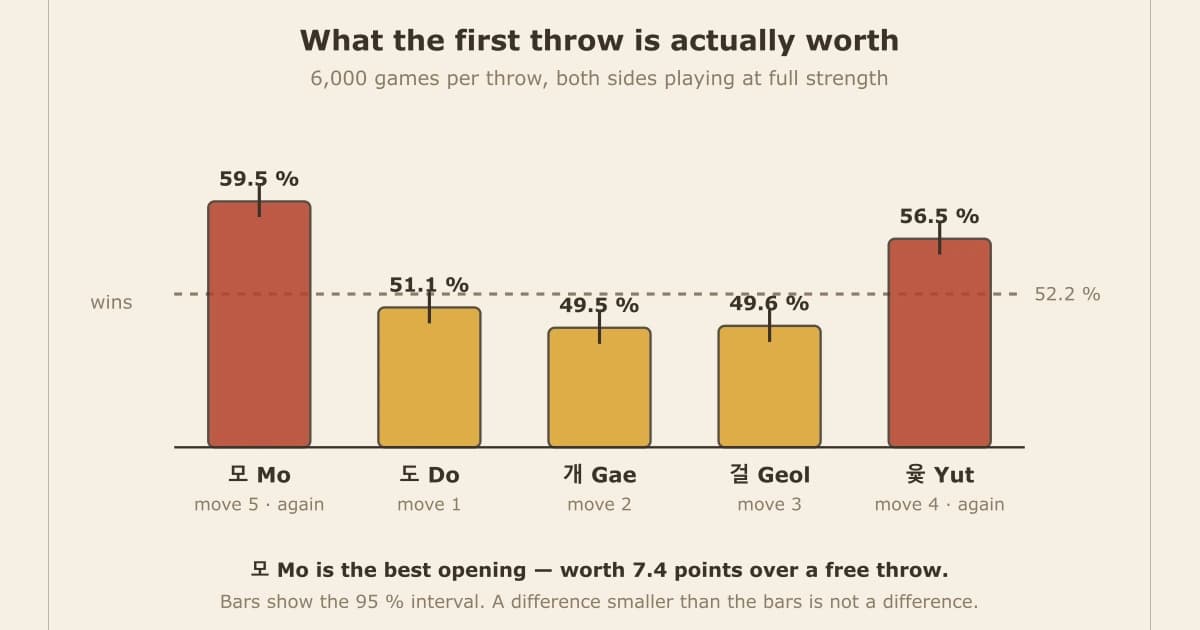
There is a thing people say at Seollal tables: throw a Mo to open and you have half won already. A Mo is no flat sides at all — the rarest result, one in sixteen — and it moves five, which lands a horse exactly on the first corner.
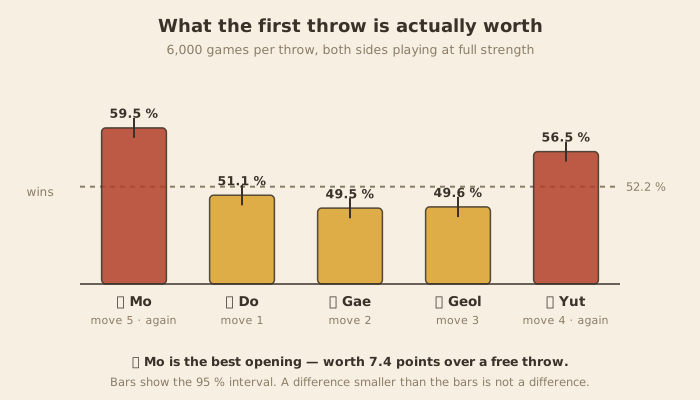
It sounded like the sort of claim that is repeated because it is satisfying. So we checked it: six thousand games for each possible opening throw, both sides playing at full strength afterwards.
| Opening throw | Moves | Another throw? | First player wins |
|---|---|---|---|
| 모 Mo | 5 | yes | 59.5 % |
| 윷 Yut | 4 | yes | 56.5 % |
| 도 Do | 1 | no | 51.1 % |
| 걸 Geol | 3 | no | 49.6 % |
| 개 Gae | 2 | no | 49.5 % |
| any throw at all | — | — | 52.2 % |
The table talk is right. A Mo opening is worth about seven percentage points over an ordinary start — a real, large edge in a game this short.
But the reason is not quite the one people give. Look at Yut: it moves only four, lands nowhere special, and is still worth four and a half points. What Mo and Yut have in common is not the distance — it is that both of them hand you the sticks again. The extra throw is doing most of the work, and the corner is a bonus on top of it.
And the other three? Do, Gae and Geol sit within about a point and a half of each other, and the error bars overlap. There is no meaningfully good or bad choice among them — which is worth saying, because it would have been easy to rank them anyway and tell a tidy story about it.
Jegichagi (제기차기) — the shuttlecock one
A weighted paper or cloth shuttlecock kicked with the inside of the foot, counted until it drops. It is played standing in a circle in the courtyard, and it is the one that separates the generations fastest: children can do dozens, and adults discover their ankles are forty years old.
Tuho (투호) — arrows into a jar
Throwing wooden arrows into a narrow-necked pot from a few paces. It is the oldest thing on this list by function — a court game from the Goryeo and Joseon periods, played by aristocrats and now set up at folk villages and palace grounds for anybody who walks past. It is also the only one here where being tall is a disadvantage.
Gonggi (공기) — five stones
Five small stones, thrown and caught on the back of the hand, in stages of increasing difficulty. Effectively Korean jacks. It is a schoolyard game the rest of the year and a floor game at Seollal, and the plastic sets sold today are the direct descendants of five actual pebbles.
Go-Stop (고스톱) — the one with money on it
Played with hwatu, the small flower cards derived from Japanese hanafuda. It is a fast, loud, three-handed matching game with a scoring system that takes a holiday to learn, and it is what the adults migrate to once the children are asleep. Small amounts of money change hands, which is the entire point.
Why Yut Nori is the one that survived
Every game on this list is still played. But Yut Nori is the one that scales: jegichagi needs a body that works, gonggi needs quick hands, Go-Stop needs somebody to explain the scoring for twenty minutes. Yut Nori needs four sticks and a floor, the rules fit in a sentence, and a six-year-old can beat a grandparent without anyone having to arrange it.
That is not an accident of tradition. It is a genuinely good piece of design — short enough to play ten times, chancy enough that the youngest player has a real shot, and with just enough judgement in it that the adults are not pretending. Our own measurements put the numbers on that: a strong player beats random play 88 % of the time, so skill is real, and still loses one game in eight to it.
Games of this kind are described in Chinese records of the third century. What makes Yut Nori unusual is not the age — Senet and the Royal Game of Ur are far older — but that nobody had to reconstruct it. Those two were dug up and pieced back together by scholars. Yut Nori never stopped.
Related: play Yut Nori · the oldest board game in the world · Senet against the Royal Game of Ur