
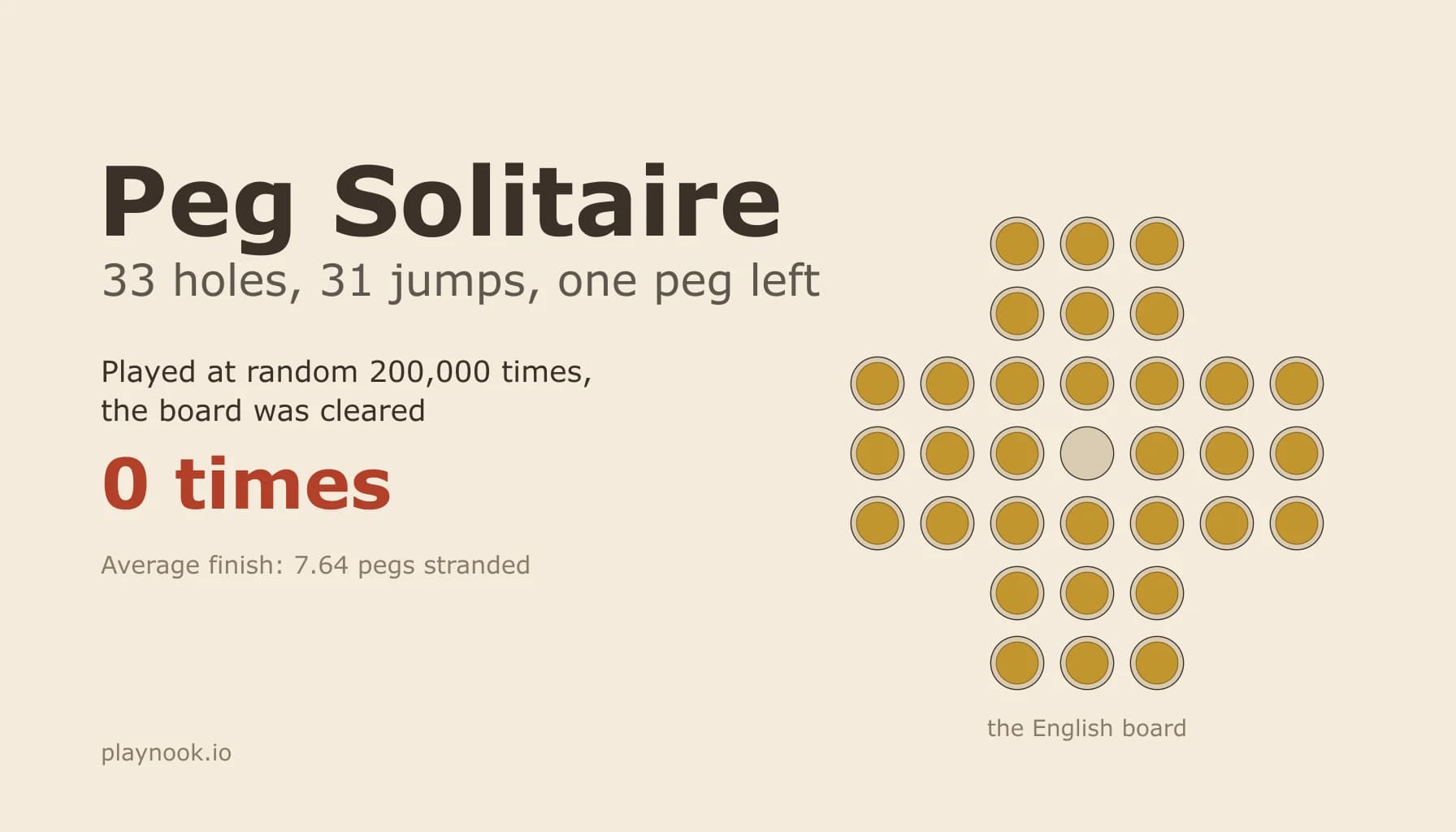
Peg solitaire is solvable. Thirty-two pegs, one empty hole in the middle, and if you jump correctly you end with a single peg sitting in the centre. That much is in every set of instructions, and it makes the game sound like a matter of patience.
It is not. We played 200,000 games by choosing a legal jump at random every single time, and the board came out clear in none of them. The average game stranded 7.6 pegs. Random play is not a fair opponent, but it sets the scale of the thing: on this board, most of the moves available to you at any moment are wrong, and nothing tells you which.
- 0 cleared boards in 200,000 random games
- 7.6 pegs left on average
- 6 jumps is all it takes to get stuck
- 46–62 % of your options lose, right to the end
Is peg solitaire hard, or am I just bad at it?
Hard. Here is every random game we ran, sorted by how many pegs were left when no jump remained.
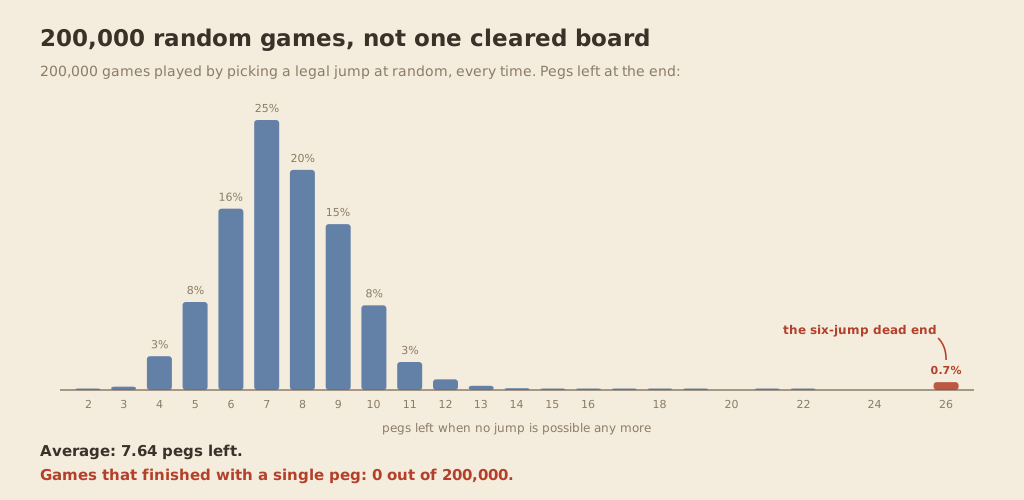
The peak sits at seven pegs. Getting down to two happened 20 times in 200,000 — one in ten thousand. Getting down to one did not happen once. That does not make it impossible, only vanishingly rare: random play is simply not how this board gets cleared.
Which is worth saying plainly, because peg solitaire looks forgiving. There are usually eight or nine jumps on offer, the board empties steadily, and nothing goes visibly wrong until suddenly four pegs are sitting in opposite corners and the game is over.
How quickly can a game of peg solitaire go wrong?
Faster than anyone expects. We searched every position reachable in the opening jumps, exhaustively, and the shortest possible dead end comes after six jumps, with 26 pegs still on the board and not one legal move left.
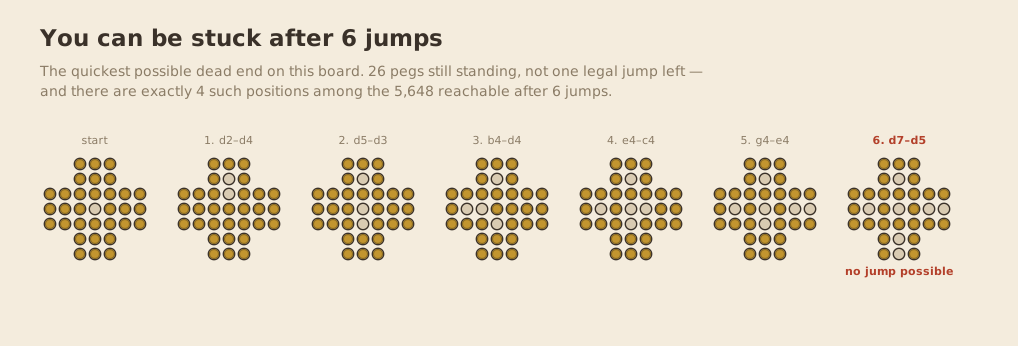
Four positions out of 5,648 is a tiny target, yet random play lands on one of them in 0.73 % of games — about one in 140. That is the isolated red bar in the first chart, sitting far out on its own: those games did not struggle to the end, they stopped almost before they began.
Where is peg solitaire actually lost?
This is the question worth answering, and it needs more than sampling. Instead of playing games and seeing what happens, we worked backwards from the finish: start with the single peg in the centre, un-jump it in every possible way, un-jump those, and keep going. What that produces is the exact set of positions from which the board can still be cleared — all of them, at every stage.
There are 8,171,208 such positions with 14 pegs left. For every single one, we counted how many jumps are available and how many of them keep the win alive.
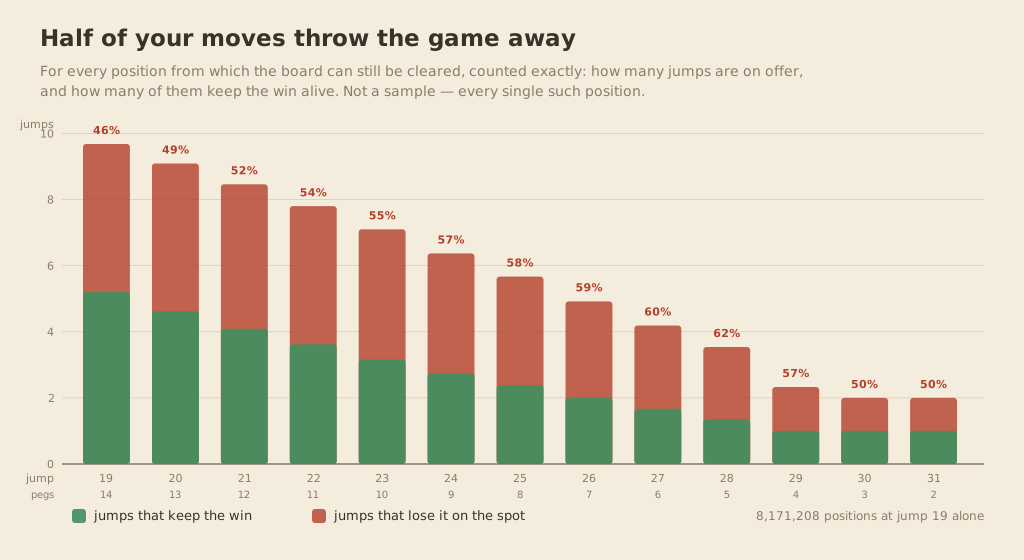
The answer is brutal and, in its way, elegant: from the nineteenth jump onwards, roughly half of everything you can do is fatal, and the share creeps up as the board empties — 46 % at fourteen pegs, 55 % at ten, 62 % at five. The number of choices shrinks at the same time, from nine or ten down to two, so the endgame is not easier for being smaller. It is a corridor that narrows while the floor gives way.
The chart starts at the nineteenth jump for a reason, and it is an honest limit rather than a choice: fourteen pegs is where the list of winnable positions stops fitting in memory. What the first eighteen jumps look like on the same measure, we do not know.
Does "keep the pegs together" actually help?
Every set of advice about peg solitaire says the same thing: do not let the pegs break up into little islands. It sounds right. Nobody had put a number on it, so we did.
Take every position with twelve pegs from which the board can still be cleared. For every legal jump out of every one of them, split the resulting board into groups of touching pegs and record whether that jump kept the win. Fifteen million jumps, sorted by how scattered they leave the board:
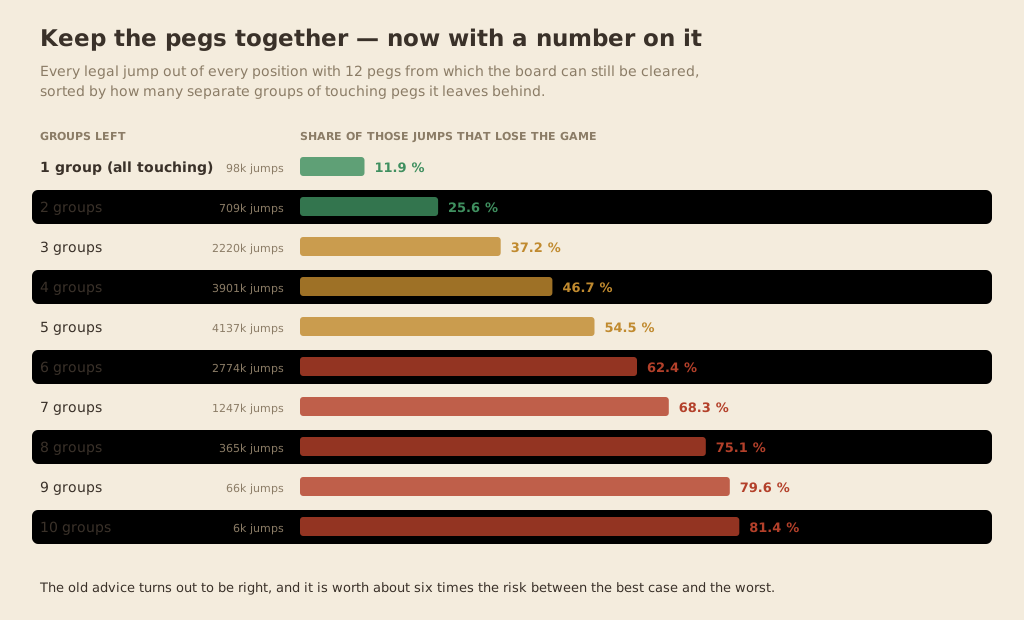
The rule is real, and the effect is enormous. A jump that leaves every peg touching another loses in 11.9 % of cases. A jump that scatters the board into seven groups loses in 68.3 % — nearly six times the risk, and the relationship is clean the whole way up. It is the one piece of folk wisdom about this game that survives contact with the arithmetic.
What it is not is a guarantee. Even the best bucket throws the game away one time in eight, which is the difference between a useful heuristic and a solution.
The game is its own mirror
One number repeated itself while we were counting, and it turned out to be the structure of the game showing through. There are 5,648 positions reachable after six jumps. There are also 5,648 positions with seven pegs from which the board can still be cleared. The same number.
It is not a coincidence. The starting position is exactly the complement of the finish — the start has a peg everywhere except the centre, the finish has a peg only in the centre. Swap pegs and holes, and a jump from A over B into C becomes a jump from C over B into A. The game played backwards, with pegs and holes exchanged, is the same game.
So the positions you can reach after k jumps correspond one-to-one with the positions you can still win from with k+1 pegs. We checked it hole by hole rather than just comparing totals, out to ten jumps deep, and every single position matched:
| After k jumps | Positions reachable | With k+1 pegs | Still winnable |
|---|---|---|---|
| 4 | 296 | 5 | 296 |
| 6 | 5,648 | 7 | 5,648 |
| 8 | 77,559 | 9 | 77,559 |
| 10 | 717,788 | 11 | 717,788 |
How many moves does a peg solitaire solution take?
Thirty-one jumps, always — every jump removes one peg, and 32 pegs down to one is 32 − 1. There is nothing to optimise there, and the game page explains why in more detail, along with the colouring argument that rules out 28 of the 33 holes as a finishing square before you have moved at all.
The number people actually compete over is different. When one peg jumps several times in a row, tradition counts the whole run as a single move, and by that reckoning the central game has a known minimum: 18 moves, found by Ernest Bergholt in 1912 and proved to be the shortest possible by John Beasley in 1964. Bergholt's solution stood unbeaten for half a century before anyone could show that nothing better existed.
Here is a solution in full — ours, not Bergholt's, and not the shortest: 31 jumps that group into 26 moves. It is for following rather than admiring.
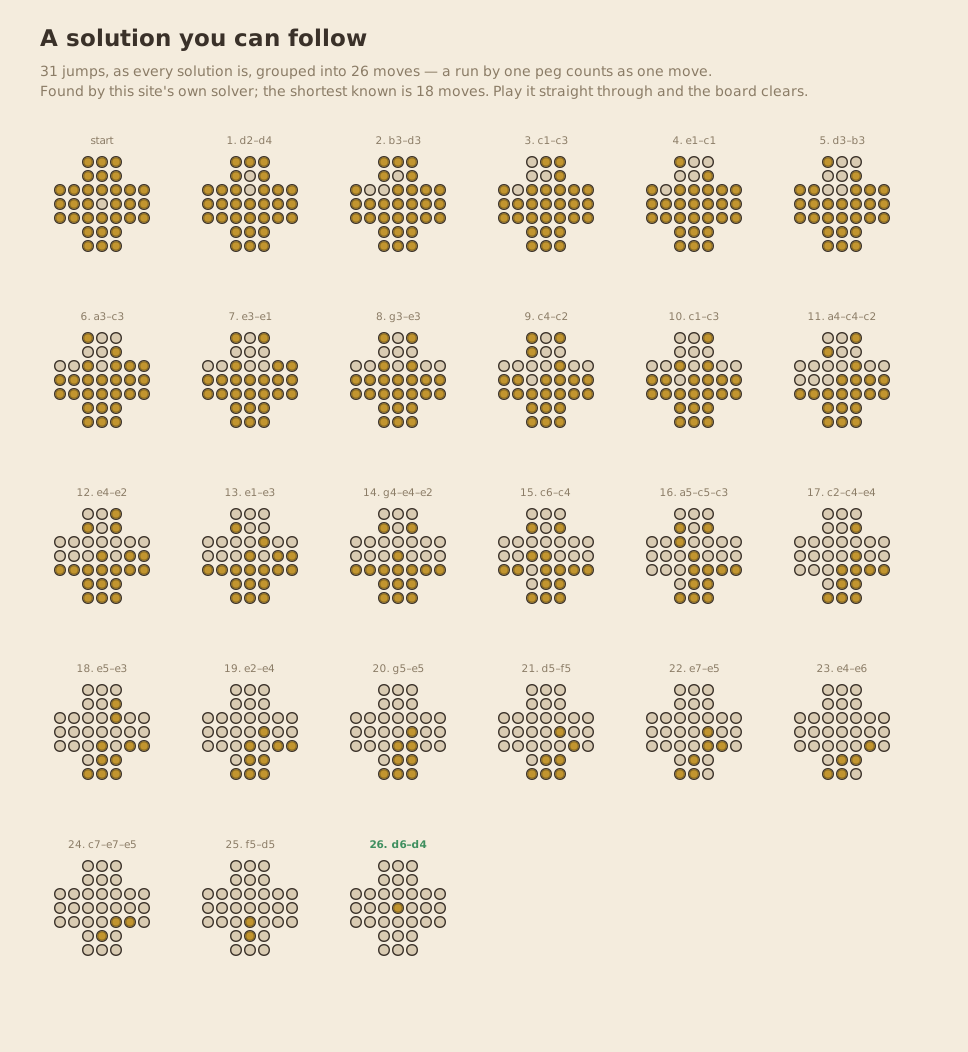
The same thing as a list, for anyone who would rather follow text than
pictures. Columns run a to g left to right, rows 1 to 7 top to
bottom, so the centre hole is d4; a move with three squares in it is a run
by one peg.
 1. d2-d4      2. b3-d3      3. c1-c3      4. e1-c1
 5. d3-b3      6. a3-c3      7. e3-e1      8. g3-e3
 9. c4-c2     10. c1-c3     11. a4-c4-c2  12. e4-e2
13. e1-e3     14. g4-e4-e2  15. c6-c4     16. a5-c5-c3
17. c2-c4-e4  18. e5-e3     19. e2-e4     20. g5-e5
21. d5-f5     22. e7-e5     23. e4-e6     24. c7-e7-e5
25. f5-d5     26. d6-d4
Exactly five of those 26 moves are runs, and every one of them is a run of two — which is the whole difference between 31 jumps and 26 moves. To reach 18 you would need thirteen jumps folded into runs rather than five, with some of them much longer. Finding a solution is easy for a computer; finding one that strings its jumps into long runs is a far harder search. That is why Bergholt's 1912 result was remarkable, and why proving nothing shorter exists took another fifty-two years.
What this means for actually playing it
- Before each jump, look at what it leaves behind, not at what it removes. The one measurable rule is the grouping one: of the jumps that keep every peg touching another, 11.9 % lose; of the jumps that split the board into six or more pieces, over 60 % do.
- Expect the last thirteen jumps to be a coin flip you must win every time. That is what the chart measures. Whether the first eighteen are kinder we genuinely do not know — but the six-jump dead end says they are not harmless either.
- Use undo without guilt. A puzzle where half of your options lose silently, twenty moves before the consequence shows up, is not a test of character. That is what the button is for.
Where these numbers come from
Everything above was computed for this article, and two things are worth knowing about how.
The backward search is what makes the danger chart exact. Asking "can this position still be won?" forwards is cheap when the answer is yes and ruinous when it is no — the first attempt here ran out of memory, because proving that a position is dead means searching everything underneath it. Backwards there is no search at all: the positions that can still win are exactly the ones you reach by un-jumping from the finish, and they can be listed. Fourteen pegs is where that list stops fitting in memory, which is why the chart begins at the nineteenth jump.
The second thing is less glamorous and more important: the move generator used for all of this is a bitboard, not the one the game page plays with. So it was checked against the real engine jump by jump over thousands of positions, and had to produce exactly the same set of legal moves every time. An error there would not have crashed anything — it would have produced a chart that was merely wrong.
If you want to try it against the measurements, the board is playable here, there is a printable version for paper, and the smaller fifteen-hole triangle is a gentler place to learn what a dead end feels like. The same 33-hole cross, incidentally, is also the board for Fox and Geese — most people meet it as a puzzle and never learn it has a second life as a game for two.